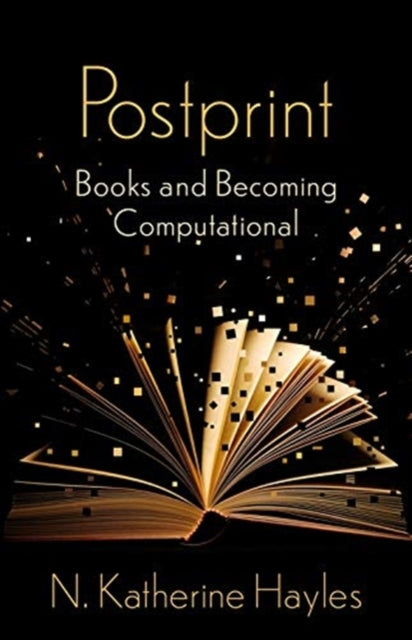
N. Katherine Hayles
Postprint: Books and Becoming Computational
Postprint: Books and Becoming Computational
💎 Earn 100 Points (£1.00) on this item.
YOU SAVE £4.94
- Condition: Brand new
- UK Delivery times: Usually arrives within 2 - 3 working days
- UK Shipping: Fee starts at £2.39. Subject to product weight & dimension
Bulk ordering. Want 15 or more copies? Get a personalised quote and bigger discounts. Learn more about bulk orders.
Couldn't load pickup availability
- More about Postprint: Books and Becoming Computational
The emergence of computational media has accelerated the pace of change in print, transforming books, language, authorship, and human identity. N. Katherine Hayles explores the postprint condition, where print and digital technologies intertwine, and how it reshapes literate societies and cognitive processes. She introduces the concept of cognitive assemblages and argues that innovations in print technology redistribute cognitive capabilities between humans and machines. Books are becoming computational, representing a significant site of ongoing cognitive transformations. Postprint offers insights into the consequences for the humanities and considers the cultural implications through readings of two novels that explore the postprint condition.
Format: Paperback / softback
Length: 248 pages
Publication date: 16 February 2021
Publisher: Columbia University Press
Since Gutenberg's time, every aspect of print has undergone a gradual transformation. However, the advent of computational media has brought about an exponential increase in the pace of these changes, revolutionizing the way books are composed, designed, edited, typeset, distributed, sold, and read. In her insightful work, N. Katherine Hayles explores the emergence of what she refers to as the "postprint condition," delving into how the interplay between print and digital technologies has not only transformed books but also language, authorship, and the very essence of what it means to be human.
Hayles takes a deep dive into the intricate relationship between print and literate societies, examining how these dynamics have evolved and are continuing to change as computational media take on tasks that were once exclusively performed by humans. She highlights the ways in which print has become deeply embedded in human culture and how these interactions are evolving as humans and computational media form transindividual collectivities through their interconnections. These cognitive assemblages, as Hayles calls them, are characterized by the circulation of interpretations and meaning-making practices that transcend individual boundaries.
At the heart of Hayles's theoretical framework lies the concept of redistributions of cognitive capabilities between humans and machines. She argues that innovations in print technology are not merely technological advancements but rather represent a shift in the distribution of cognitive abilities. Humanity is undergoing a computational transformation, just as computational systems are edging closer to processes that were once considered uniquely human. Books, in all their diverse forms, are also on a path toward becoming computational, serving as a critical site of ongoing cognitive transformations.
Through extensive interviews with scholars and university press professionals, Hayles provides a comprehensive account of the consequences of these developments for the humanities. She sheds light on the challenges and opportunities that arise from the merging of print and digital media, emphasizing the need for a reimagining of academic practices and the cultural implications of these shifts. In her analysis, she draws upon readings of two novels, "The Silent History" and "The Word Exchange," which delve into the postprint condition and offer insightful perspectives on the evolving nature of human-computer interactions.
Postprint spans various fields, including book studies, cultural theory, and media archeology, making it a strikingly original consideration of the role of computational media in the ongoing evolution of human culture. By examining the intricate interplay between print and digital technologies, Hayles offers a thought-provoking exploration of the future of literature, authorship, and the human experience. Her work prompts us to reevaluate our understanding of the past, present, and potential future of print and media, as we navigate the rapidly changing landscape of information dissemination and consumption.
Weight: 294g
Dimension: 140 x 214 x 18 (mm)
ISBN-13: 9780231198257
UK and International shipping information
UK and International shipping information
UK Delivery and returns information:
- Delivery within 2 - 3 days when ordering in the UK.
- Shipping fee for UK customers from £2.39. Fully tracked shipping service available.
- Returns policy: Return within 30 days of receipt for full refund.
International deliveries:
Shulph Ink now ships to Australia, Belgium, Canada, France, Germany, Ireland, Italy, India, Luxembourg Saudi Arabia, Singapore, Spain, Netherlands, New Zealand, United Arab Emirates, United States of America.
- Delivery times: within 5 - 10 days for international orders.
- Shipping fee: charges vary for overseas orders. Only tracked services are available for most international orders. Some countries have untracked shipping options.
- Customs charges: If ordering to addresses outside the United Kingdom, you may or may not incur additional customs and duties fees during local delivery.