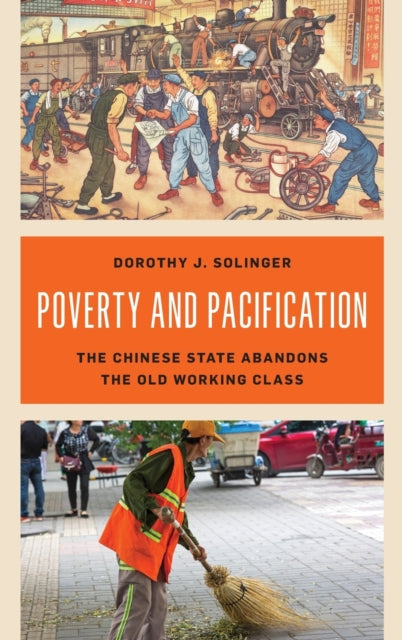
Dorothy J. Solinger
Poverty and Pacification: The Chinese State Abandons the Old Working Class
Poverty and Pacification: The Chinese State Abandons the Old Working Class
💎 Earn 531 Points (£5.31) on this item.
We can order this item for you. Delivery usually takes about 4 to 6 weeks.
This item is not held in our immediate stock. We will order it for you after checkout.
Estimated delivery: About 4 to 6 weeks
- Condition: Brand new
- UK Delivery times: Usually arrives within 2 - 3 working days
- UK Shipping: Fee starts at £2.39. Subject to product weight & dimension
Bulk ordering. Want 15 or more copies? Get a personalised quote and bigger discounts. Learn more about bulk orders.
Couldn't load pickup availability
- More about Poverty and Pacification: The Chinese State Abandons the Old Working Class
Dorothy Solinger's book explores the plight of urban workers left behind in China's modernization drive, tracing the origins of their predicament to the mid-1990s and the Minimum Livelihood Guarantee (dibao) welfare effort. It highlights the induced urban poverty and the struggle for survival of these discarded laborers, detailing the history and workings of the dibao and its missteps.
Format: Hardback
Length: 332 pages
Publication date: 16 February 2022
Publisher: Bloomsbury Publishing Plc
Chinas single-minded drive to modernize has left behind a group of little-known urban workers who have been marginalized and forgotten. Dorothy Solinger's groundbreaking book, "The Urban Workers' Plight in China: From State-Owned Factories to Minimum Livelihood Guarantee," explores the origins of their plight and the induced urban poverty that resulted. She details the history and workings of the Minimum Livelihood Guarantee (dibao) and its missteps, as well as changes in policy over time. Drawing on dozens of interviews, this book brings to life the urban workers who have been relegated to obsolescence, isolation, and invisibility by Chinas quest for modernity.
Solinger begins by tracing the origins of their plight to the mid-1990s, when the Chinese government found that state-owned factories were failing in large numbers in the face of market reforms just as the country was about to enter the World Trade Organization. Under these circumstances, leaders urged firms to lay off tens of millions of previously lifetime-employed, welfare-secure, under-educated, middle-aged employees. As these dislocated people were left without any source of livelihood, the regime settled on a tiny welfare effort, the Minimum Livelihood Guarantee (dibao), to provide some support and, most important from the viewpoint of the leadership, to keep them quiet so that enterprise reform could proceed peacefully.
Solinger explores the induced urban poverty that resulted and relates the painful struggle for survival of these discarded laborers. She details the history and workings of the dibao and its missteps, as well as changes in policy over time. Drawing on dozens of interviews, this book brings to life the urban workers who have been relegated to obsolescence, isolation, and invisibility by Chinas quest for modernity.
One of the key factors that contributed to the induced urban poverty was the lack of social safety nets. The dibao was designed to provide a basic income to those who were laid off, but it was often insufficient to meet their basic needs. Many workers were forced to turn to informal employment, such as street vending or construction, which was often low-paying and dangerous. This led to a cycle of poverty and social exclusion, as these workers were unable to access education, healthcare, and other basic services.
Solinger also highlights the role of government policies in exacerbating the plight of urban workers. For example, the government's emphasis on economic growth and urbanization led to the displacement of millions of people from their homes and communities. This displacement often resulted in the loss of social networks and support systems, which made it difficult for workers to find new jobs and rebuild their lives.
In addition to the lack of social safety nets and government policies, Solinger also identifies the role of cultural factors in shaping the plight of urban workers. For example, the Chinese culture places a high value on social hierarchy and respect for authority, which can make it difficult for workers to challenge their employers or seek better working conditions. This can lead to a culture of silence and compliance, which can be detrimental to the health and well-being of workers.
Despite these challenges, Solinger also highlights the resilience and determination of urban workers. Many workers have found ways to survive and thrive in the face of adversity. For example, some workers have started their own businesses, while others have joined labor unions or advocacy groups to fight for their rights. These efforts have led to some improvements in the working conditions of urban workers, but there is still much work to be done.
One of the key recommendations that Solinger makes in her book is to strengthen the social safety nets in China. This can be done by increasing the minimum wage, providing universal healthcare, and expanding access to education and training programs. Solinger also suggests that the government should prioritize the needs of urban workers in its economic development policies, and should work to create more job opportunities and reduce the displacement of people from their homes and communities.
In conclusion, Dorothy Solinger's groundbreaking book, "The Urban Workers' Plight in China: From State-Owned Factories to Minimum Livelihood Guarantee," provides a powerful and humanizing account of the plight of urban workers in China. She explores the origins of their plight and the induced urban poverty that resulted, and highlights the role of social safety nets, government policies, and cultural factors in shaping their lives. Solinger's recommendations for strengthening the social safety nets in China are essential for improving the working conditions of urban workers and creating a more equitable society.
Weight: 646g
Dimension: 158 x 235 x 30 (mm)
ISBN-13: 9781538154953
This item can be found in:
UK and International shipping information
UK and International shipping information
UK Delivery and returns information:
- Delivery within 2 - 3 days when ordering in the UK.
- Shipping fee for UK customers from £2.39. Fully tracked shipping service available.
- Returns policy: Return within 30 days of receipt for full refund.
International deliveries:
Shulph Ink now ships to Australia, Belgium, Canada, France, Germany, Ireland, Italy, India, Luxembourg Saudi Arabia, Singapore, Spain, Netherlands, New Zealand, United Arab Emirates, United States of America.
- Delivery times: within 5 - 10 days for international orders.
- Shipping fee: charges vary for overseas orders. Only tracked services are available for most international orders. Some countries have untracked shipping options.
- Customs charges: If ordering to addresses outside the United Kingdom, you may or may not incur additional customs and duties fees during local delivery.