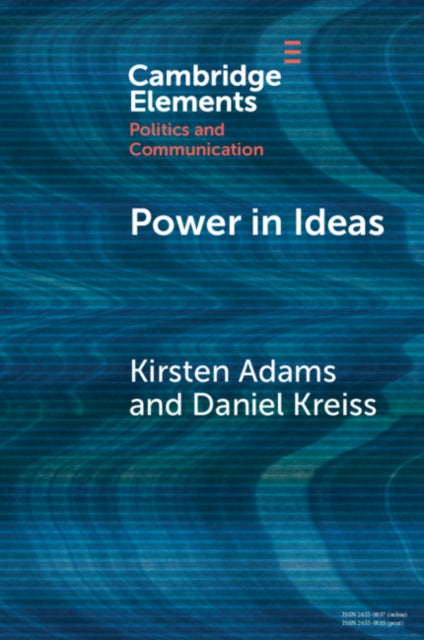
Kirsten Adams,Daniel Kreiss
Power in Ideas: A Case-Based Argument for Taking Ideas Seriously in Political Communication
Power in Ideas: A Case-Based Argument for Taking Ideas Seriously in Political Communication
💎 Earn 84 Points (£0.84) on this item.
We can order this item for you. Delivery usually takes about 4 to 6 weeks.
This item is not held in our immediate stock. We will order it for you after checkout.
Estimated delivery: About 4 to 6 weeks
YOU SAVE £1.01
- Condition: Brand new
- UK Delivery times: Usually arrives within 2 - 3 working days
- UK Shipping: Fee starts at £3.89. Subject to product weight & dimension
Bulk ordering. Want 15 or more copies? Get a personalised quote and bigger discounts. Learn more about bulk orders.
Couldn't load pickup availability
- More about Power in Ideas: A Case-Based Argument for Taking Ideas Seriously in Political Communication
The Element develops an analytical framework for understanding the role of ideas in political life and communication, combining interpretive approaches to derive meaning and quantitative analysis to determine their reach, spread, and impact. It illustrates this approach through three case studies: reparations, free expression, and universal basic income.
Format: Paperback / softback
Length: 75 pages
Publication date: 13 May 2021
Publisher: Cambridge University Press
This Element develops an analytical framework for understanding the role of ideas in political life and communication. Power in Ideas argues that the empirical study of ideas should combine interpretive approaches to derive meaning and understand influence with quantitative analysis to help determine the reach, spread, and impact of ideas. This Element illustrates this approach through three case studies: the idea of reparations in Ta-Nehisi Coates' "The Case for Reparations," the idea of free expression in Mark Zuckerberg's Facebook policy speech at Georgetown University, and the idea of universal basic income in Andrew Yang's "Freedom Dividend." Power in Ideas traces the landscapes and spheres within which these ideas emerged and were articulated, the ways they were encoded in discourse, the fields they traveled across, and how they became powerful.
Introduction:
Power in Ideas is a critical Element that explores the profound impact of ideas on political life and communication. It argues that the empirical study of ideas should combine interpretive approaches to derive meaning and understand influence with quantitative analysis to determine the reach, spread, and impact of ideas. This Element aims to provide a comprehensive framework for understanding the power of ideas and their role in shaping societies and cultures.
The Role of Ideas in Political Life and Communication:
Ideas play a crucial role in shaping political life and communication. They provide the foundation for ideologies, policies, and movements, and can influence public opinion and decision-making processes. The study of ideas involves exploring their origins, development, and dissemination, as well as their impact on individuals, groups, and societies.
Combining Interpretive Approaches with Quantitative Analysis:
Power in Ideas advocates for a combined approach to the empirical study of ideas. Interpretive approaches focus on understanding the meaning and significance of ideas, while quantitative analysis helps determine the reach, spread, and impact of ideas. By combining these two approaches, scholars can gain a deeper understanding of the power of ideas and their role in shaping political life and communication.
Case Studies:
To illustrate the approach outlined in Power in Ideas, three case studies are presented. These case studies cover a range of topics, including reparations, free expression, and universal basic income. Each case study explores the landscapes and spheres within which these ideas emerged and were articulated, the ways they were encoded in discourse, the fields they traveled across, and how they became powerful.
Reparations:
Ta-Nehisi Coates' "The Case for Reparations" provides a powerful exploration of the idea of reparations for slavery and its impact on American society. Coates argues that reparations are not just about compensating individuals for past wrongs, but about addressing the systemic inequalities that continue to exist in American society. Through his case study, Coates demonstrates how the idea of reparations has gained traction and influence in political life and communication.
Free Expression:
Mark Zuckerberg's Facebook policy speech at Georgetown University provides a case study of the idea of free expression in the digital age. Zuckerberg discusses the importance of free speech and the challenges posed by online censorship and misinformation. Through his case study, Zuckerberg highlights how the idea of free expression has become a contentious issue in political life and communication, with different perspectives and interpretations.
Universal Basic Income:
Andrew Yang's "Freedom Dividend" presents a case study of the idea of universal basic income. Yang argues that a universal basic income would provide a financial safety net for all individuals and reduce economic inequality. Through his case study, Yang demonstrates how the idea of universal basic income has gained popularity and influence in political life and communication, with advocates and critics alike.
Conclusion:
Power in Ideas provides a valuable framework for understanding the power of ideas in political life and communication. By combining interpretive approaches with quantitative analysis, scholars can gain a deeper understanding of the role of ideas in shaping societies and cultures. The case studies presented in this Element illustrate the approach outlined in Power in Ideas and provide insights into the landscapes and spheres within which these ideas emerged and were articulated, the ways they were encoded in discourse, the fields they traveled across, and how they became powerful.
Weight: 158g
Dimension: 151 x 227 x 14 (mm)
ISBN-13: 9781108948104
UK and International shipping information
UK and International shipping information
We deliver throughout the United Kingdom and to 128 countries and territories worldwide, including the United States, Australia, Canada, Germany, Spain and France.