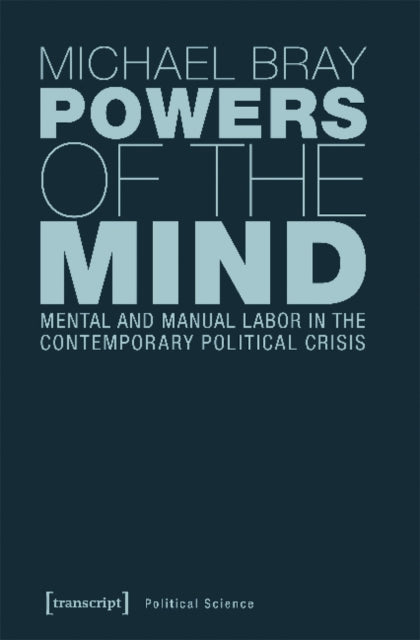
Michael Bray
Powers of the Mind - Mental and Manual Labor in the Contemporary Political Crisis
Powers of the Mind - Mental and Manual Labor in the Contemporary Political Crisis
💎 Earn 462 Points (£4.62) on this item.
We can order this item for you. Delivery usually takes about 4 to 6 weeks.
This item is not held in our immediate stock. We will order it for you after checkout.
Estimated delivery: About 4 to 6 weeks
YOU SAVE £19.49
- Condition: Brand new
- UK Delivery times: Usually arrives within 2 - 3 working days
- UK Shipping: Fee starts at £2.39. Subject to product weight & dimension
Bulk ordering. Want 15 or more copies? Get a personalised quote and bigger discounts. Learn more about bulk orders.
Couldn't load pickup availability
- More about Powers of the Mind - Mental and Manual Labor in the Contemporary Political Crisis
The division between mental and manual labor is a critical aspect of contemporary political struggles, as emphasized by Michael Bray. He argues that the forms of control and organization articulated by this division in practices of production, democracy, racialization, and financialization are becoming increasingly important. Bray critiques the left for its tendency to side implicitly with the powers of mental labor and calls for anti-capitalist politics to challenge those powers.
Format: Paperback / softback
Length: 200 pages
Publication date: 08 December 2021
Publisher: Transcript Verlag
The Marxist understanding of the division between mental and manual labor is a crucial yet often overlooked dimension of contemporary political conflicts. By departing from this innovative perspective, Michael Bray delves into the conceptual and socio-political evolution of this labor split, highlighting the growing significance of the control and organization mechanisms articulated through it in practices of production, democracy, racialization, and financialization. In his critique of the left, Bray argues that understanding and confronting the powers inherent in mental labor is an essential task for anti-capitalist politics in our times.
The historical roots of the division between mental and manual labor can be traced back to the emergence of capitalism. In the early stages of industrialization, the division of labor was based on the physical strength and skills of workers, with manual labor being associated with physical exertion and physical strength. As capitalism evolved, however, it became increasingly reliant on mental labor, which involved cognitive processes such as thinking, planning, and decision-making. This shift led to the emergence of a new class of intellectuals and professionals who were responsible for managing and overseeing the operations of capitalist enterprises.
The division between mental and manual labor has had far-reaching consequences for society. On the one hand, it has created a hierarchical structure in which mental labor is considered to be more prestigious and valuable than manual labor. This has led to a concentration of wealth and power in the hands of a small elite, while many workers are left to struggle in low-paying and insecure jobs. On the other hand, the division between mental and manual labor has also contributed to the marginalization and exploitation of certain groups of workers, such as women, people of color, and immigrants.
The forms of control and organization articulated by the division between mental and manual labor are becoming increasingly important in contemporary political struggles. In the workplace, for example, the increasing reliance on technology and automation has led to a shift in the power dynamics between workers and employers. While mental labor is often seen as more productive and valuable, manual labor is often seen as less skilled and less desirable. This has led to a growing inequality in the distribution of wealth and income, with a small elite controlling a disproportionate share of the resources.
In the realm of politics, the division between mental and manual labor is also becoming increasingly relevant. The rise of neoliberalism and the globalization of the economy has led to a concentration of power in the hands of multinational corporations and financial institutions. These institutions are responsible for managing and regulating the global economy, and they are increasingly relying on mental labor to do so. This has led to a growing influence of intellectuals and professionals in political decision-making, while many workers and marginalized communities are left to bear the brunt of the consequences of these decisions.
To challenge the powers of mental labor and promote a more equitable and democratic society, it is essential to understand and confront the mechanisms of control and organization articulated by the division between mental and manual labor. This requires a shift in our understanding of the relationship between labor and capital, as well as a recognition of the ways in which social and economic structures perpetuate inequality and exploitation.
One approach to challenging the powers of mental labor is to promote worker empowerment and collective bargaining. By empowering workers to negotiate with employers and advocate for their rights, we can create a more equitable distribution of wealth and income. This can be achieved through the implementation of labor laws and regulations that protect workers from exploitation and discrimination, as well as through the creation of worker-owned cooperatives and social enterprises.
Another approach to challenging the powers of mental labor is to promote education and training programs that equip workers with the skills and knowledge necessary to thrive in the modern economy. This can include programs that focus on developing critical thinking and problem-solving skills, as well as programs that provide training in new technologies and industries. By investing in education and training, we can create a more skilled and adaptable workforce that is capable of competing in the global marketplace.
In addition to these approaches, it is also important to challenge the dominant narratives and ideologies that perpetuate the division between mental and manual labor. This can include challenging the idea that mental labor is more valuable and productive than manual labor, as well as challenging the idea that certain groups of workers are less skilled or less deserving of respect and dignity. By promoting a more inclusive and equitable society, we can create a more just and sustainable economy that benefits all members of society.
In conclusion, the Marxist conception of the division between mental and manual labor is a critical yet often overlooked aspect of contemporary political struggles. By understanding and confronting the powers inherent in mental labor, we can promote a more equitable and democratic society that benefits all members of society. This requires a shift in our understanding of the relationship between labor and capital, as well as a recognition of the ways in which social and economic structures perpetuate inequality and exploitation. By promoting worker empowerment, education and training, and challenging dominant narratives and ideologies, we can create a more just and sustainable economy that benefits all members of society.
Weight: 422g
Dimension: 154 x 231 x 19 (mm)
ISBN-13: 9783837641479
This item can be found in:
UK and International shipping information
UK and International shipping information
UK Delivery and returns information:
- Delivery within 2 - 3 days when ordering in the UK.
- Shipping fee for UK customers from £2.39. Fully tracked shipping service available.
- Returns policy: Return within 30 days of receipt for full refund.
International deliveries:
Shulph Ink now ships to Australia, Belgium, Canada, France, Germany, Ireland, Italy, India, Luxembourg Saudi Arabia, Singapore, Spain, Netherlands, New Zealand, United Arab Emirates, United States of America.
- Delivery times: within 5 - 10 days for international orders.
- Shipping fee: charges vary for overseas orders. Only tracked services are available for most international orders. Some countries have untracked shipping options.
- Customs charges: If ordering to addresses outside the United Kingdom, you may or may not incur additional customs and duties fees during local delivery.