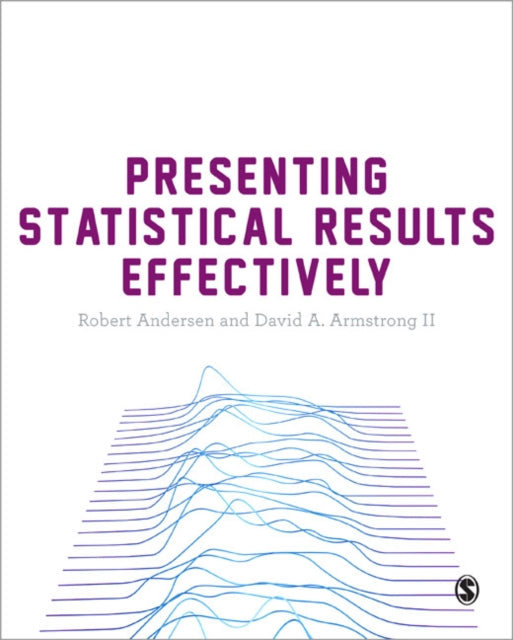
Robert Andersen,David A. Armstrong II
Presenting Statistical Results Effectively
Presenting Statistical Results Effectively
We can order this item for you. Delivery usually takes about 4 to 6 weeks.
This item is not held in our immediate stock. We will order it for you after checkout.
Estimated delivery: About 4 to 6 weeks
YOU SAVE £6.96
- Condition: Brand new
- UK Delivery times: Usually arrives within 2 - 3 working days
- UK Shipping: Fee starts at £3.89. Subject to product weight & dimension
Bulk ordering. Want 15 or more copies? Get a personalised quote and bigger discounts. Learn more about bulk orders.
Couldn't load pickup availability
- More about Presenting Statistical Results Effectively
This book provides practical guidance for interpreting and discussing statistical results, covering key concepts such as analytic and presentation techniques, cognitive processes, distribution assessment, and result communication. It is tailored for statistics students and researchers and can be applied to various models and contexts.
Format: Paperback / softback
Length: 456 pages
Publication date: 20 December 2021
Publisher: SAGE Publications Ltd
This comprehensive guide is a must-have for any statistics student or researcher seeking to interpret and discuss their results in a way that not only gives them meaning but also maximizes their impact on their target audience. Whether your data involves a wide range of variables or a specific focus, this book provides a roadmap for analysis and presentation that can be easily extended to other models and contexts.
The book is divided into several chapters, each dedicated to a specific aspect of building statistical models and communicating their results. Here's a breakdown of the key chapters:
Chapter 1: Introduction to Statistical Modeling and Data Analysis
This chapter provides an overview of statistical modeling and data analysis, including the types of data and models commonly used in different fields. It also introduces the cognitive processes involved in decoding information and the importance of understanding these processes to effectively communicate your results.
Chapter 2: Finding the Right Analytic and Presentation Techniques
In this chapter, you'll learn how to identify the appropriate analytic and presentation techniques for your type of data. You'll explore different types of statistical models, such as linear and non-linear models, and learn when and how to choose the most suitable model for your analysis. You'll also learn how to assess distributions and relationships among variables and how to use tables or graphs to effectively present your results.
Chapter 3: Assessing Distributions and Relationships Among Variables
This chapter focuses on understanding the distributions and relationships among variables in your data. You'll learn how to identify different types of distributions, such as normal, binomial, and Poisson, and how to assess the fit of these distributions to your data. You'll also learn how to use statistical tests, such as t-tests and chi-square tests, to evaluate the significance of relationships between variables.
Chapter 4: Building, Comparing, and Presenting Results for Linear and Non-Linear Models
In this chapter, you'll learn how to build, compare, and present results for linear and non-linear models. You'll explore different types of linear models, such as regression and logistic regression, and learn how to interpret the coefficients and significance tests associated with these models. You'll also learn how to build and compare non-linear models, such as neural networks and decision trees, and how to interpret the results of these models.
Chapter 5: Working with Univariate, Bivariate, and Multivariate Distributions
This chapter focuses on working with univariate, bivariate, and multivariate distributions in your data. You'll learn how to identify different types of distributions, such as normal, binomial, and Poisson, and how to assess the fit of these distributions to your data. You'll also learn how to use statistical tests, such as t-tests and chi-square tests, to evaluate the significance of relationships between variables in different distributions.
Chapter 6: Communicating multivariate distributions
This chapter focuses on communicating the processes involved in and the importance of your results. You'll learn how to effectively communicate the assumptions and limitations of your analysis, as well as the strengths and weaknesses of your models. You'll also learn how to tailor your communication to different audiences, such as technical professionals and non-technical stakeholders, and how to use visual aids, such as tables and graphs, to enhance understanding and impact.
In addition to the comprehensive coverage of statistical modeling and data analysis, this book also includes numerous examples and case studies to illustrate the practical application of the techniques discussed. These examples and case studies are drawn from a wide range of fields, including economics, psychology, and healthcare, and provide real-world insights into the challenges and opportunities associated with statistical analysis and communication.
Whether you're a beginner in statistics or a seasoned researcher seeking to improve your skills, this book offers hands-on guidance on how to interpret and discuss your results in a way that not only gives them meaning but also maximizes their impact on your target audience. So, why wait? Get your copy today and take your statistical analysis and communication to the next level!
In conclusion, this comprehensive guide is a must-have for any statistics student or researcher seeking to interpret and discuss their results in a way that not only gives them meaning but also maximizes their impact on their target audience. Whether your data involves a wide range of variables or a specific focus, this book provides a roadmap for analysis and presentation that can be easily extended to other models and contexts. With its focus on best practices for building statistical models and effectively communicating their results, this book helps you gain a deeper understanding of the cognitive processes involved in decoding information and the importance of understanding these processes to effectively communicate your results. By following the guidance provided in this book, you'll be able to find the right results, assess distributions and relationships among variables, choose the right tables or graphs, build, compare, and present results for linear and non-linear models, work with univariate, bivariate, and multivariate distributions, and communicate the processes involved in and the importance of your results. So, why wait? Get your copy today and take your statistical analysis and communication to the next level!
Weight: 860g
Dimension: 527 x 260 x 25 (mm)
ISBN-13: 9781446269817
UK and International shipping information
UK and International shipping information
We deliver throughout the United Kingdom and to 128 countries and territories worldwide, including the United States, Australia, Canada, Germany, Spain and France.