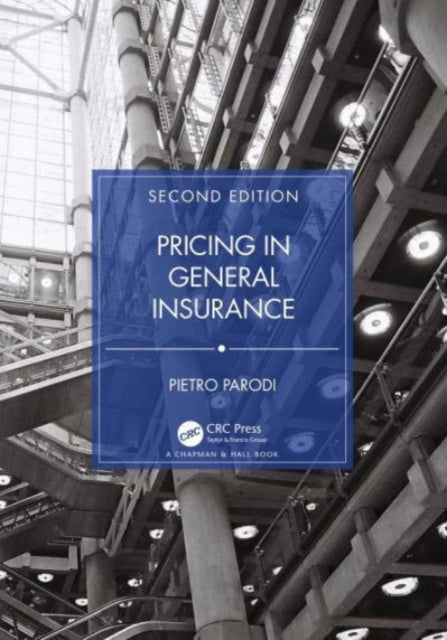
PietroParodi
Pricing in General Insurance
Pricing in General Insurance
💎 Earn 490 Points (£4.90) on this item.
YOU SAVE £5.83
- Condition: Brand new
- UK Delivery times: Usually arrives within 2 - 3 working days
- UK Shipping: Fee starts at £3.89. Subject to product weight & dimension
Bulk ordering. Want 15 or more copies? Get a personalised quote and bigger discounts. Learn more about bulk orders.
Couldn't load pickup availability
- More about Pricing in General Insurance
Pricing in General Insurance, Second Edition, is a comprehensive update on the first edition, covering pricing models, rate change calculations, exposure rating, premium building, capital allocation, machine learning, and rating factor selection. It is aimed at students of general insurance and actuarial science and practitioners in the field, with online material to increase its practical value.
Format: Hardback
Length: 696 pages
Publication date: 02 May 2023
Publisher: Taylor & Francis Ltd
Pricing in General Insurance, Second Edition, presents pricing as a formalized process that begins with gathering information about a specific policyholder or risk and concludes with a commercially informed rate. The first edition of the book was highly acclaimed by students and practitioners alike for its pragmatic approach, informal style, and comprehensive coverage of topics, including:
Background and context for pricing: This chapter provides an overview of the factors that influence insurance pricing, such as risk, uncertainty, and economic conditions. It also discusses the historical development of insurance pricing and the role of actuaries in the industry.
Process of experience rating: This chapter covers the various methods used to rate insurance policies, including traditional approaches such as burning cost analysis and more modern approaches such as stochastic modeling. It also discusses the challenges associated with experience rating and the use of data analytics in improving the accuracy of rate calculations.
Exposure rating for both property and casualty products: This chapter discusses the process of assigning risk ratings to different types of insurance policies, including personal lines, commercial lines, and specialty products such as credit risk and weather derivatives. It also covers the use of rating factors and the development of rating models.
Specialized techniques for personal lines (e.g., GLMs), reinsurance, and specific products such as credit risk and weather derivatives: This chapter explores the use of specialized techniques in personal lines insurance, such as Generalized Linear Models (GLMs) and the development of reinsurance contracts. It also discusses the unique challenges associated with credit risk and weather derivatives and the methods used to mitigate them.
General-purpose techniques such as credibility, multi-line pricing, and insurance optimization: This chapter covers the use of general-purpose techniques in insurance pricing, such as credibility analysis, multi-line pricing, and insurance optimization. It also discusses the challenges associated with these techniques and the use of simulation and optimization algorithms in improving the efficiency of pricing processes.
The second edition of the book is a substantial update on the first edition, encompassing:
New chapter on pricing models: This chapter provides an in-depth exploration of the structure, development, calibration, and maintenance of pricing models. It covers the different types of pricing models used in insurance, such as actuarial models, statistical models, and machine learning models, and discusses the advantages and disadvantages of each model.
New chapter on rate change calculations and the pricing cycle. This chapter discusses the process of calculating rate changes for insurance policies and the factors that influence rate changes. It also covers the use of rate change calculations in risk management and the development of pricing strategies.
Substantially enhanced treatment of exposure rating: This chapter provides a comprehensive treatment of exposure rating, including increased limit the limit factors, burning cost analysis, and the use of triangle-free techniques for claim count development. It also discusses the challenges associated with exposure rating and the use of data analytics in improving the accuracy of rate calculations.
Expanded treatment of premium building and capital allocation: This chapter covers the process of building premium and allocating capital in insurance companies. It discusses the use of premium building techniques, such as rate smoothing and premium capping, and the development of capital allocation models. It also covers the challenges associated with premium building and capital allocation and the use of risk-based capital models in improving the efficiency of capital allocation processes.
Improved treatment of machine learning: This chapter explores the use of machine learning in insurance pricing and the development of machine learning models. It covers the different types of machine learning models used in insurance, such as supervised learning, unsupervised learning, and reinforcement learning, and discusses the advantages and disadvantages of each model.
Enriched treatment of rating factor selection, and the inclusion of generalised additive models: This chapter covers the process of selecting rating factors and the development of rating models. It discusses the use of rating factors in insurance pricing and the development of generalised additive models, which are used to capture the non-linear relationships between rating factors and premium.
The book delivers a practical introduction to all aspects of general insurance pricing and is aimed at students of general insurance and actuarial. It provides a comprehensive coverage of the theoretical foundations of insurance pricing, as well as the practical applications of pricing techniques in the real world. The book is written in a clear and concise manner, making it accessible to students with a range of backgrounds and expertise.
In conclusion, Pricing in General Insurance, Second Edition, is an essential resource for students of general insurance and actuarial. It provides a comprehensive and up-to-date coverage of all aspects of insurance pricing, including the theoretical foundations, practical applications, and emerging trends in the industry. The book is written in a clear and concise manner, making it accessible to students with a range of backgrounds and expertise. I highly recommend this book to anyone interested in learning more about insurance pricing and the role of actuaries in the industry.
Weight: 1480g
Dimension: 270 x 200 x 44 (mm)
ISBN-13: 9780367769031
Edition number: 2 ed
UK and International shipping information
UK and International shipping information
We deliver throughout the United Kingdom and to 128 countries and territories worldwide, including the United States, Australia, Canada, Germany, Spain and France.