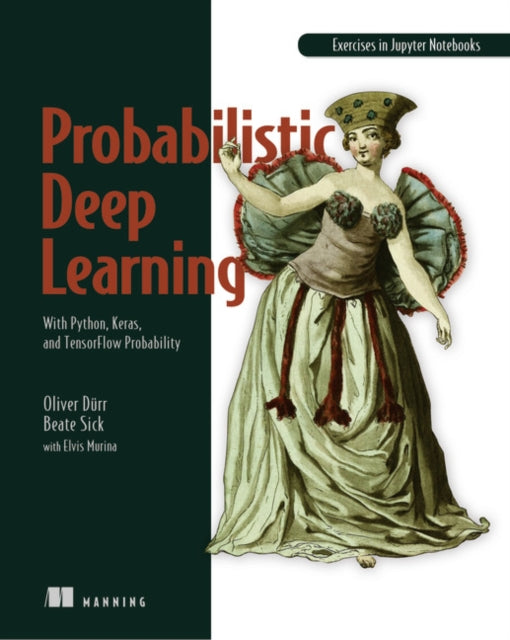
Oliver Durr,Beate Sick,Elvis Murina
Probabilistic Deep Learning
Probabilistic Deep Learning
💎 Earn 203 Points (£2.03) on this item.
YOU SAVE £5.29
- Condition: Brand new
- UK Delivery times: Usually arrives within 2 - 3 working days
- UK Shipping: Fee starts at £2.39. Subject to product weight & dimension
Bulk ordering. Want 15 or more copies? Get a personalised quote and bigger discounts. Learn more about bulk orders.
Couldn't load pickup availability
- More about Probabilistic Deep Learning
Probabilistic Deep Learning provides readers with the tools to identify and account for uncertainty and potential errors in their results, using the maximum likelihood principle of curve fitting and the Python-based Tensorflow Probability framework. It is aimed at a reader experienced with developing machine learning or deep learning applications and covers topics such as the maximum likelihood principle, probabilistic DL models, Bayesian deep learning, and applying probabilistic principles to variational auto-encoders.
Format: Paperback / softback
Length: 296 pages
Publication date: 01 February 2021
Publisher: Manning Publications
Probabilistic Deep Learning is a groundbreaking approach that empowers readers to identify and address uncertainty and potential errors in their results through the use of probabilistic deep learning models. This comprehensive guide begins by applying the fundamental maximum likelihood principle of curve fitting to deep learning, enabling readers to harness the power of this powerful technology.
Next, readers will delve into the Python-based Tensorflow Probability framework, a powerful tool for building Bayesian neural networks that can explicitly state their uncertainties. By leveraging the principles of probabilistic inference, readers will gain the ability to make informed decisions based on the range of possible outcomes provided by these models.
Key Features:
The Maximum Likelihood Principle: This guide provides a deep understanding of the maximum likelihood principle, which underpins deep learning applications. Readers will learn how to apply this principle to optimize the performance of deep learning models and improve their accuracy.
Probabilistic DL Models: Readers will explore probabilistic deep learning models that can indicate the range of possible outcomes for a given input. These models are particularly useful in scenarios where there is inherent uncertainty, such as in self-driving cars, scientific research, financial industries, and other accuracy-critical applications.
Bayesian Deep Learning: Bayesian deep learning is a powerful approach that allows for the uncertainty that occurs in real-world situations. Readers will learn how to set up Bayesian neural networks that can account for this uncertainty and provide more reliable predictions.
Applying Probabilistic Principles to Variational Auto-Encoders: This guide demonstrates how probabilistic principles can be applied to variational auto-encoders, a type of deep learning model that is used for unsupervised learning. Readers will learn how to use these models to generate meaningful representations of complex data and uncover hidden patterns.
Aimed at a Reader Experienced with Developing Machine Learning or Deep Learning Applications: This book is designed for readers with a solid foundation in developing machine learning or deep learning applications. It assumes a basic understanding of machine learning and statistical concepts and provides detailed explanations and examples to help readers grasp the probabilistic deep learning approach.
About the Technology: Probabilistic deep learning models are well-suited for dealing with the noise and uncertainty of real-world data, which is a crucial factor for self-driving cars, scientific research, financial industries, and other accuracy-critical applications. By leveraging the power of probabilistic inference, these models can provide more reliable predictions and help decision-makers make informed decisions based on the available data.
Oliver Dürr is a professor for data science at the University of Applied Sciences in Konstanz, Germany. He has extensive experience in machine learning and statistics and has supervised numerous bachelor's, master's, and PhD theses on the topic of deep learning. He has also planned and conducted several postgraduate and master's-level courses on deep learning.
Beate Sick holds a chair for applied statistics at ZHAW, a leading Swiss university of applied sciences. She is a researcher and lecturer at the University of Zurich and ETH Zurich, and has extensive experience in applied statistics and machine learning. She has supervised numerous bachelor's, master's, and PhD theses on the topic of deep learning and has published numerous papers in the field.
Elvis Murina is a research assistant responsible for the extensive exercises that accompany this book. He has a strong background in machine learning and statistics and has worked on various projects related to deep learning. He has also contributed to several open-source projects in the machine learning community.
Dürr and Sick are both experts in machine learning and statistics. They have supervised numerous bachelor's, master's, and PhD theses on the topic of deep learning and have planned and conducted several postgraduate and master's-level courses on deep learning. Their expertise in the field makes this book an invaluable resource for anyone interested in learning probabilistic deep learning and applying it to real-world problems.
In conclusion, Probabilistic Deep Learning is a groundbreaking approach that empowers readers to identify and address uncertainty and potential errors in their results through the use of probabilistic deep learning models. This comprehensive guide provides a deep understanding of the maximum likelihood principle, probabilistic DL models, Bayesian deep learning, and applying probabilistic principles to variational auto-encoders. By leveraging the power of probabilistic inference, readers can gain the ability to make informed decisions based on the range of possible outcomes provided by these models and improve the accuracy of their applications. Whether you are a machine learning or deep learning practitioner, this book is a must-read for anyone interested in advancing their skills in this exciting field.
Weight: 558g
Dimension: 186 x 234 x 21 (mm)
ISBN-13: 9781617296079
UK and International shipping information
UK and International shipping information
UK Delivery and returns information:
- Delivery within 2 - 3 days when ordering in the UK.
- Shipping fee for UK customers from £2.39. Fully tracked shipping service available.
- Returns policy: Return within 30 days of receipt for full refund.
International deliveries:
Shulph Ink now ships to Australia, Belgium, Canada, France, Germany, Ireland, Italy, India, Luxembourg Saudi Arabia, Singapore, Spain, Netherlands, New Zealand, United Arab Emirates, United States of America.
- Delivery times: within 5 - 10 days for international orders.
- Shipping fee: charges vary for overseas orders. Only tracked services are available for most international orders. Some countries have untracked shipping options.
- Customs charges: If ordering to addresses outside the United Kingdom, you may or may not incur additional customs and duties fees during local delivery.