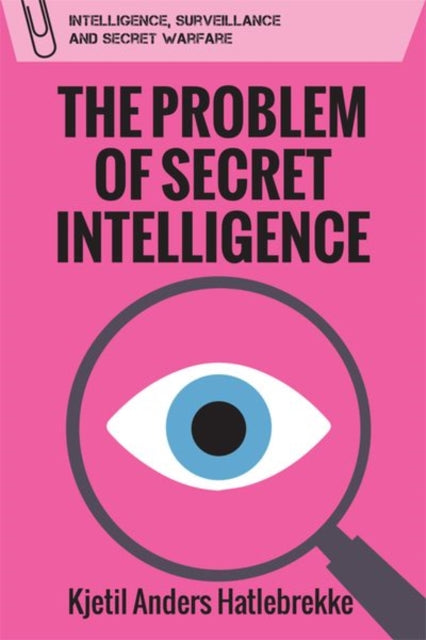
Kjetil Anders Hatlebrekke
Problem of Secret Intelligence
Problem of Secret Intelligence
💎 Earn 383 Points (£3.83) on this item.
YOU SAVE £23.30
- Condition: Brand new
- UK Delivery times: Usually arrives within 2 - 3 working days
- UK Shipping: Fee starts at £2.39. Subject to product weight & dimension
Bulk ordering. Want 15 or more copies? Get a personalised quote and bigger discounts. Learn more about bulk orders.
Couldn't load pickup availability
- More about Problem of Secret Intelligence
Intelligence analysis is based on an inference between history and the future, limiting our perception of new threats. Kjetil Anders Hatlebrekke proposes a new approach that focuses on understanding threats beyond our experience, which are the most dangerous to society.
Format: Hardback
Length: 272 pages
Publication date: 30 June 2019
Publisher: Edinburgh University Press
Intelligence is a complex and multifaceted concept that has been the subject of extensive study and debate for many years. It is often defined as the ability to acquire, process, and use information to achieve a goal or solve a problem. However, defining intelligence is not a straightforward task, and there is no systematic theory of intelligence that has been universally accepted.
One of the challenges in defining intelligence is that it is based on an inference between history and the future. This means that intelligence analysts rely on past data and trends to predict future events and threats. While this approach can be effective in many cases, it can also be limited in its ability to perceive new threats and variations of threats.
Kjetil Anders Hatlebrekke, a researcher in the field of intelligence analysis, has proposed a new approach to intelligence analysis that focuses on understanding the threats that appear beyond our experience and are therefore the most dangerous to society. According to Hatlebrekke, good intelligence is based on a deep understanding of the underlying causes of threats and the ability to identify patterns and connections that may not be immediately apparent.
One of the key challenges in understanding the threats that appear beyond our experience is the fact that they are often complex and interconnected. This means that they can be difficult to predict and respond to. Hatlebrekke argues that intelligence analysts need to be able to think creatively and outside the box to identify these threats and develop effective strategies for responding to them.
Another challenge in defining intelligence is the fact that it is influenced by a wide range of factors, including genetics, environment, and education. This means that intelligence can vary widely between individuals and groups. Hatlebrekke argues that intelligence should be viewed as a dynamic and evolving concept that can be influenced by a variety of factors.
Despite these challenges, there have been some significant advances in the field of intelligence analysis in recent years. For example, advances in data analysis and machine learning have made it possible to analyze large amounts of data and identify patterns and connections that may not have been previously apparent. This has led to the development of new intelligence technologies and strategies that are more effective in responding to threats.
However, there are also concerns about the use of intelligence technologies and strategies. Some argue that they can be used to violate human rights and undermine democratic institutions. Hatlebrekke argues that intelligence should be used in a responsible and ethical manner and that it should be subject to strict oversight and regulation.
In conclusion, intelligence is a complex and multifaceted concept that has been the subject of extensive study and debate for many years. While defining intelligence is not a straightforward task, there is a growing recognition of the importance of understanding the threats that appear beyond our experience and the need to develop effective strategies for responding to them. By focusing on a deep understanding of the underlying causes of threats and the ability to identify patterns and connections, intelligence analysts can help to make the world a safer and more secure place.
Weight: 630g
Dimension: 164 x 241 x 21 (mm)
ISBN-13: 9780748691838
UK and International shipping information
UK and International shipping information
UK Delivery and returns information:
- Delivery within 2 - 3 days when ordering in the UK.
- Shipping fee for UK customers from £2.39. Fully tracked shipping service available.
- Returns policy: Return within 30 days of receipt for full refund.
International deliveries:
Shulph Ink now ships to Australia, Belgium, Canada, France, Germany, Ireland, Italy, India, Luxembourg Saudi Arabia, Singapore, Spain, Netherlands, New Zealand, United Arab Emirates, United States of America.
- Delivery times: within 5 - 10 days for international orders.
- Shipping fee: charges vary for overseas orders. Only tracked services are available for most international orders. Some countries have untracked shipping options.
- Customs charges: If ordering to addresses outside the United Kingdom, you may or may not incur additional customs and duties fees during local delivery.