Shulph Ink
Procedural Review in European Fundamental Rights Cases
Procedural Review in European Fundamental Rights Cases
💎 Earn 160 Points (£1.60) on this item.
We can order this item for you. Delivery usually takes about 4 to 6 weeks.
This item is not held in our immediate stock. We will order it for you after checkout.
Estimated delivery: About 4 to 6 weeks
YOU SAVE £1.90
- Condition: Brand new
- UK Delivery times: Usually arrives within 2 - 3 working days
- UK Shipping: Fee starts at £2.39. Subject to product weight & dimension
Bulk ordering. Want 15 or more copies? Get a personalised quote and bigger discounts. Learn more about bulk orders.
Couldn't load pickup availability
- More about Procedural Review in European Fundamental Rights Cases
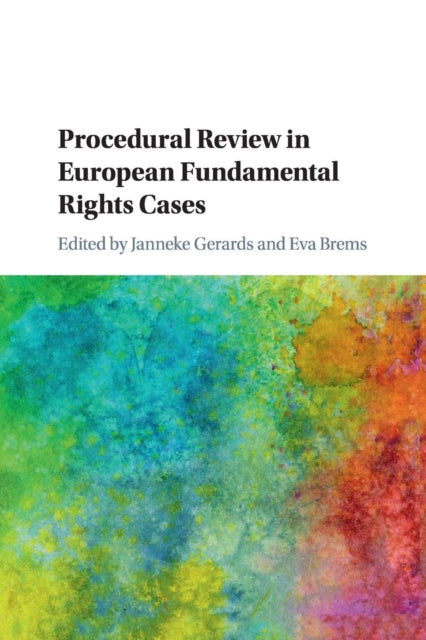
European courts are increasingly considering the quality of the procedure that leads to fundamental rights interference, but this procedural review is controversial. This book is the first in-depth study of procedural review, considering the theoretical and conceptual issues and its applicability in different legal systems. It is of great importance to scholars and practitioners interested in fundamental rights adjudication, judicial reasoning, and procedural justice.
Format: Paperback / softback
Length: 279 pages
Publication date: 16 August 2018
Publisher: Cambridge University Press
Traditionally, courts have adjudicated fundamental rights cases by applying substantive tests of reasonableness or proportionality. However, European courts are increasingly taking into account the quality of the procedure that has led to a fundamental rights interference. This procedural review is far from uncontroversial. There is a lack of clarity regarding what procedural review truly means, its potential for judicial decision-making, its relationship to substantive review, and its limitations.
Contributions from experts in the field are featured in this book, which is the first in-depth study of procedural review. It considers the theoretical and conceptual issues at play, as well as the applicability of procedural review in different legal systems. This book will be of great importance to scholars and practitioners interested in fundamental rights adjudication in Europe, judicial reasoning, and procedural justice.
The concept of procedural review has gained prominence in recent years as European courts have increasingly recognized the importance of ensuring that fundamental rights are protected in a fair and efficient manner. Procedural review is a process by which courts examine the procedures followed by government agencies or other actors when they interfere with a person's fundamental rights. The aim of procedural review is to ensure that the interference is justified, proportionate, and in accordance with the principles of legal certainty, fairness, and respect for human rights.
One of the key aspects of procedural review is the emphasis on the importance of legal certainty. Legal certainty is the principle that individuals should be able to predict how the law will apply to their situation and what consequences they will face if they violate the law. When government agencies or other actors interfere with a person's fundamental rights, they must do so in a way that is clear and predictable, so that individuals can understand their rights and obligations and make informed decisions about how to respond.
Procedural review also emphasizes the importance of fairness and respect for human rights. When government agencies or other actors interfere with a person's fundamental rights, they must do so in a way that is fair and just. This means that the interference must be based on objective criteria and that the individual must be given the opportunity to present their case and challenge the decision. It also means that the decision must be made by an independent and impartial body, such as a court, and that the individual must be able to appeal the decision if they are dissatisfied with it.
Another important aspect of procedural review is the role that it plays in protecting individual rights. By examining the procedures followed by government agencies or other actors, procedural review can help to ensure that individuals are not subjected to arbitrary or discriminatory treatment. It can also help to prevent the abuse of power by government agencies or other actors and to ensure that the rights of individuals are protected even in the face of challenging circumstances.
Despite the many benefits of procedural review, there are also some challenges that need to be addressed. One of the challenges is the lack of clarity regarding what procedural review means and what its potential for judicial decision-making is. There is also a lack of consensus regarding the relationship between procedural review and substantive review, and the extent to which procedural review should be used to protect individual rights.
Another challenge is the potential for procedural review to be used as a tool for political interference or as a means of delaying or obstructing government action. There have been concerns that procedural review can be used to slow down the process of implementing laws or policies that are unpopular with certain groups or individuals. This can lead to a lack of accountability and transparency in government decision-making and can undermine the democratic process.
To address these challenges, it is important to develop a clear and comprehensive understanding of procedural review. This can be achieved through the development of legal standards and guidelines, as well as through the training and education of judges and other legal professionals. It is also important to ensure that procedural review is conducted in a fair and impartial manner, and that individuals are given the opportunity to present their cases and challenge decisions that they believe are unfair or discriminatory.
In conclusion, procedural review is an important tool for protecting individual rights and ensuring that government agencies and other actors interfere with fundamental rights in a fair and efficient manner. However, there are some challenges that need to be addressed to ensure that procedural review is effective and sustainable. By developing a clear and comprehensive understanding of procedural review, and by ensuring that it is conducted in a fair and impartial manner, we can help to promote the protection of individual rights and ensure that the democratic process is upheld.
Weight: 438g
Dimension: 152 x 227 x 22 (mm)
ISBN-13: 9781316635148
UK and International shipping information
UK and International shipping information
UK Delivery and returns information:
- Delivery within 2 - 3 days when ordering in the UK.
- Shipping fee for UK customers from £2.39. Fully tracked shipping service available.
- Returns policy: Return within 30 days of receipt for full refund.
International deliveries:
Shulph Ink now ships to Australia, Belgium, Canada, France, Germany, Ireland, Italy, India, Luxembourg Saudi Arabia, Singapore, Spain, Netherlands, New Zealand, United Arab Emirates, United States of America.
- Delivery times: within 5 - 10 days for international orders.
- Shipping fee: charges vary for overseas orders. Only tracked services are available for most international orders. Some countries have untracked shipping options.
- Customs charges: If ordering to addresses outside the United Kingdom, you may or may not incur additional customs and duties fees during local delivery.