Derek Beach,Rasmus Brun Pedersen
Process-Tracing Methods: Foundations and Guidelines
Process-Tracing Methods: Foundations and Guidelines
💎 Earn 165 Points (£1.65) on this item.
- Condition: Brand new
- UK Delivery times: Usually arrives within 2 - 3 working days
- UK Shipping: Fee starts at £3.89. Subject to product weight & dimension
Bulk ordering. Want 15 or more copies? Get a personalised quote and bigger discounts. Learn more about bulk orders.
Couldn't load pickup availability
- More about Process-Tracing Methods: Foundations and Guidelines
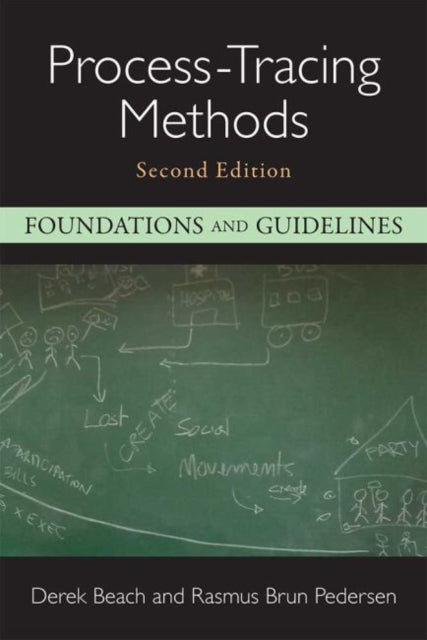
Process-tracing is a social science method for studying causal mechanisms by making strong inferences about how a cause contributes to an outcome. This extensively revised and updated edition introduces four distinct variants and explains how to identify the most appropriate variant for the research question.
Format: Paperback / softback
Length: 328 pages
Publication date: 30 January 2019
Publisher: The University of Michigan Press
Process-tracing in social science is a powerful method for understanding the intricate relationships between causes and outcomes. By meticulously tracing the pathways and mechanisms that lead to specific outcomes, researchers can make robust inferences about the factors that contribute to these outcomes. In this extensively revised and updated edition, Derek Beach and Rasmus Brun Pedersen have introduced a refined definition of process-tracing, distinguishing it into four distinct variants and exploring their applications and limitations. The authors delve into the underlying logic of process-tracing, explaining how causal mechanisms can be understood and how Bayesian logic enables strong inferences within individual cases. They provide detailed instructions for selecting the most appropriate variant of process-tracing based on the research question at hand and offer a comprehensive set of guidelines for each stage of the research process.
Process-tracing is a versatile approach that has been applied across various social science disciplines, including sociology, psychology, economics, and political science. It allows researchers to examine the complex interplay between multiple factors and their impact on outcomes. For example, in the field of sociology, process-tracing has been used to study the formation and development of social networks, the spread of social movements, and the dynamics of social inequality. In psychology, process-tracing has been employed to understand the mechanisms behind cognitive processes, such as decision-making, memory, and attention. In economics, process-tracing has been used to examine the economic mechanisms behind market crashes, economic growth, and financial crises. In political science, process-tracing has been used to study the dynamics of political institutions, policy-making processes, and the influence of political actors on public opinion.
One of the key advantages of process-tracing is its ability to provide a holistic understanding of complex systems. By tracing the pathways and mechanisms that lead to specific outcomes, researchers can identify the critical factors that contribute to these outcomes. This information can then be used to develop effective policies and interventions to address social problems and improve outcomes for individuals and communities.
However, process-tracing is not without its challenges. One of the main challenges is the need for extensive data collection and analysis. Process-tracing requires detailed information about the individuals, organizations, and social processes involved in the outcome of interest. This can be time-consuming and resource-intensive, particularly when studying large-scale social phenomena or complex systems.
Another challenge is the potential for bias and confounding in the data. Process-tracing relies on the assumption that there are causal relationships between the variables of interest. However, this assumption may not always be valid, particularly when there are multiple variables at play or when the data is limited or biased.
To address these challenges, researchers must carefully design their research studies and employ rigorous data analysis techniques. They must also be transparent about their methods and assumptions, and carefully consider the potential limitations and biases of their data.
In conclusion, process-tracing is a powerful method for understanding the causal mechanisms linking causes with outcomes in social science. By providing a holistic understanding of complex systems and identifying critical factors that contribute to outcomes, process-tracing can help researchers develop effective policies and interventions to address social problems and improve outcomes for individuals and communities. However, researchers must carefully design their research studies and employ rigorous data analysis techniques to address the challenges of bias and confounding in the data.
Weight: 496g
Dimension: 153 x 227 x 30 (mm)
ISBN-13: 9780472037353
Edition number: 2 Revised edition
UK and International shipping information
UK and International shipping information
We deliver throughout the United Kingdom and to 128 countries and territories worldwide, including the United States, Australia, Canada, Germany, Spain and France.