Professor John Guillory
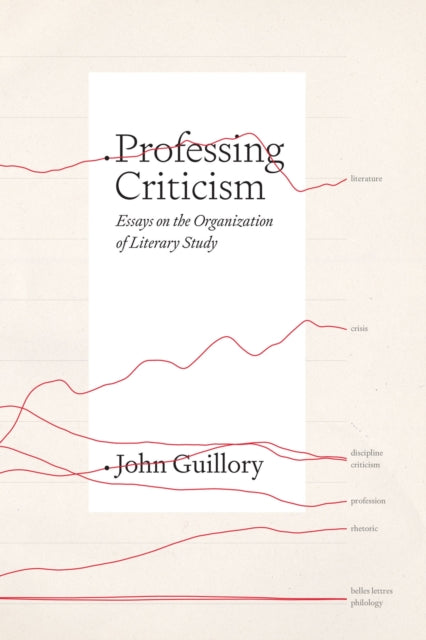
Professing Criticism: Essays on the Organization of Literary Study
Professing Criticism: Essays on the Organization of Literary Study
💎 Earn 113 Points (£1.13) on this item.
YOU SAVE £1.34
- Condition: Brand new
- UK Delivery times: Usually arrives within 2 - 3 working days
- UK Shipping: Fee starts at £2.39. Subject to product weight & dimension
Bulk ordering. Want 15 or more copies? Get a personalised quote and bigger discounts. Learn more about bulk orders.
Couldn't load pickup availability
- More about Professing Criticism: Essays on the Organization of Literary Study
The book explores the contradictions within literary study as a discipline and a profession, tracing its historical and modern organization, and its ambivalence towards the literary object and professionalization. It offers an explanation for the perennial churn in literary study, revolutionizing methods and objects, and the crisis of professional identification. It concludes with five key rationales for literary study, providing a credible account of the discipline's aims and reminding professors of their existing strengths.
Format: Paperback / softback
Length: 464 pages
Publication date: 18 November 2022
Publisher: The University of Chicago Press
The field of literary study, both as a discipline and as a profession, has faced significant challenges in recent years, particularly as the humanities face a labor crisis and declining enrollments. John Guillory, a renowned scholar in the field, has delved into the complexities of literary study, examining its historical and contemporary organization, both before and after its professionalization. In his eagerly anticipated new book, Professing Criticism, Guillory explores the enduring traces of this volatile history, revealing how they have become permanent features of the university.
Despite its ambivalence towards the literary object and its anxious embrace of professionalism, literary study continues to grapple with the relationship between discipline and profession. This tension is evident in its oscillation between a critical stance and a commercial orientation, which undermines the discipline's commitment to scholarly inquiry.
In response to these challenges, Professing Criticism offers a timely and insightful exploration of the perennial churn in literary study, the constant revolutionizing of its methods and objects, and the ongoing crisis of professional identification. Through a series of essays, the book provides an incisive explanation for these phenomena, shedding light on the factors that contribute to their persistence.
One of the key themes explored in the book is the perpetual churn in literary study, which is driven by a range of factors, including changes in academic discourse, technological advancements, and shifts in cultural values. The book argues that this churn is not merely a matter of academic fashion but reflects deeper tensions within the discipline, such as the tension between traditional scholarship and commercial interests.
Another important aspect of the book is its examination of the constant revolutionizing of literary methods and objects. Guillory argues that the field has undergone a significant transformation over the past few decades, with the rise of new genres, forms, and approaches to literary analysis. This revolution has led to a proliferation of new academic journals, conferences, and research centers, which have contributed to the professionalization of literary study.
However, the book also raises concerns about the implications of this professionalization for the discipline. Guillory argues that the commercialization of literary study has led to a dilution of its critical edge, as scholars are increasingly driven by the need to publish and secure funding. This has resulted in a focus on popular genres, trends, and commercial viability, rather than on the deeper exploration of literary texts and their cultural significance.
In addition to these challenges, Professing Criticism also explores the ongoing crisis of professional identification in literary study. The book argues that the field has struggled to establish a clear and coherent identity, as it is caught between the demands of academia and the marketplace. This crisis is particularly evident in the increasing commodification of academic work, as scholars are pressured to publish in high-impact journals, attend conferences, and engage in public outreach to secure funding and recognition.
To address these challenges, Professing Criticism offers a robust outline of five key rationales for literary study. These rationales provide a framework for understanding the aims and objectives of the discipline, as well as the values and practices that should guide its work. The first rationale is the pursuit of knowledge, which emphasizes the importance of scholarly inquiry and the pursuit of truth. The second rationale is the importance of cultural understanding, which recognizes the role.
The third rationale is the importance of aesthetic pleasure, which emphasizes the role of literature in shaping our understanding of the world and our place in it. The fourth rationale is the importance of social justice, which recognizes the role of literature in promoting social change and challenging oppressive systems of power. The fifth rationale is the importance of personal growth and development, which emphasizes the role of literature in fostering critical thinking, empathy, and creativity.
In conclusion, Professing Criticism is a timely and insightful exploration of the challenges facing literary study in the modern era. Through its incisive analysis of the field's historical and contemporary organization, its exploration of the perennial churn, and its robust outline of five key rationales for literary study, the book provides a valuable contribution to the ongoing debate about the future of the discipline. As the humanities continue to navigate the complexities of the 21st century, it is essential that we continue to engage with the critical questions raised by Professing Criticism and work towards building a more robust and sustainable future for literary study.
Dimension: 229 x 152 x 13 (mm)
ISBN-13: 9780226821306
This item can be found in:
UK and International shipping information
UK and International shipping information
UK Delivery and returns information:
- Delivery within 2 - 3 days when ordering in the UK.
- Shipping fee for UK customers from £2.39. Fully tracked shipping service available.
- Returns policy: Return within 30 days of receipt for full refund.
International deliveries:
Shulph Ink now ships to Australia, Belgium, Canada, France, Germany, Ireland, Italy, India, Luxembourg Saudi Arabia, Singapore, Spain, Netherlands, New Zealand, United Arab Emirates, United States of America.
- Delivery times: within 5 - 10 days for international orders.
- Shipping fee: charges vary for overseas orders. Only tracked services are available for most international orders. Some countries have untracked shipping options.
- Customs charges: If ordering to addresses outside the United Kingdom, you may or may not incur additional customs and duties fees during local delivery.