Shulph Ink
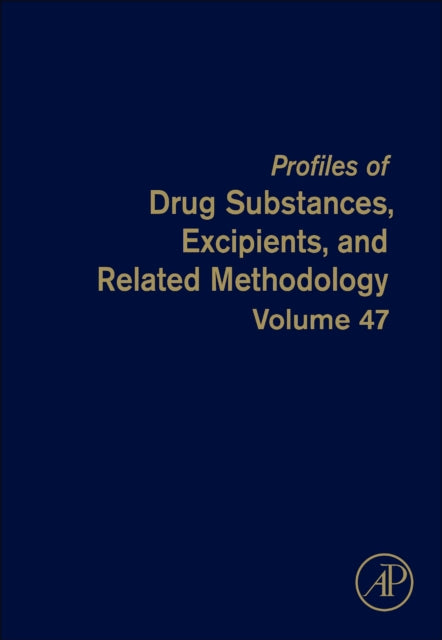
Profiles of Drug Substances, Excipients, and Related Methodology
Profiles of Drug Substances, Excipients, and Related Methodology
💎 Earn 981 Points (£9.81) on this item.
- Condition: Brand new
- UK Delivery times: Usually arrives within 2 - 3 working days
- UK Shipping: Fee starts at £2.39. Subject to product weight & dimension
Bulk ordering. Want 15 or more copies? Get a personalised quote and bigger discounts. Learn more about bulk orders.
Couldn't load pickup availability
- More about Profiles of Drug Substances, Excipients, and Related Methodology
Volume 47 of Profiles of Drug Substances, Excipients, and Related Methodology covers drug development and formulation, with comprehensive profiles of five drug compounds and a chapter on chemometrics.
Format: Hardback
Length: 398 pages
Publication date: 28 March 2022
Publisher: Elsevier Science & Technology
This comprehensive volume, Profiles of Drug Substances, Excipients, and Related Methodology, Volume 47, delves into the intricate realm of drug development and formulation, catering to the vital information requirements of the drug development community across all phases of pharmaceutical advancement. In this updated edition, readers are presented with detailed profiles of five drug compounds: Vinpocetine, Loratadine, Ticagrelor, Lodenafil, and Danazol. Additionally, the volume features a chapter that explores the application of chemometrics, utilizing direct spectroscopic methods as a valuable quality control tool in the pharmaceutical industry, with a focus on their validation.
The drug development process is a complex and rigorous journey that requires a deep understanding of various scientific disciplines, including chemistry, biology, and pharmacology. It involves the identification of potential drug candidates, the synthesis of these compounds, the evaluation of their safety and efficacy in preclinical studies, and the rigorous clinical trials that are necessary to obtain regulatory approval.
One of the critical aspects of drug development is the formulation of drugs. Formulation refers to the process of preparing a drug product that is safe, effective, and suitable for administration to patients. It involves the selection of appropriate excipients, such as fillers, binders, and preservatives, as well as the development of a suitable dosage form, such as tablets, capsules, or liquids.
The selection of excipients is crucial in ensuring the stability, bioavailability, and shelf life of the drug product. Excipients can affect the drug's absorption, distribution, metabolism, and excretion, and therefore, must be carefully chosen to minimize any potential adverse effects on patients.
In addition to excipients, drug development also involves the selection of appropriate analytical methods to evaluate the quality and purity of drug substances and drug products. These methods include chromatography, spectroscopy, and microbiology, among others.
Chromatography is a widely used analytical method that separates drug substances based on their physical and chemical properties. It can be used to identify and quantify the presence of impurities, as well as to determine the purity and identity of the drug substance. Spectroscopy, on the other hand, is a technique that uses electromagnetic radiation to analyze the chemical composition of substances. It can be used to identify and characterize drug compounds, as well as to monitor the stability and degradation of drug products.
Microbiology is another important analytical method used in drug development. It involves the study of microorganisms, such as bacteria, fungi, and viruses, and their interactions with drug substances and drug products. Microbiology is used to evaluate the safety and efficacy of drug products, as well as to monitor the quality of manufacturing processes.
In addition to analytical methods, drug development also involves the use of various methodologies to evaluate the safety and efficacy of drug products. These methodologies include clinical trials, which are designed to evaluate the safety and efficacy of a drug product in humans. Clinical trials can be conducted in different phases, depending on the stage of drug development and the safety profile of the drug product.
Clinical trials are conducted by trained medical professionals who monitor the safety and well-being of participants throughout the trial. Participants are assigned to different treatment groups, and the efficacy of the treatment is compared to a control group. If the treatment is found to be safe and effective, it may be approved for marketing and distribution.
In conclusion, Profiles of Drug Substances, Excipients, and Related Methodology, Volume 47 is a valuable resource for the drug development community. It provides comprehensive profiles of five drug compounds, as well as a chapter that explores the application of chemometrics in quality control in the pharmaceutical industry. The volume also highlights the importance of drug formulation, analytical methods, and methodologies in drug development, and underscores the critical role that clinical trials play in ensuring the safety and efficacy of drug products.
Weight: 450g
Dimension: 229 x 152 (mm)
ISBN-13: 9780323854825
This item can be found in:
UK and International shipping information
UK and International shipping information
UK Delivery and returns information:
- Delivery within 2 - 3 days when ordering in the UK.
- Shipping fee for UK customers from £2.39. Fully tracked shipping service available.
- Returns policy: Return within 30 days of receipt for full refund.
International deliveries:
Shulph Ink now ships to Australia, Belgium, Canada, France, Germany, Ireland, Italy, India, Luxembourg Saudi Arabia, Singapore, Spain, Netherlands, New Zealand, United Arab Emirates, United States of America.
- Delivery times: within 5 - 10 days for international orders.
- Shipping fee: charges vary for overseas orders. Only tracked services are available for most international orders. Some countries have untracked shipping options.
- Customs charges: If ordering to addresses outside the United Kingdom, you may or may not incur additional customs and duties fees during local delivery.