Jan Sebastian Zipp
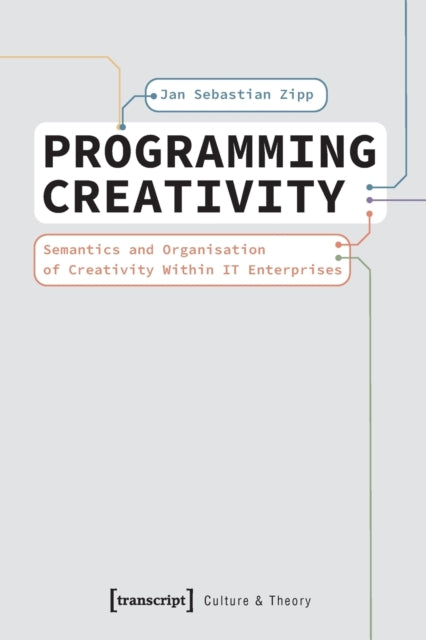
Programming Creativity: Semantics and Organisation of Creativity Within IT Enterprises
Programming Creativity: Semantics and Organisation of Creativity Within IT Enterprises
💎 Earn 194 Points (£1.94) on this item.
We can order this item for you. Delivery usually takes about 4 to 6 weeks.
This item is not held in our immediate stock. We will order it for you after checkout.
Estimated delivery: About 4 to 6 weeks
YOU SAVE £8.18
- Condition: Brand new
- UK Delivery times: Usually arrives within 2 - 3 working days
- UK Shipping: Fee starts at £2.39. Subject to product weight & dimension
Bulk ordering. Want 15 or more copies? Get a personalised quote and bigger discounts. Learn more about bulk orders.
Couldn't load pickup availability
- More about Programming Creativity: Semantics and Organisation of Creativity Within IT Enterprises
The study explores the concept of creativity in large IT companies during digital change, including new ways of working and potential artificial creativity with no human interaction. It provides insights into the representation and organization of creativity as a social practice, contributing to a critical engagement with the prevailing understanding of creativity in IT.
Format: Paperback / softback
Length: 200 pages
Publication date: 15 July 2022
Publisher: Transcript Verlag
Creativity is a fundamental aspect of human existence, transcending boundaries and permeating various fields, including IT. In the context of IT, creativity takes on a unique dimension as it encompasses the exploration, innovation, and implementation of new technologies, solutions, and processes to meet the ever-evolving demands of a rapidly changing digital landscape.
In the era of digital transformation, large IT companies are facing significant challenges and opportunities. One of the key challenges is the need to adapt to new ways of working, such as remote work, agile methodologies, and collaboration tools. This requires IT professionals to be creative in finding innovative solutions that enable teams to work effectively and efficiently, regardless of their location or time zone.
Another area of creativity in IT is the potential for artificial creativity, which involves the use of algorithms, machine learning, and other advanced technologies to generate creative output without human intervention. This has the potential to revolutionize industries such as art, music, and literature, by enabling machines to create works that are indistinguishable from human creations.
However, the concept of creativity in IT also raises important ethical and philosophical questions. For example, how can we ensure that artificial creativity is ethical and does not perpetuate biases or discrimination? How can we balance the need for innovation with the preservation of human values and creativity?
To address these challenges, Jan Sebastian Zipp conducts an in-depth analysis of the representation and organization of creativity as a social practice in large IT companies. Drawing on constitutive elements such as Silicon Valley and its connection to counterculture, Zipp explores the inherent logic of the creativity narrative of IT. His study contributes vital foundations for a critical engagement with the prevailing understanding of creativity in the digital age.
One of the key findings of Zipp's analysis is that creativity in IT is not just about individual creativity but also about the collective creativity of teams and organizations. He argues that creativity is not just a skill or a trait but a social practice that is shaped by the cultural, economic, and political context in which it occurs. This means that the organization of creativity in IT is not just about individual talent or expertise but also about the structure, culture, and values of the company.
Zipp also highlights the importance of diversity and inclusion in the context of creativity in IT. He argues that diverse teams and organizations are more likely to generate innovative solutions and that creativity is not just a privilege of a few but a collective responsibility of everyone. This requires IT professionals to create an inclusive workplace that values diversity and encourages collaboration and teamwork.
In conclusion, creativity is a fundamental aspect of human existence, and it plays a crucial role in the context of IT. In the era of digital transformation, large IT companies are facing significant challenges and opportunities, and creativity is essential in finding innovative solutions that enable teams to work effectively and efficiently. However, the concept of creativity in IT also raises important ethical and philosophical questions, and it requires a critical engagement with the prevailing understanding of creativity in the digital age. By examining the representation and organization of creativity as a social practice, Jan Sebastian Zipp's study contributes vital foundations for a critical engagement with the prevailing understanding of creativity in the digital age.
Weight: 284g
Dimension: 23 x 15 x 1 (mm)
ISBN-13: 9783837663167
This item can be found in:
UK and International shipping information
UK and International shipping information
UK Delivery and returns information:
- Delivery within 2 - 3 days when ordering in the UK.
- Shipping fee for UK customers from £2.39. Fully tracked shipping service available.
- Returns policy: Return within 30 days of receipt for full refund.
International deliveries:
Shulph Ink now ships to Australia, Belgium, Canada, France, Germany, Ireland, Italy, India, Luxembourg Saudi Arabia, Singapore, Spain, Netherlands, New Zealand, United Arab Emirates, United States of America.
- Delivery times: within 5 - 10 days for international orders.
- Shipping fee: charges vary for overseas orders. Only tracked services are available for most international orders. Some countries have untracked shipping options.
- Customs charges: If ordering to addresses outside the United Kingdom, you may or may not incur additional customs and duties fees during local delivery.