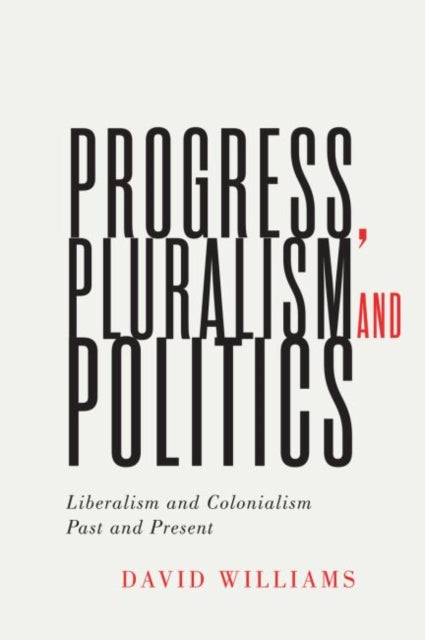
David Williams
Progress, Pluralism, and Politics: Liberalism and Colonialism, Past and Present
Progress, Pluralism, and Politics: Liberalism and Colonialism, Past and Present
💎 Earn 150 Points (£1.50) on this item.
YOU SAVE £3.91
- Condition: Brand new
- UK Delivery times: Usually arrives within 2 - 3 working days
- UK Shipping: Fee starts at £2.39. Subject to product weight & dimension
Bulk ordering. Want 15 or more copies? Get a personalised quote and bigger discounts. Learn more about bulk orders.
Couldn't load pickup availability
- More about Progress, Pluralism, and Politics: Liberalism and Colonialism, Past and Present
Liberal thinkers of the eighteenth and nineteenth centuries were aware of the political costs and human cruelties of European colonialism but saw progressive possibilities. David Williams explores the colonial and anti-colonial arguments of Adam Smith, Immanuel Kant, Jeremy Bentham, and L.T. Hobhouse in his book "Progress, Pluralism, and Politics." He reveals the central ambiguities of liberal thought in dealing with an illiberal world, such as appeals to universal history, attempts to mediate between identity and difference, and different ways of thinking about achieving liberal goods in other places.
Format: Paperback / softback
Length: 224 pages
Publication date: 17 December 2020
Publisher: McGill-Queen's University Press
Liberal thinkers of the eighteenth and nineteenth centuries were acutely aware of the political consequences and human suffering associated with European colonialism, yet they also saw progressive potential in European expansion. In his book "Progress, Pluralism, and Politics," David Williams delves into the colonial and anti-colonial arguments of renowned thinkers such as Adam Smith, Immanuel Kant, Jeremy Bentham, and L.T. Hobhouse. Williams explores the complex and nuanced attitudes of these thinkers towards European conquest and colonial rule, situated within a web of tensions. These tensions involve the impact of colonialism on European states, the possibilities for progress in distant and diverse regions, and the interplay between universalism and cultural pluralism. By examining these tensions, Williams uncovers some of the central ambiguities that shape how liberal thought has grappled with the reality of an illiberal world.
One significant aspect of this exploration is the appeal to various forms of universal history. Liberal thinkers sought to understand the historical trajectory of human societies and to draw lessons from past experiences. They argued that universal history could provide a framework for understanding the diverse cultures and societies encountered during colonialism and that it could guide the development of more inclusive and equitable policies.
Another important theme in the book is the attempt to mediate between the claims of identity and the reality of difference. Liberal thinkers recognized that colonialism often resulted in the erasure of local cultures and identities, and they sought to find ways to preserve and celebrate diversity while promoting universal values such as human rights and democracy. This involved complex negotiations and compromises, as liberal states sought to balance the interests of their colonial subjects with their own political and economic goals.
The book also explores different approaches to thinking about the achievement of liberal goods in other places. Liberal thinkers recognized that the pursuit of liberal ideals could be contextualized and adapted to different cultural and historical contexts. They argued that the universal principles of liberalism could be realized through local initiatives and grassroots movements, rather than through top-down imposition of Western values. This involved a nuanced understanding of the political, social, and economic dynamics of different regions and a willingness to engage with local leaders and communities.
Overall, "Progress, Pluralism, and Politics" offers a valuable contribution to the ongoing debate on political thought and the relationship between liberalism and colonialism. By examining the complex and nuanced attitudes of liberal thinkers towards European expansion, the book sheds light on the central ambiguities that characterize the ways in which liberal thought has dealt with the reality of an illiberal world. It provides insights into the challenges and opportunities that arise when liberal ideals are pursued in diverse and complex contexts, and it highlights the importance of nuanced and contextualized approaches to promoting human rights and democracy in a globalized world.
Weight: 318g
Dimension: 153 x 228 x 19 (mm)
ISBN-13: 9780228004097
UK and International shipping information
UK and International shipping information
UK Delivery and returns information:
- Delivery within 2 - 3 days when ordering in the UK.
- Shipping fee for UK customers from £2.39. Fully tracked shipping service available.
- Returns policy: Return within 30 days of receipt for full refund.
International deliveries:
Shulph Ink now ships to Australia, Belgium, Canada, France, Germany, Ireland, Italy, India, Luxembourg Saudi Arabia, Singapore, Spain, Netherlands, New Zealand, United Arab Emirates, United States of America.
- Delivery times: within 5 - 10 days for international orders.
- Shipping fee: charges vary for overseas orders. Only tracked services are available for most international orders. Some countries have untracked shipping options.
- Customs charges: If ordering to addresses outside the United Kingdom, you may or may not incur additional customs and duties fees during local delivery.