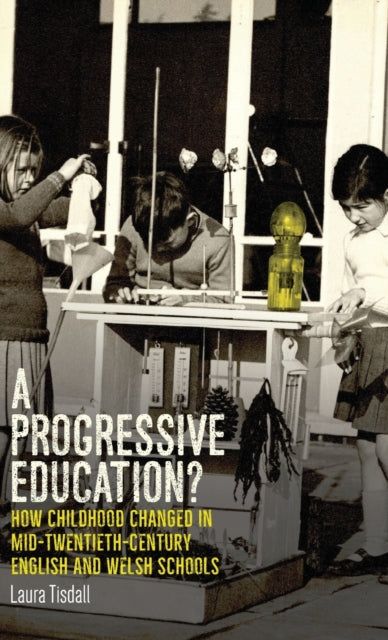
Laura Tisdall
Progressive Education?: How Childhood Changed in Mid-Twentieth-Century English and Welsh Schools
Progressive Education?: How Childhood Changed in Mid-Twentieth-Century English and Welsh Schools
💎 Earn 376 Points (£3.76) on this item.
We can order this item for you. Delivery usually takes about 4 to 6 weeks.
This item is not held in our immediate stock. We will order it for you after checkout.
Estimated delivery: About 4 to 6 weeks
YOU SAVE £9.77
- Condition: Brand new
- UK Delivery times: Usually arrives within 2 - 3 working days
- UK Shipping: Fee starts at £3.89. Subject to product weight & dimension
Bulk ordering. Want 15 or more copies? Get a personalised quote and bigger discounts. Learn more about bulk orders.
Couldn't load pickup availability
- More about Progressive Education?: How Childhood Changed in Mid-Twentieth-Century English and Welsh Schools
This book explores how ideas about childhood and adolescence were transformed in English and Welsh schools after WWII, challenging the dominant narrative of progressive education and shaping a more restrictive and pessimistic image of childhood. It will be valuable for historians, sociologists, education professionals, and policy-makers.
Format: Hardback
Length: 296 pages
Publication date: 30 September 2019
Publisher: Manchester University Press
After World War II, significant changes occurred in English and Welsh schools regarding childhood and adolescence. This book, spanning from 1918 to 1979, argues that by centering childhood in the history of education, we can challenge the narratives we tell about how and why schooling itself transformed. It has been suggested that the dominance of "progressive education" after 1945 led to a backlash against permissive attitudes towards pupils in Western Europe and the United States. However, British child-centered education, in alliance with developmental psychology, shaped a more restrictive and pessimistic image of childhood. Drawing on a wide range of sources, including school logbooks and oral histories, this book will be invaluable for historians, sociologists, education professionals, and policy-makers interested in modern Britain.
Introduction:
The post-World War II period witnessed significant transformations in English and Welsh schools regarding childhood and adolescence. This book, spanning from 1918 to 1979, aims to explore these changes and challenge the narratives we tell about how and why schooling itself transformed. It has been suggested that the dominance of "progressive education" after 1945 led to a backlash against permissive attitudes towards pupils in Western Europe and the United States. However, British child-centered education, in alliance with developmental psychology, shaped a more restrictive and pessimistic image of childhood.
Dominance of Progressive Education:
After World War II, there was a significant push towards progressive education in both English and Welsh schools. This movement emphasized the importance of individual student needs, active learning, and a focus on social and emotional development. Teachers were encouraged to adopt innovative teaching methods and to create a more inclusive and supportive learning environment. However, it is argued that the dominance of progressive education after 1945 led to a backlash against permissive attitudes towards pupils.
Backlash against Permissive Attitudes:
Some scholars suggest that the dominance of progressive education after 1945 led to a backlash against permissive attitudes towards pupils. They argue that the emphasis on individual student needs and active learning created a sense of competition and pressure among students, which could be harmful to their mental health. Additionally, the emphasis on social and emotional development may have led to a neglect of academic rigor and a focus on superficial qualities such as conformity and popularity.
British Child-Centered Education:
In contrast to the progressive education movement, British child-centered education emerged as a response to the backlash against permissive attitudes. This approach placed greater emphasis on the child's individual needs and interests, and it sought to create a learning environment that was supportive, nurturing, and enjoyable. Teachers were encouraged to focus on the child's development as a whole, including their physical, emotional, social, and intellectual growth.
Shaping a More Restrictive and Pessimistic Image of Childhood:
Despite the emphasis on child-centered education, it is argued that British child-centered education ultimately shaped a more restrictive and pessimistic image of childhood. This is because the approach was heavily influenced by developmental psychology, which emphasized the importance of early childhood experiences and the formation of stable patterns of behavior. Teachers were trained to view children as passive recipients of information, and they were encouraged to use rewards and punishments to control and shape their behavior.
Conclusion:
In conclusion, this book argues that ideas about both childhood and adolescence were transformed in English and Welsh schools after World War II. While the dominance of progressive education after 1945 led to a backlash against permissive attitudes, British child-centered education emerged as a response to this backlash. However, it is argued that British child-centered education ultimately shaped a more restrictive and pessimistic image of childhood, as it was heavily influenced by developmental psychology and sought to control and shape children's behavior through rewards and punishments. This book will be valuable for historians, sociologists, education professionals, and policy-makers interested in modern Britain and the history of education.
Weight: 470g
Dimension: 213 x 136 x 27 (mm)
ISBN-13: 9781526132895
UK and International shipping information
UK and International shipping information
We deliver throughout the United Kingdom and to 128 countries and territories worldwide, including the United States, Australia, Canada, Germany, Spain and France.