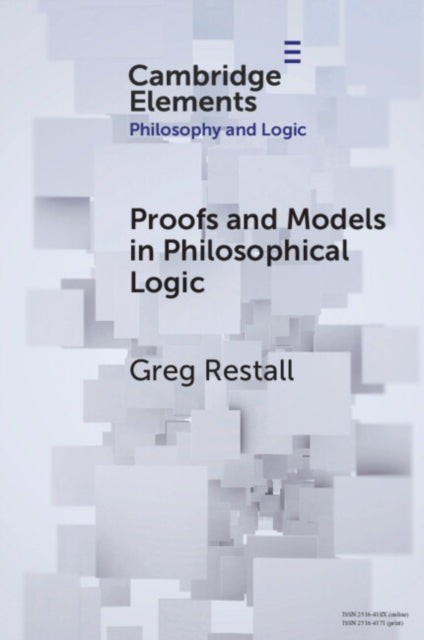
GregRestall
Proofs and Models in Philosophical Logic
Proofs and Models in Philosophical Logic
💎 Earn 84 Points (£0.84) on this item.
We can order this item for you. Delivery usually takes about 4 to 6 weeks.
This item is not held in our immediate stock. We will order it for you after checkout.
Estimated delivery: About 4 to 6 weeks
YOU SAVE £1.01
- Condition: Brand new
- UK Delivery times: Usually arrives within 2 - 3 working days
- UK Shipping: Fee starts at £2.39. Subject to product weight & dimension
Bulk ordering. Want 15 or more copies? Get a personalised quote and bigger discounts. Learn more about bulk orders.
Couldn't load pickup availability
- More about Proofs and Models in Philosophical Logic
This Element provides an introduction to recent work in philosophical logic, focusing on the semantic paradoxes of the sorites paradox. It introduces and motivates different proof systems and models for various logics, compares and contrasts substructural treatments, and introduces model theoretic treatments. It argues that both proofs and models have their place in the toolkits of philosophers and logicians.
Format: Paperback / softback
Length: 75 pages
Publication date: 21 April 2022
Publisher: Cambridge University Press
This Element serves as an introduction to recent work in philosophical logic, with a particular focus on the semantic paradoxes known as the sorites paradox. It provides an overview of different proof systems and models employed in various logics, including classical logic, intuitionistic logic, three-valued and four-valued logics, and substructural logics. The Element compares and contrasts various approaches to substructural treatments of the paradox, highlighting how the structural rules of contraction, cut, and identity play a central role in paradoxical derivations. It then introduces model-theoretic treatments of the paradoxes, including a simple fixed-point model construction that generates three-valued models for theories of truth, which can serve as models for a wide range of non-classical logics. The Element concludes with a discussion of the relationship between proofs and models, arguing that both have their respective roles in the toolkits of philosophers and logicians.
Introduction:
In recent years, philosophical logic has seen significant developments in the study of semantic paradoxes, particularly the sorites paradox. This Element aims to provide an introduction to recent work in this field, with a focus on proof systems and models for various logics.
Proof Systems:
Different proof systems have been proposed to address the sorites paradox. One prominent approach is the use of cut-elimination systems, which aim to eliminate certain assumptions or hypotheses from a proof until a contradiction is reached. For example, the standard cut-elimination system for classical logic employs the rule of contraction, which states that if A and B are true, then A implies B. By repeatedly applying this rule, one can eventually reach a contradiction, demonstrating that the initial assumption is false.
Models:
Models are another important tool in the study of semantic paradoxes. They provide a way to formalize the logical structure of a theory and to interpret its semantic properties. Different kinds of models have been proposed for various logics, including classical logic, intuitionistic logic, three-valued and four-valued logics, and substructural logics.
The Sorites Paradox:
The sorites paradox is a classic example of a semantic paradox. It involves a series of increasingly large collections of sand, where each collection is just a small fraction of the previous collection. However, it is claimed that there is no collection of sand that is not a collection of sand. This paradox raises questions about the nature of truth and the principles of logic.
Substructural Treatments:
Substructural treatments of the sorites paradox aim to address the paradox by modifying the logical structure of the theory. One approach is to introduce additional axioms or rules that restrict the use of certain operators or predicates. For example, in the context of classical logic, the rule of excluded middle can be used to restrict the use of the universal quantifier to only those cases where it is possible to prove its truth.
Model Theoretic Treatments:
Model-theoretic treatments of the sorites paradox involve the construction of models that capture the semantic properties of the paradox. One approach is to use fixed-point models, which are models that have a fixed set of elements and a fixed set of relations between those elements. By iteratively adding new elements to the model, one can eventually reach a model that satisfies all the axioms of the theory.
Conclusion:
In conclusion, this Element provides an introduction to recent work in philosophical logic, with a focus on the sorites paradox and its substructural and model-theoretic treatments. Both proof systems and models play important roles in the study of semantic paradoxes, and they continue to be an active area of research in the field.
Weight: 154g
Dimension: 152 x 228 x 9 (mm)
ISBN-13: 9781009045384
This item can be found in:
UK and International shipping information
UK and International shipping information
UK Delivery and returns information:
- Delivery within 2 - 3 days when ordering in the UK.
- Shipping fee for UK customers from £2.39. Fully tracked shipping service available.
- Returns policy: Return within 30 days of receipt for full refund.
International deliveries:
Shulph Ink now ships to Australia, Belgium, Canada, France, Germany, Ireland, Italy, India, Luxembourg Saudi Arabia, Singapore, Spain, Netherlands, New Zealand, United Arab Emirates, United States of America.
- Delivery times: within 5 - 10 days for international orders.
- Shipping fee: charges vary for overseas orders. Only tracked services are available for most international orders. Some countries have untracked shipping options.
- Customs charges: If ordering to addresses outside the United Kingdom, you may or may not incur additional customs and duties fees during local delivery.