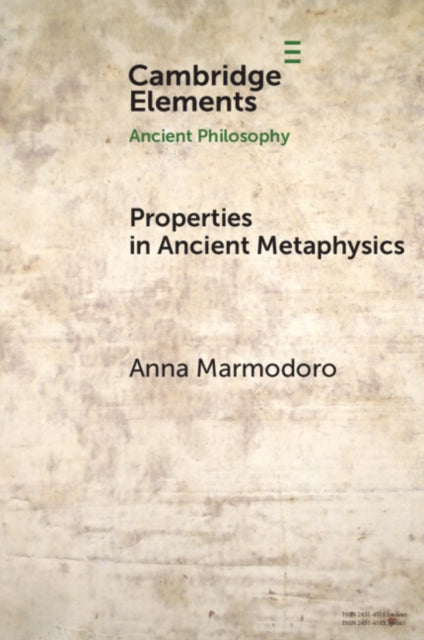
AnnaMarmodoro
Properties in Ancient Metaphysics
Properties in Ancient Metaphysics
💎 Earn 84 Points (£0.84) on this item.
We can order this item for you. Delivery usually takes about 4 to 6 weeks.
This item is not held in our immediate stock. We will order it for you after checkout.
Estimated delivery: About 4 to 6 weeks
YOU SAVE £1.01
- Condition: Brand new
- UK Delivery times: Usually arrives within 2 - 3 working days
- UK Shipping: Fee starts at £2.39. Subject to product weight & dimension
Bulk ordering. Want 15 or more copies? Get a personalised quote and bigger discounts. Learn more about bulk orders.
Couldn't load pickup availability
- More about Properties in Ancient Metaphysics
Anaxagoras, Plato, and Aristotle theorized about properties, discussing qualification, qualitative similarity, compositeness, and oneness. Plato conceptualized recurring universals but did not reify them, while Aristotle developed his metaphysics around them and identified the instantiation of properties. His account of the oneness of a substance was not hylomorphic.
Format: Paperback / softback
Length: 78 pages
Publication date: 21 December 2023
Publisher: Cambridge University Press
This Element provides an overview of how the ancient thinkers (Anaxagoras, Plato, and Aristotle) theorised about properties. This overview highlights the inquiries, problems, and solutions they pursued while engaged in dialogue with each other. It examines alternative philosophical perspectives existing in antiquity concerning the explanation of property qualification, qualitative similarity, compositeness, and oneness. It further argues that although Plato was the first to conceptualise recurring universals, he did not reify them and did not admit them in his ontology; it was Aristotle who did, and developed his metaphysics around them.
Aristotle, building on Plato's work, identified the metaphysical phenomenon of the instantiation of properties and developed an account for it. Finally, this Element outlines Aristotle's sophisticated account of the oneness of a substance and argues that it was not hylomorphic.
Anaxagoras, Plato, and Aristotle were ancient thinkers who engaged in a rich dialogue about the nature of properties. Anaxagoras, a pre-Socratic philosopher, believed that everything was made up of four elements: earth, air, fire, and water. Plato, on the other hand, developed a more complex theory of forms, which he believed were the underlying principles of reality. Aristotle, building on Plato's work, identified the metaphysical phenomenon of the instantiation of properties and developed an account for it.
Aristotle's account of the instantiation of properties was based on the idea that substances are composed of both matter and form. Matter is the physical substance that makes up an object, while form is the underlying structure or pattern that gives an object its identity. Aristotle argued that properties are instantiated by the combination of matter and form in different ways, depending on the object in question.
For example, a chair is made up of wood and metal, which are two different types of matter. The wood provides the physical substance of the chair, while the metal provides the form or structure that gives the chair its identity. The combination of these two types of matter in different proportions gives rise to the properties of the chair, such as its weight, shape, and color.
Aristotle also developed a sophisticated account of the oneness of a substance. He argued that a substance is not a collection of different parts, but rather a single entity that is composed of both matter and form. This oneness of a substance is what gives it its identity and distinguishes it from other objects.
Aristotle's account of the oneness of a substance was not hylomorphic, which means that he did not believe that a substance was composed of a physical body and a spiritual soul. Instead, he argued that a substance was a single entity that was composed of both matter and form.
In conclusion, Anaxagoras, Plato, and Aristotle were ancient thinkers who engaged in a rich dialogue about the nature of properties. Anaxagoras believed that everything was made up of four elements, while Plato developed a more complex theory of forms. Aristotle, building on Plato's work, identified the metaphysical phenomenon of the instantiation of properties and developed an account for it. Aristotle's account of the instantiation of properties was based on the idea that substances are composed of both matter and form, and that properties are instantiated by the combination of these two types of matter in different ways. He also developed a sophisticated account of the oneness of a substance, which was not hylomorphic and was based on the idea that a substance is a single entity that is composed of both matter and form.
ISBN-13: 9781009101462
This item can be found in:
UK and International shipping information
UK and International shipping information
UK Delivery and returns information:
- Delivery within 2 - 3 days when ordering in the UK.
- Shipping fee for UK customers from £2.39. Fully tracked shipping service available.
- Returns policy: Return within 30 days of receipt for full refund.
International deliveries:
Shulph Ink now ships to Australia, Belgium, Canada, France, Germany, Ireland, Italy, India, Luxembourg Saudi Arabia, Singapore, Spain, Netherlands, New Zealand, United Arab Emirates, United States of America.
- Delivery times: within 5 - 10 days for international orders.
- Shipping fee: charges vary for overseas orders. Only tracked services are available for most international orders. Some countries have untracked shipping options.
- Customs charges: If ordering to addresses outside the United Kingdom, you may or may not incur additional customs and duties fees during local delivery.