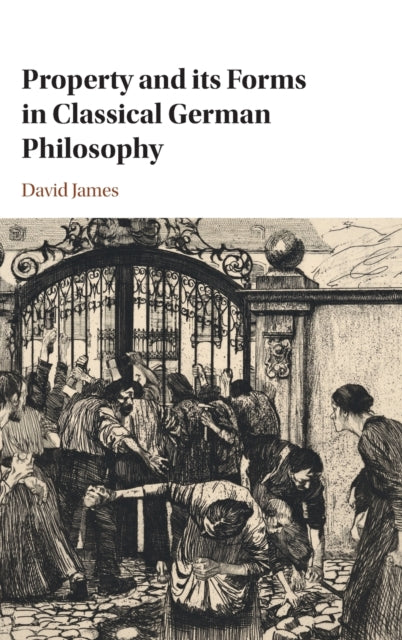
DavidJames
Property and its Forms in Classical German Philosophy
Property and its Forms in Classical German Philosophy
💎 Earn 387 Points (£3.87) on this item.
We can order this item for you. Delivery usually takes about 4 to 6 weeks.
This item is not held in our immediate stock. We will order it for you after checkout.
Estimated delivery: About 4 to 6 weeks
YOU SAVE £4.59
- Condition: Brand new
- UK Delivery times: Usually arrives within 2 - 3 working days
- UK Shipping: Fee starts at £2.39. Subject to product weight & dimension
Bulk ordering. Want 15 or more copies? Get a personalised quote and bigger discounts. Learn more about bulk orders.
Couldn't load pickup availability
- More about Property and its Forms in Classical German Philosophy
The theme of property is central to social and political issues, and David James reconstructs the theories of property developed by Kant, Fichte, Hegel, and Marx. He argues that social recognition plays a crucial role in these theories and assesses their arguments for specific forms of property.
Format: Hardback
Length: 214 pages
Publication date: 05 January 2023
Publisher: Cambridge University Press
The theme of property holds immense significance in contemporary society, intertwining with pressing social and political concerns such as wealth inequality and the debate over government intervention in limiting property rights. However, the very definition of property remains a subject of profound inquiry, often leading to a narrow focus on a single historical form of property ownership. In his book, David James delves into the theories of property developed by four influential figures in classical German philosophy: Kant, Fichte, Hegel, and Marx. Through a meticulous reconstruction of their ideas, James argues that while these philosophers may have diverse perspectives on property, the concept of social recognition emerges as a central theme across their theories. He assesses their arguments for specific forms of property that would align with a society committed to the ideals of freedom.
Kant's philosophy of property revolves around the idea of individual autonomy and the inherent value of human beings. He advocates for a system of private property that allows individuals to own and control their possessions, with the caveat that their actions should not infringe upon the rights of others. Kant's belief in the moral worth of individuals and their ability to make rational choices shapes his understanding of property rights.
Fichte, on the other hand, emphasizes the social nature of property and the role it plays in fostering individual freedom. He argues that property is not merely a physical object but a social construct that arises from the collective will of individuals. Fichte's vision of a society governed by the principle of "I will" emphasizes the importance of individual autonomy and the collective responsibility to ensure the well-being of all members.
Hegel's philosophy of property is rooted in his dialectical approach to understanding reality. He sees property as a dynamic entity that evolves through the interaction of individuals and social institutions. Hegel argues that property rights should be protected and expanded to ensure the greatest possible freedom for all individuals. He also emphasizes the importance of social recognition and the role that property plays in fostering social harmony.
Marx's philosophy of property is closely linked to his analysis of capitalism and the class struggle. He argues that property is a tool of exploitation and that the ownership of property is a means of consolidating power and wealth among the ruling class. Marx's vision of a socialist society where property is collectively owned and controlled aims to address the inequalities and injustices perpetuated by capitalism.
Through his comprehensive examination of these philosophers' theories, James highlights the common threads that unite their perspectives on property. He argues that social recognition plays a crucial role in shaping the nature and distribution of property rights. He also critiques their arguments and offers alternative perspectives on property ownership and governance.
In conclusion, The Theme of Property explores the complex and multifaceted concept of property, shedding light on the theories developed by four influential figures in classical German philosophy. By examining the concept of social recognition as a central theme across these theories, James offers a nuanced and insightful analysis of property rights and their implications for contemporary society. This book is a valuable resource for scholars, policymakers, and individuals interested in understanding the complexities of property ownership and the role it plays in shaping our world.
Weight: 466g
ISBN-13: 9781009288149
Edition number: New ed
This item can be found in:
UK and International shipping information
UK and International shipping information
UK Delivery and returns information:
- Delivery within 2 - 3 days when ordering in the UK.
- Shipping fee for UK customers from £2.39. Fully tracked shipping service available.
- Returns policy: Return within 30 days of receipt for full refund.
International deliveries:
Shulph Ink now ships to Australia, Belgium, Canada, France, Germany, Ireland, Italy, India, Luxembourg Saudi Arabia, Singapore, Spain, Netherlands, New Zealand, United Arab Emirates, United States of America.
- Delivery times: within 5 - 10 days for international orders.
- Shipping fee: charges vary for overseas orders. Only tracked services are available for most international orders. Some countries have untracked shipping options.
- Customs charges: If ordering to addresses outside the United Kingdom, you may or may not incur additional customs and duties fees during local delivery.