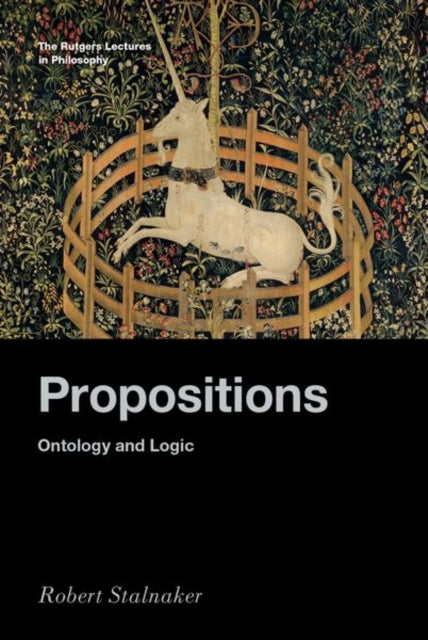
RobertStalnaker
Propositions: Ontology and Logic
Propositions: Ontology and Logic
💎 Earn 108 Points (£1.08) on this item.
YOU SAVE £1.29
- Condition: Brand new
- UK Delivery times: Usually arrives within 2 - 3 working days
- UK Shipping: Fee starts at £2.39. Subject to product weight & dimension
Bulk ordering. Want 15 or more copies? Get a personalised quote and bigger discounts. Learn more about bulk orders.
Couldn't load pickup availability
- More about Propositions: Ontology and Logic
Robert Stalnaker defends an ontology of propositions and uses it to justify an enrichment to modal logic for regimented languages that represent scientific and philosophical commitments. He adopts a neo-Quinean methodology and argues that the theory developed motivates and clarifies Quine's naturalistic metaphysical picture.
Format: Hardback
Length: 216 pages
Publication date: 12 April 2023
Publisher: Oxford University Press Inc
Distinguished philosopher Robert Stalnaker presents a comprehensive defense of an ontology of propositions and the logical tools employed to represent them in the third volume of the Rutgers Lectures in Philosophy series. He offers a rigorous formulation of a theory of propositions within a first-order extensional logic framework, but then leverages the commitments of this theory to justify an enrichment of modal logic as an appropriate framework for regimented languages designed to capture our scientific and philosophical commitments. Stalnaker's book adopts a self-consciously neo-Quinean methodology, arguing that the theory developed therein serves as a motivating force and clarifies Quine's naturalistic metaphysical perspective.
In the opening chapter, Stalnaker establishes the groundwork for his argument by exploring the nature of propositions and their role in our cognitive endeavors. He distinguishes between atomic propositions, which are indivisible and have truth values, and complex propositions, which are composed of atomic propositions and can have truth values. Stalnaker argues that complex propositions are the fundamental units of thought and that our cognitive capacities are primarily geared towards the manipulation and evaluation of complex propositions.
The second chapter delves into the formalization of a theory of propositions within a first-order extensional logic framework. Stalnaker introduces the concept of truth-functional dependencies, which are relations between propositions that hold solely in virtue of their truth values. He then defines a truth-functional logic as a formal system that operates on truth-functional dependencies and allows for the derivation of new propositions from existing ones. Stalnaker demonstrates how this formalization can be used to develop a theory of propositions that captures the essential features of our cognitive understanding of propositions.
In the third chapter, Stalnaker explores the implications of his theory of propositions for modal logic. He argues that modal logic is well-suited for regimented languages that are designed to represent our scientific and philosophical commitments. He introduces the concept of a regimented language, which is a language that is constructed to represent a specific set of commitments. Stalnaker then shows how his theory of propositions can be used to enrich modal logic with the necessary resources to handle the representation of these commitments.
The fourth chapter examines the relationship between Stalnaker's theory of propositions and Quine's naturalistic metaphysical picture. Stalnaker argues that Quine's naturalistic metaphysical perspective is compatible with his theory of propositions. He demonstrates how Quine's views on the individuation of entities and the reduction of metaphysics to natural science can be reconciled with the formalization of propositions provided by his theory.
In the final chapter, Stalnaker summarizes the main arguments of his book and offers some concluding remarks. He emphasizes the importance of understanding the nature of propositions and the logical resources employed to represent them. He also suggests that his theory of propositions can be used to develop a more comprehensive and coherent understanding of our cognitive capacities and the nature of reality.
Overall, Robert Stalnaker's book is a significant contribution to the field of philosophy. It offers a rigorous and comprehensive defense of an ontology of propositions and the logical tools employed to represent them. Stalnaker's theory of propositions provides a solid foundation for developing a more nuanced and sophisticated understanding of our cognitive capacities and the nature of reality. His book is a must-read for anyone interested in philosophy, cognitive science, and the foundations of mathematics.
Dimension: 210 x 140 (mm)
ISBN-13: 9780197647035
This item can be found in:
UK and International shipping information
UK and International shipping information
UK Delivery and returns information:
- Delivery within 2 - 3 days when ordering in the UK.
- Shipping fee for UK customers from £2.39. Fully tracked shipping service available.
- Returns policy: Return within 30 days of receipt for full refund.
International deliveries:
Shulph Ink now ships to Australia, Belgium, Canada, France, Germany, Ireland, Italy, India, Luxembourg Saudi Arabia, Singapore, Spain, Netherlands, New Zealand, United Arab Emirates, United States of America.
- Delivery times: within 5 - 10 days for international orders.
- Shipping fee: charges vary for overseas orders. Only tracked services are available for most international orders. Some countries have untracked shipping options.
- Customs charges: If ordering to addresses outside the United Kingdom, you may or may not incur additional customs and duties fees during local delivery.