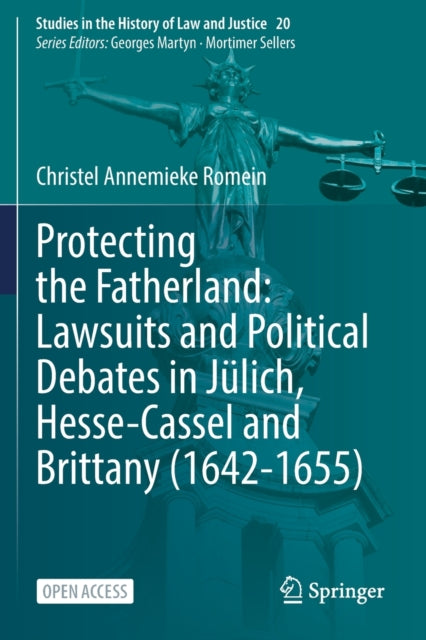
Christel Annemieke Romein
Protecting the Fatherland: Lawsuits and Political Debates in Julich, Hesse-Cassel and Brittany (1642-1655)
Protecting the Fatherland: Lawsuits and Political Debates in Julich, Hesse-Cassel and Brittany (1642-1655)
💎 Earn 144 Points (£1.44) on this item.
We can order this item for you. Delivery usually takes about 4 to 6 weeks.
This item is not held in our immediate stock. We will order it for you after checkout.
Estimated delivery: About 4 to 6 weeks
YOU SAVE £6.09
- Condition: Brand new
- UK Delivery times: Usually arrives within 2 - 3 working days
- UK Shipping: Fee starts at £2.39. Subject to product weight & dimension
Bulk ordering. Want 15 or more copies? Get a personalised quote and bigger discounts. Learn more about bulk orders.
Couldn't load pickup availability
- More about Protecting the Fatherland: Lawsuits and Political Debates in Julich, Hesse-Cassel and Brittany (1642-1655)
This book explores the use of fatherland terminology by the nobility in Jülich, Hesse-Cassel, and Brittany from 1642 to 1655, arguing that dynasties dominated the political arena and that the nobility used this terminology to object to princely politics. It provides insights into how the nobility safeguarded the welfare and prosperity of the fatherland and its inhabitants.
Format: Paperback / softback
Length: 218 pages
Publication date: 09 October 2021
Publisher: Springer Nature Switzerland AG
This open-access book offers a comprehensive comparative analysis of the usage of fatherland terminology in a political and legal context in Jülich, Hesse-Cassel, and Brittany from 1642 to 1655. Fatherland terminology encompasses terms such as patria, patriot, and nation, which were commonly employed by the noble class during this period. In the realm of historiography, the use of these words by the nobility is often interpreted as an early manifestation of nationalism, which conflicted with the princely initiative of state-building. The book posits that neither "states" nor "nationalism" truly existed at that time; rather, the political landscape was dominated by dynasties. Furthermore, it challenges the notion of deliberate state-building and demonstrates that the nobility employed this terminology as a means to oppose princely politics while assuming a "presupposed office." This status granted the nobility the ability to position themselves outside the traditional ruler-subject constellation and critique the prevailing circumstances.
The Duchy of Jülich and the Landgraviate of Hesse-Cassel serve as examples of small economies of scale characterized by homogeneous nobilities, where the impact of the Thirty Years War was particularly severe. This led to illegal tax levying and the billeting of soldiers, prompting the nobility to criticize princely politics. In contrast, the Duchy of Brittany, with its larger economy of scale and diverse nobility, adopted an alternative approach to pursuing its interests and maintaining low tax rates. The primary objective of this book is to explore and present three representative cases that shed light on how the nobility safeguarded the welfare and prosperity of the fatherland and its inhabitants.
In the Duchy of Jülich, the nobility utilized fatherland terminology to object to princely politics and challenge the authority. They sought to establish their authority and autonomy within the political sphere, positioning themselves as protectors of the fatherland and its inhabitants. The nobility in Jülich advocated for the rights and interests of the common people, often advocating for policies that favored the welfare of the community over the interests of the prince. They also sought to establish their own institutions and networks of power, such as the Jülich Academy, which aimed to promote education and scientific research.
In the Landgraviate of Hesse-Cassel, the nobility also employed fatherland terminology to object to princely politics and assert their authority. They sought to establish their own institutions and networks of power, such as the Hesse-Cassel Circle. The nobility in Hesse-Cassel advocated for the rights and interests of the common people, often advocating for policies that favored the welfare of the community over the interests of the prince. They also sought to establish their own institutions and networks of power, such as the Hesse-Cassel Academy, which aimed to promote education and scientific research.
In the Duchy of Brittany, the nobility utilized fatherland terminology to pursue their interests and maintain low tax rates. They sought to establish their own institutions and networks of power, such as the Brittany Academy, which aimed to promote education and scientific research. The nobility in Brittany advocated for the rights and interests of the common people, often advocating for policies that favored the welfare of the community over the interests of the prince. They also sought to establish their own institutions and networks of power, such as the Brittany Academy, which aimed to promote education and scientific research.
These three representative cases offer valuable insights into how the nobility safeguarded the welfare and prosperity of the fatherland and its inhabitants. They demonstrate that the nobility was not merely a passive actor in the political landscape but rather a proactive force that sought to establish their authority and autonomy within the political sphere. They also highlight the diverse approaches taken by the nobility in different regions, with some advocating for policies that favored the welfare of the community while others pursued their interests and maintained low tax rates. By examining these cases, this book contributes to our understanding of the complex and multifaceted nature of the nobility during the early modern period.
Weight: 379g
Dimension: 235 x 155 (mm)
ISBN-13: 9783030742423
Edition number: 1st ed. 2021
This item can be found in:
UK and International shipping information
UK and International shipping information
UK Delivery and returns information:
- Delivery within 2 - 3 days when ordering in the UK.
- Shipping fee for UK customers from £2.39. Fully tracked shipping service available.
- Returns policy: Return within 30 days of receipt for full refund.
International deliveries:
Shulph Ink now ships to Australia, Belgium, Canada, France, Germany, Ireland, Italy, India, Luxembourg Saudi Arabia, Singapore, Spain, Netherlands, New Zealand, United Arab Emirates, United States of America.
- Delivery times: within 5 - 10 days for international orders.
- Shipping fee: charges vary for overseas orders. Only tracked services are available for most international orders. Some countries have untracked shipping options.
- Customs charges: If ordering to addresses outside the United Kingdom, you may or may not incur additional customs and duties fees during local delivery.