MarcusColla
Prussia in the Historical Culture of the German Democratic Republic: Communists and Kings
Prussia in the Historical Culture of the German Democratic Republic: Communists and Kings
💎 Earn 570 Points (£5.70) on this item.
We can order this item for you. Delivery usually takes about 4 to 6 weeks.
This item is not held in our immediate stock. We will order it for you after checkout.
Estimated delivery: About 4 to 6 weeks
- Condition: Brand new
- UK Delivery times: Usually arrives within 2 - 3 working days
- UK Shipping: Fee starts at £2.39. Subject to product weight & dimension
Bulk ordering. Want 15 or more copies? Get a personalised quote and bigger discounts. Learn more about bulk orders.
Couldn't load pickup availability
- More about Prussia in the Historical Culture of the German Democratic Republic: Communists and Kings
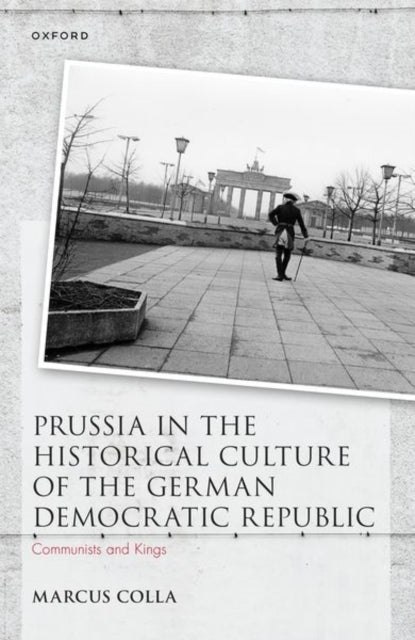
The Prussian state's history shows how the past was fluid in the German Democratic Republic, transforming from a symbol of militarism to one of celebration. Marcus Colla's book explores why this happened, looking at the roles of political figures, historians, cultural elites, heritage preservationists, and popular culture in constructing a unique historical culture.
Format: Hardback
Length: 336 pages
Publication date: 06 October 2022
Publisher: Oxford University Press
The history of the Prussian state in the German Democratic Republic (GDR) offers a remarkable illustration of the fluidity of the past within the country. Initially portrayed in East German official histories as the historical engine of German militarism and reaction, Prussia underwent a remarkable transformation in official and public memory from the late 1970s onwards. This transformative period is known as the "Prussia-Renaissance," during which the GDR began to recognize and even celebrate figures from Prussian history who had not necessarily served a progressive agenda. However, the Prussia-Renaissance was not just a political and cultural phenomenon; it had a significant impact on the wider public. While the Prussia-Renaissance may have been a relatively short-lived phenomenon, it left a deep vein in the historical memory of the GDR that defied reduction to high politics alone.
In order to explore the reasons behind this phenomenon, Marcus Colla employs a multi-perspective approach in his book. He examines the roles played by political figures, historians, cultural elites, heritage preservationists, exhibition curators, heimat museums, television producers, novelists, playwrights, singers, and other purveyors of popular culture. By doing so, Colla seeks to understand how a distinctive historical culture was constructed in the GDR.
Colla poses four fundamental questions for our understanding of life, politics, and culture in communist East Germany. Firstly, he asks how history was made in the GDR. Secondly, he explores how history was understood by the GDR's citizens. Thirdly, he examines how history was contested within the GDR. Finally, he examines how history was used by the GDR's government and society.
Through his comprehensive analysis, Colla demonstrates that the Prussia-Renaissance was not just a top-down initiative by the GDR's government. It was a complex and multifaceted phenomenon that involved a wide range of individuals and groups. Political figures, historians, cultural elites, and heritage preservationists played crucial roles in shaping the way government's approach to history. They worked to promote a positive image of Prussia and its role in German history, while also challenging negative stereotypes and promoting a more inclusive understanding of the past.
At the same time, the Prussia-Renaissance was also shaped by the broader cultural context of the GDR. The country's socialist ideology emphasized the importance of national identity and heritage, and the Prussian past was seen as a valuable part of that identity. The GDR's citizens, therefore, had a strong interest in learning about their country's history, particularly its Prussian heritage.
However, the Prussia-Renaissance was not without its challenges. Critics argued that the GDR was using history to promote a particular political agenda, and that it was ignoring or downplaying other aspects of German history that did not fit into its narrative. There were also concerns about the commercialization of history and the commodification of heritage, which some saw as a threat to the integrity of the past.
Despite these challenges, the Prussia-Renaissance had a significant impact on the historical memory of the GDR. It helped to promote a sense of national identity and pride, and it contributed to the development of a more inclusive and nuanced understanding of the past. The GDR's citizens were able to engage with their history in a way that was previously not possible, and it helped to bridge the gap between the past and the present.
In conclusion, the history of the Prussian state in the German Democratic Republic offers a powerful illustration of the fluidity of the past within the country. Initially attacked in East German official histories as the historical engine of German militarism and reaction, Prussia underwent a remarkable transformation in official and public memory from the late 1970s onwards. The Prussia-Renaissance was a complex and multifaceted phenomenon that involved a wide range of individuals and groups. It was shaped by the broader cultural context of the GDR, as well as by the government's desire to promote a positive image of Prussia and its role in German history. While the Prussia-Renaissance faced challenges, it had a significant impact on the historical memory of the GDR and helped to promote a sense of national identity and pride.
Weight: 694g
Dimension: 240 x 160 x 20 (mm)
ISBN-13: 9780192865908
This item can be found in:
UK and International shipping information
UK and International shipping information
UK Delivery and returns information:
- Delivery within 2 - 3 days when ordering in the UK.
- Shipping fee for UK customers from £2.39. Fully tracked shipping service available.
- Returns policy: Return within 30 days of receipt for full refund.
International deliveries:
Shulph Ink now ships to Australia, Belgium, Canada, France, Germany, Ireland, Italy, India, Luxembourg Saudi Arabia, Singapore, Spain, Netherlands, New Zealand, United Arab Emirates, United States of America.
- Delivery times: within 5 - 10 days for international orders.
- Shipping fee: charges vary for overseas orders. Only tracked services are available for most international orders. Some countries have untracked shipping options.
- Customs charges: If ordering to addresses outside the United Kingdom, you may or may not incur additional customs and duties fees during local delivery.