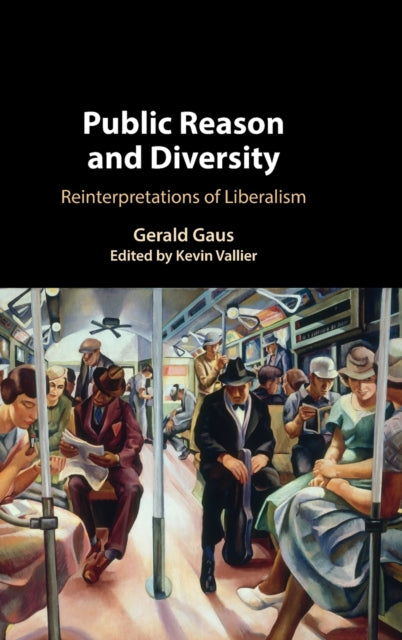
Gerald Gaus
Public Reason and Diversity: Reinterpretations of Liberalism
Public Reason and Diversity: Reinterpretations of Liberalism
💎 Earn 387 Points (£3.87) on this item.
We can order this item for you. Delivery usually takes about 4 to 6 weeks.
This item is not held in our immediate stock. We will order it for you after checkout.
Estimated delivery: About 4 to 6 weeks
YOU SAVE £4.59
- Condition: Brand new
- UK Delivery times: Usually arrives within 2 - 3 working days
- UK Shipping: Fee starts at £2.39. Subject to product weight & dimension
Bulk ordering. Want 15 or more copies? Get a personalised quote and bigger discounts. Learn more about bulk orders.
Couldn't load pickup availability
- More about Public Reason and Diversity: Reinterpretations of Liberalism
Gerald Gaus was a prominent liberal theorist who defended the liberal order's ability to handle diversity and disagreement. This book collects his most seminal and creative essays, covering a broad span of his career, including reasonable pluralism, moral rights, public reason, and the redistributive state. It is valuable for readers in political philosophy, political science, and economics.
Format: Hardback
Length: 300 pages
Publication date: 04 August 2022
Publisher: Cambridge University Press
Gerald Gaus, a prominent liberal theorist of the late 20th and early 21st centuries, emerged as a trailblazer in defending the liberal order. His groundbreaking defense hinged on the unique ability of the liberal system to navigate diversity and disagreement, fostering a principled openness to pluralism and diversity. This remarkable collection brings together Gaus's most seminal and innovative essays, spanning a broad range of his career. It includes previously unpublished pieces, as well as essays published shortly before his passing, covering topics such as reasonable pluralism, moral rights, public reason, and the redistributive state. The volume serves as a comprehensive gateway to the work of one of the most influential liberal thinkers of recent times, appealing to a wide audience, including political philosophy, political science, and economics enthusiasts.
Gaus's intellectual journey was marked by a profound commitment to promoting a society that values both individual freedom and social cohesion. He recognized that the liberal order, with its emphasis on individual rights and democratic governance, was well-suited to accommodating diverse perspectives and promoting peaceful coexistence. However, Gaus also believed that the liberal tradition needed to evolve to address emerging challenges and uphold its principles in the face of changing circumstances.
One of Gaus's most significant contributions was his defense of reasonable pluralism. He argued that the liberal order could accommodate a wide range of religious, cultural, and ideological beliefs without compromising its core values of individual freedom and equality. Gaus recognized that diversity was not a threat to the liberal order but rather an opportunity for it to thrive. He believed that by fostering a culture of respect and tolerance for different perspectives, the liberal system could promote social harmony and foster a sense of common purpose.
Gaus's work on moral rights was also groundbreaking. He argued that individuals have inherent moral rights, such as the right to life, liberty, and the pursuit of happiness. These rights are universal and apply to all individuals, regardless of their background or circumstances. Gaus believed that the liberal order should protect and promote these moral rights, ensuring that individuals are treated with dignity and respect.
In addition to his defense of individual rights, Gaus also emphasized the importance of public reason. He argued that the liberal order should be guided by a common set of rational principles that can be understood and accepted by all members of society. Public reason, Gaus believed, was essential for promoting democratic governance and ensuring that decisions are made in the public interest.
Gaus's work on the redistributive state was also influential. He argued that the liberal order should provide social welfare programs and policies to ensure that all individuals have access to basic needs, such as food, shelter, and healthcare. Gaus believed that the redistributive state was not only a moral obligation but also a necessary component of a just and equitable society.
Throughout his career, Gaus engaged with a wide range of thinkers and intellectuals, including political philosophers such as John Rawls and Robert Nozick, as well as social scientists such as Charles Wright and Amartya Sen. His work was deeply influenced by the social contract theory, which emphasizes the mutual agreement between individuals and the state to establish and maintain a just and peaceful society.
Gaus's legacy continues to inspire and influence liberal thinkers and policymakers around the world. His commitment to promoting individual freedom, social cohesion, and a principled openness to pluralism and diversity remains a guiding force in contemporary debates about political and social justice. This remarkable collection of essays serves as a testament to the enduring significance of Gerald Gaus's intellectual contributions to the field of liberal theory.
Weight: 551g
ISBN-13: 9781316512593
This item can be found in:
UK and International shipping information
UK and International shipping information
UK Delivery and returns information:
- Delivery within 2 - 3 days when ordering in the UK.
- Shipping fee for UK customers from £2.39. Fully tracked shipping service available.
- Returns policy: Return within 30 days of receipt for full refund.
International deliveries:
Shulph Ink now ships to Australia, Belgium, Canada, France, Germany, Ireland, Italy, India, Luxembourg Saudi Arabia, Singapore, Spain, Netherlands, New Zealand, United Arab Emirates, United States of America.
- Delivery times: within 5 - 10 days for international orders.
- Shipping fee: charges vary for overseas orders. Only tracked services are available for most international orders. Some countries have untracked shipping options.
- Customs charges: If ordering to addresses outside the United Kingdom, you may or may not incur additional customs and duties fees during local delivery.