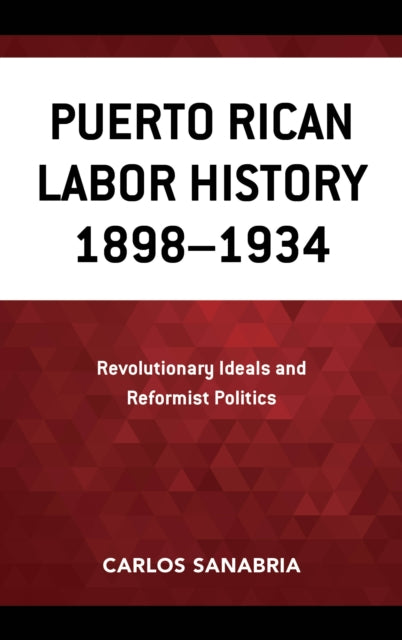
Carlos Sanabria
Puerto Rican Labor History 1898-1934: Revolutionary Ideals and Reformist Politics
Puerto Rican Labor History 1898-1934: Revolutionary Ideals and Reformist Politics
💎 Earn 451 Points (£4.51) on this item.
We can order this item for you. Delivery usually takes about 4 to 6 weeks.
This item is not held in our immediate stock. We will order it for you after checkout.
Estimated delivery: About 4 to 6 weeks
- Condition: Brand new
- UK Delivery times: Usually arrives within 2 - 3 working days
- UK Shipping: Fee starts at £2.39. Subject to product weight & dimension
Bulk ordering. Want 15 or more copies? Get a personalised quote and bigger discounts. Learn more about bulk orders.
Couldn't load pickup availability
- More about Puerto Rican Labor History 1898-1934: Revolutionary Ideals and Reformist Politics
This book presents a history of the organized labor movement in Puerto Rico from US colonial domination in 1898 to the Great Depression in the 1930s. Despite the early influence of revolutionary ideologies, the organized workers’ movement sought to create change through the organization of labor and participation in electoral politics.
Format: Hardback
Length: 162 pages
Publication date: 22 December 2017
Publisher: Lexington Books
From the United States' colonial rule of Puerto Rico in 1898 to the Great Depression in the early 1930s, Puerto Rican Labor History 1898–1934 chronicles the development of the organized labor movement on the island. Although revolutionary European socialist and anarchist ideas had a significant impact on the early twentieth-century Puerto Rican labor leaders, the organized labor movement, as represented by the Federación Libre de los Trabajadores de Puerto Rico and the Partido Socialista, evolved into a fundamentally reformist trade unionist campaign. Instead of calling for the overthrow of capitalism, the abolition of private property, and the wage labor system, and their replacement by a socialist egalitarian cooperative society free of centralized government authority, the organized workers movement focused on the immediate struggle for higher wages and better working conditions through labor organization and participation in electoral politics.
The early twentieth century saw the rise of several Puerto Rican labor leaders who were strongly influenced by revolutionary European socialist and anarchist ideology. These leaders, such as Luis Muñoz Marin and Pedro Albizu Campos, advocated for the overthrow of capitalism, the abolition of private property, and the wage labor system, and their replacement by a socialist egalitarian cooperative society free of centralized government authority. However, the organized workers movement in Puerto Rico, led by organizations such as the Federación Libre de los Trabajadores de Puerto Rico and the Partido Socialista, took a different approach. Instead of advocating for radical social change, these organizations focused on the immediate struggle for higher wages and better working conditions. They organized labor and participated in electoral politics to achieve these goals.
One of the key achievements of the organized workers movement in Puerto Rico was the establishment of the Puerto Rico Labor Union (PRLU). Founded in 1917, the PRLU was the first trade union in Puerto Rico to be recognized by the American Federation of Labor (AFL). The PRLU played a significant role in the struggle for higher wages and better working conditions for Puerto Rican workers. The union organized strikes, protests, and other forms of activism to pressure employers to improve working conditions and pay higher wages.
The PRLU also played a role in the political development of Puerto Rico. The union supported the island's independence from the United States and advocated for the creation of a socialist government that would provide social welfare programs and economic equality for all Puerto Ricans. The PRLU's support for these goals helped to shape the political landscape of Puerto Rico and contributed to the island's eventual independence from the United States in 1952.
Despite the PRLU's successes, the organized workers movement in Puerto Rico faced several challenges throughout the early twentieth century. One of the biggest challenges was the resistance of employers and the government to workers' demands for better working conditions and higher wages. Employers often resorted to violence and intimidation to suppress labor activism, and the government often cracked down on strikes and protests.
Another challenge for the organized workers movement was the lack of support from some sectors of Puerto Rican society. Some Puerto Ricans, particularly those who benefited from the island's economic status as a U.S. territory, were opposed to the idea of labor organization and advocated for maintaining the status quo. This opposition contributed to the marginalization of the organized workers movement and limited its ability to achieve its goals.
Despite these challenges, the organized workers movement in Puerto Rico continued to play a significant role in the struggle for social and economic justice for Puerto Rican workers. The movement's focus on the immediate struggle for higher wages and better working conditions helped to improve the lives of many Puerto Rican workers and contributed to the island's eventual independence from the United States. Today, the organized workers movement in Puerto Rico continues to be a powerful force for social and economic change on the island. The movement continues to advocate for workers' rights, social welfare programs, and economic equality for all Puerto Ricans.
In conclusion, Puerto Rican Labor History 1898–1934 presents a history of the organized labor movement in Puerto Rico from the United States' colonial domination of the island in 1898 to the Great Depression in the early 1930s. Although the most prominent Puerto Rican labor leaders in the early twentieth century were strongly influenced by revolutionary European socialist and anarchist ideology, the organized labor movement as represented by the Federación Libre de los Trabajadores de Puerto Rico and the Partido Socialista evolved into a fundamentally reformist trade unionist campaign that relied heavily on the democratic rights guaranteed by the United States government and the support of the American Federation of Labor. Rather than advocating for the overthrow of capitalism, the abolition of private property, and the wage labor system, and their replacement by a socialist egalitarian cooperative society free of centralized government authority, the organized workers movement focused on the immediate struggle for higher wages and better working conditions by means of the organization of labor and participation in electoral politics. The early twentieth century saw the rise of several Puerto Rican labor leaders who were strongly influenced by revolutionary European socialist and anarchist ideology. These leaders, such as Luis Muñoz Marin and Pedro Albizu Campos, advocated for the overthrow of capitalism, the abolition of private property, and the wage labor system, and their replacement by a socialist egalitarian cooperative society free of centralized government authority. However, the organized workers movement in Puerto Rico, led by organizations such as the Federación Libre de los Trabajadores de Puerto Rico and the Partido Socialista, took a different approach. Instead of advocating for radical social change, these organizations focused on the immediate struggle for higher wages and better working conditions. They organized labor and participated in electoral politics to achieve these goals. One of the key achievements of the organized workers movement in Puerto Rico was the establishment of the Puerto Rico Labor Union (PRLU). Founded in 1917, the PRLU was the first trade union in Puerto Rico to be recognized by the American Federation of Labor (AFL). The PRLU played a significant role in the struggle for higher wages and better working conditions for Puerto Rican workers. The union organized strikes, protests, and other forms of activism to pressure employers to improve working conditions and pay higher wages. The PRLU also played a role in the political development of Puerto Rico. The union supported the island's independence from the United States and advocated for the creation of a socialist government that would provide social welfare programs and economic equality for all Puerto Ricans. The PRLU's support for these goals helped to shape the political landscape of Puerto Rico and contributed to the island's eventual independence from the United States in 1952. Despite the PRLU's successes, the organized workers movement in Puerto Rico faced several challenges throughout the early twentieth century. One of the biggest challenges was the resistance of employers and the government to workers' demands for better working conditions and higher wages. Employers often resorted to violence and intimidation to suppress labor activism, and the government often cracked down on strikes and protests. Another challenge for the organized workers movement was the lack of support from some sectors of Puerto Rican society. Some Puerto Ricans, particularly those who benefited from the island's economic status as a U.S. territory, were opposed to the idea of labor organization and advocated for maintaining the status quo. This opposition contributed to the marginalization of the organized workers movement and limited its ability to achieve its goals. Despite these challenges, the organized workers movement in Puerto Rico continued to play a significant role in the struggle for social and economic justice for Puerto Rican workers. The movement's focus on the immediate struggle for higher wages and better working conditions helped to improve the lives of many Puerto Rican workers and contributed to the island's eventual independence from the United States. Today, the organized workers movement in Puerto Rico continues to be a powerful force for social and economic change on the island. The movement continues to advocate for workers' rights, social welfare programs, and economic equality for all Puerto Ricans.
Weight: 402g
Dimension: 162 x 237 x 20 (mm)
ISBN-13: 9781498537834
UK and International shipping information
UK and International shipping information
UK Delivery and returns information:
- Delivery within 2 - 3 days when ordering in the UK.
- Shipping fee for UK customers from £2.39. Fully tracked shipping service available.
- Returns policy: Return within 30 days of receipt for full refund.
International deliveries:
Shulph Ink now ships to Australia, Belgium, Canada, France, Germany, Ireland, Italy, India, Luxembourg Saudi Arabia, Singapore, Spain, Netherlands, New Zealand, United Arab Emirates, United States of America.
- Delivery times: within 5 - 10 days for international orders.
- Shipping fee: charges vary for overseas orders. Only tracked services are available for most international orders. Some countries have untracked shipping options.
- Customs charges: If ordering to addresses outside the United Kingdom, you may or may not incur additional customs and duties fees during local delivery.