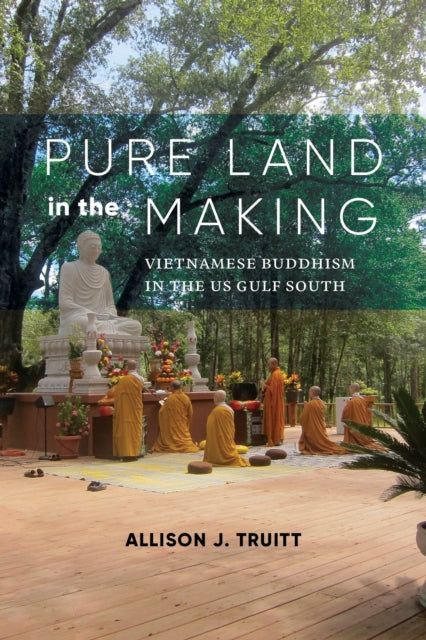
Allison J. Truitt
Pure Land in the Making: Vietnamese Buddhism in the US Gulf South
Pure Land in the Making: Vietnamese Buddhism in the US Gulf South
💎 Earn 175 Points (£1.75) on this item.
- Condition: Brand new
- UK Delivery times: Usually arrives within 2 - 3 working days
- UK Shipping: Fee starts at £2.39. Subject to product weight & dimension
Bulk ordering. Want 15 or more copies? Get a personalised quote and bigger discounts. Learn more about bulk orders.
Couldn't load pickup availability
- More about Pure Land in the Making: Vietnamese Buddhism in the US Gulf South
Buddhist temples in the Gulf Coast region have played a significant role in nurturing immigrant communities, particularly Vietnamese Americans, by providing a sense of community and hope. However, their experiences as migrants have influenced their religious practices and interpretations of Buddhist tenets, and organized religion has shaped their understanding of what it means to be Vietnamese in the United States. This ethnographic study explores the adaptation of Buddhist practices to fit American cultural contexts, including temple fundraising drives and the rebranding of the Vu Lan festival as Vietnamese Mother's Day. It also reveals the vital role these faith communities have played in helping Vietnamese Americans navigate challenges from racial discrimination to Hurricane Katrina.
Format: Paperback / softback
Length: 226 pages
Publication date: 15 February 2021
Publisher: University of Washington Press
Buddhist temples have played a significant role in the nurturing of immigrant communities in Louisiana, Florida, and other Gulf Coast states since the 1970s. Tens of thousands of Vietnamese immigrants have settled in these areas, rebuilding their lives after the wars in Indochina. For many, their faith has been an essential source of community and hope. However, how have their experiences as migrants influenced their religious practices and interpretations of Buddhist tenets? And how has organized religion shaped their understanding of what it means to be Vietnamese in the United States? This ethnographic study follows the monks and lay members of temples in the Gulf Coast region who practice Pure Land Buddhism, which is prevalent in East Asia but less familiar in the United States than forms such as Zen. By treating the temple as a site to be made and remade, Vietnamese Americans have developed approaches that sometimes contradict fundamental Buddhist principles of nonattachment. This book considers the adaptation of Buddhist practices to fit American cultural contexts, from temple fundraising drives to the rebranding of the Vu Lan festival as Vietnamese Mother's Day. It also reveals the vital role these faith communities have played in helping Vietnamese Americans navigate challenges from racial discrimination to Hurricane Katrina.
One of the key challenges facing Vietnamese immigrants in the United States is racial discrimination. Many Vietnamese immigrants face discrimination in employment, housing, and education, and they may also experience language barriers and cultural differences. Buddhist temples have played a crucial role in providing a sense of community and support for Vietnamese immigrants. They offer a place for people to gather and practice their faith, and they also provide services such as language classes, job training, and counseling.
One of the most significant ways that Buddhist temples have helped Vietnamese immigrants navigate racial discrimination is through the practice of mindfulness. Mindfulness is a practice that involves being present at the moment and paying attention to one's thoughts and feelings. Buddhist temples offer meditation classes and retreats that help people develop mindfulness skills. These skills can help people manage stress, anxiety, and depression, and they can also help people develop a more positive outlook on life.
Another way that Buddhist temples have helped Vietnamese immigrants navigate racial discrimination is through the practice of interfaith dialogue. Interfaith dialogue involves engaging with people of different religious backgrounds in order to learn about their beliefs and practices. Buddhist temples have hosted interfaith events and workshops that have brought together people of different faiths to discuss issues of social justice and human rights.
In addition to providing a sense of community and support, Buddhist temples have also played a role in helping Vietnamese immigrants navigate Hurricane Katrina. Many Vietnamese immigrants were displaced by the hurricane, and they lost their homes and belongings. Buddhist temples provided shelter and food to those who were affected by the hurricane, and they also provided counseling and support to those who were struggling with the emotional aftermath of the disaster.
One of the challenges that Buddhist temples face in the United States is the need to adapt their practices to fit American cultural contexts. For example, many Buddhist temples in the United States are located in urban areas, and they may need to adjust their services to meet the needs of urban residents. They may also need to address issues such as gender inequality and sexual harassment.
To address these challenges, Buddhist temples have developed a variety of strategies. For example, some temples have started to offer services such as yoga and tai chi, which are popular in the United States. They have also started to offer services such as meditation classes and retreats that are specifically designed for women and children.
In addition to adapting their practices to fit American cultural contexts, Buddhist temples have also played a role in promoting cultural exchange. They have hosted events and workshops that have brought together people of different cultures to learn about each other's beliefs and practices. They have also worked to promote cultural awareness and appreciation in the broader community.
Despite the challenges that Buddhist temples face in the United States, they continue to play a vital role in the nurturing of immigrant communities. They offer a place for people to gather and practice their faith, and they provide services that help people navigate challenges from racial discrimination to Hurricane Katrina. By adapting their practices to fit American cultural contexts, Buddhist temples can continue to play a vital role in the future of American society.
In conclusion, Buddhist temples have played a significant role in the nurturing of immigrant communities in Louisiana, Florida, and other Gulf Coast states since the 1970s. They offer a place for people to gather and practice their faith, and they provide services that help people navigate challenges from racial discrimination to Hurricane Katrina. By adapting their practices to fit American cultural contexts, Buddhist temples can continue to play a vital role in the future of American society.
Weight: 318g
Dimension: 229 x 152 (mm)
ISBN-13: 9780295748474
UK and International shipping information
UK and International shipping information
UK Delivery and returns information:
- Delivery within 2 - 3 days when ordering in the UK.
- Shipping fee for UK customers from £2.39. Fully tracked shipping service available.
- Returns policy: Return within 30 days of receipt for full refund.
International deliveries:
Shulph Ink now ships to Australia, Belgium, Canada, France, Germany, Ireland, Italy, India, Luxembourg Saudi Arabia, Singapore, Spain, Netherlands, New Zealand, United Arab Emirates, United States of America.
- Delivery times: within 5 - 10 days for international orders.
- Shipping fee: charges vary for overseas orders. Only tracked services are available for most international orders. Some countries have untracked shipping options.
- Customs charges: If ordering to addresses outside the United Kingdom, you may or may not incur additional customs and duties fees during local delivery.