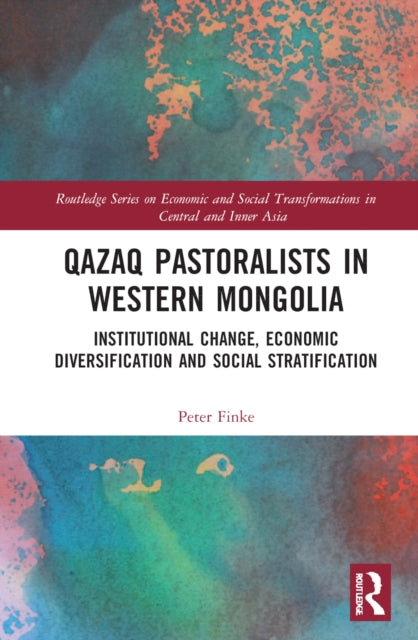
PeterFinke
Qazaq Pastoralists in Western Mongolia: Institutional Change, Economic Diversification and Social Stratification
Qazaq Pastoralists in Western Mongolia: Institutional Change, Economic Diversification and Social Stratification
💎 Earn 811 Points (£8.11) on this item.
We can order this item for you. Delivery usually takes about 4 to 6 weeks.
This item is not held in our immediate stock. We will order it for you after checkout.
Estimated delivery: About 4 to 6 weeks
YOU SAVE £9.63
- Condition: Brand new
- UK Delivery times: Usually arrives within 2 - 3 working days
- UK Shipping: Fee starts at £2.39. Subject to product weight & dimension
Bulk ordering. Want 15 or more copies? Get a personalised quote and bigger discounts. Learn more about bulk orders.
Couldn't load pickup availability
- More about Qazaq Pastoralists in Western Mongolia: Institutional Change, Economic Diversification and Social Stratification
This book examines the challenges and opportunities faced by pastoralists in Western Mongolia,who have experienced dramatic changes in recent decades,including the dismantling of the socialist economy,natural disasters,and emigration. It highlights the emergence of the market as the dominant mode of production and exchange,the individual household's adaptation to the new economic system,problems of collective action and institutional fragmentation,and the importance of social networks of mutual support and cooperation.
Format: Hardback
Length: 242 pages
Publication date: 31 August 2023
Publisher: Taylor & Francis Ltd
This book delves into the intricate interplay between individual flexibility and strategies for livelihood, alongside the social expectations that shape behavior and foster mutual trust and cooperation. By examining the case of Qazaq Pastoralists in Western Mongolia, the author sheds light on the universal human quest to strike a balance between personal autonomy and the demands of society.
In recent decades, Western Mongolia has undergone significant transformations, marked by the dismantling of the socialist economy, the occurrence of natural disasters, and a significant emigration of the local Qazaq minority to the newly independent state of Qazaqstan. These developments have presented pastoralists with a range of opportunities and challenges.
The first aspect to highlight is the emergence of the market as the dominant mode of production and exchange. This shift has brought about both uncertainties and opportunities. On the one hand, the market has facilitated the exchange of goods and services, leading to increased economic growth and development. On the other hand, it has also created a volatile and unpredictable environment, where individuals and households must navigate complex economic systems and adapt to rapidly changing market conditions.
The second aspect to examine is the individual household and its adaptation to the new economic system. This adaptation has led to the creation of new opportunities as well as precarities. On the one hand, individuals have been able to leverage their skills and resources to establish successful businesses and improve their livelihoods. On the other hand, the new economic system has resulted in rapid social stratification, with some individuals experiencing significant economic gains while others struggle to make ends meet.
The third aspect to consider is the patterns of pastoral land allocation, which highlight problems of collective action and institutional fragmentation in the wake of a retreating state apparatus. The state has historically played a significant role in managing pastoral land, ensuring fair distribution and preventing conflicts between different groups. However, with the decline of the state's authority, pastoral land allocation has become more decentralized, leading to tensions and conflicts over access to resources.
Finally, social networks of mutual support and cooperation constitute a key component of pastoral livelihood, but they are under great pressure due to short time horizons and a lack of trust. Pastoralists rely heavily on their social networks to cope with the challenges of their profession, including natural disasters, market fluctuations, and social tensions. However, these networks are often fragile, and the pressures of individualism and competition can undermine their effectiveness.
In conclusion, this book offers a comprehensive analysis of the opportunities and challenges faced by Qazaq Pastoralists in Western Mongolia. It provides a longitudinal perspective on the changes that have occurred in the region and highlights the intricate interplay between individual flexibility, strategies for livelihood, and social expectations. The book will be a valuable resource for academics in the fields of Central Asian Studies, Anthropology, Human Geography, and Development Studies, as it contributes to our understanding of human adaptability and decision-making, economic and social inequalities, institutional change, and the difficulty of deriving at cooperative solutions.
Dimension: 234 x 156 (mm)
ISBN-13: 9780367700850
This item can be found in:
UK and International shipping information
UK and International shipping information
UK Delivery and returns information:
- Delivery within 2 - 3 days when ordering in the UK.
- Shipping fee for UK customers from £2.39. Fully tracked shipping service available.
- Returns policy: Return within 30 days of receipt for full refund.
International deliveries:
Shulph Ink now ships to Australia, Belgium, Canada, France, Germany, Ireland, Italy, India, Luxembourg Saudi Arabia, Singapore, Spain, Netherlands, New Zealand, United Arab Emirates, United States of America.
- Delivery times: within 5 - 10 days for international orders.
- Shipping fee: charges vary for overseas orders. Only tracked services are available for most international orders. Some countries have untracked shipping options.
- Customs charges: If ordering to addresses outside the United Kingdom, you may or may not incur additional customs and duties fees during local delivery.