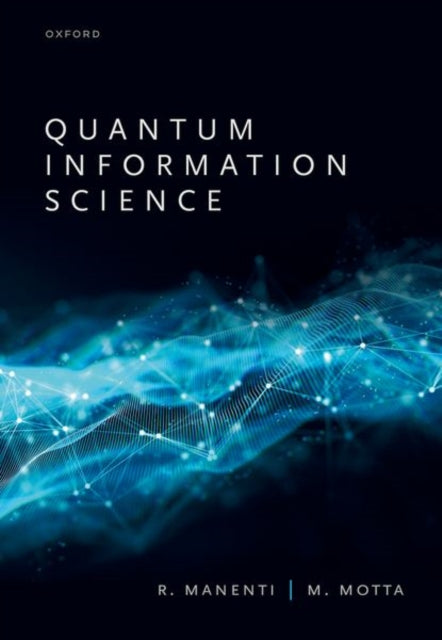
RiccardoManenti,MarioMotta
Quantum Information Science
Quantum Information Science
💎 Earn 287 Points (£2.87) on this item.
YOU SAVE £3.42
- Condition: Brand new
- UK Delivery times: Usually arrives within 2 - 3 working days
- UK Shipping: Fee starts at £2.39. Subject to product weight & dimension
Bulk ordering. Want 15 or more copies? Get a personalised quote and bigger discounts. Learn more about bulk orders.
Couldn't load pickup availability
- More about Quantum Information Science
This book provides an introduction to quantum information science, teaching readers to build and program a quantum computer and leverage its potential. Written by two professionals, it covers quantum algorithms, quantum chemistry, and quantum engineering of superconducting qubits.
Format: Hardback
Length: 768 pages
Publication date: 25 August 2023
Publisher: Oxford University Press
Quantum information science, the foundation of the new quantum revolution of this century, is introduced in this book. It teaches readers to construct and program quantum computers and harness their potential. Written by two experts in the experimental and theoretical fields of quantum information science, the book covers various topics such as quantum algorithms, quantum chemistry, and quantum engineering of superconducting qubits. With over 200 figures and 100 exercises with solutions and summaries at the end of each chapter, this book is poised to become the new standard in the field.
The field of quantum information science is a rapidly evolving and interdisciplinary area that is at the forefront of the new quantum revolution of this century. It encompasses the study of quantum systems and their interactions, as well as the development of technologies and algorithms that leverage the unique properties of quantum mechanics to perform computations and information processing that are impossible for classical computers.
One of the key aspects of quantum information science is the development of quantum computers. Quantum computers are machines that use quantum bits, or qubits, as their basic units of information. Qubits are particles that can exist in a superposition of states, which means that they can be in multiple states at the same time. This property allows quantum computers to perform certain computations much faster than classical computers, particularly for problems that involve searching large databases or simulating complex physical systems.
Another important area of quantum information science is quantum algorithms. Quantum algorithms are designed to exploit the properties of quantum mechanics to solve problems that are difficult for classical computers. For example, quantum algorithms can be used to perform factoring, which is a computationally intensive task that is used in cryptography and other fields. Quantum algorithms can also be used to simulate complex physical systems, such as molecules and atoms, which are difficult to model using classical computers.
Quantum information science also has applications in fields such as quantum chemistry and quantum engineering. Quantum chemistry is the study of the behavior of molecules and atoms using quantum mechanics. Quantum engineering is the application of quantum mechanics to the design and construction of new technologies. For example, quantum engineering can be used to design new materials that have unique properties, such as superconductivity, or to develop new sensors that are more sensitive and accurate than traditional sensors.
In conclusion, quantum information science is a rapidly evolving and interdisciplinary area that is at the forefront of the new quantum revolution of this century. It encompasses the study of quantum systems and their interactions, as well as the development of technologies and algorithms that leverage the unique properties of quantum mechanics to perform computations and information processing that are impossible for classical computers. The development of quantum computers, quantum algorithms, and quantum engineering has the potential to revolutionize many fields, from cryptography to materials science and engineering. As the field continues to evolve, it will be important to continue to invest in research and development to unlock the full potential of quantum information science and to address the challenges that remain.
Weight: 1600g
Dimension: 252 x 176 x 42 (mm)
ISBN-13: 9780198787488
UK and International shipping information
UK and International shipping information
UK Delivery and returns information:
- Delivery within 2 - 3 days when ordering in the UK.
- Shipping fee for UK customers from £2.39. Fully tracked shipping service available.
- Returns policy: Return within 30 days of receipt for full refund.
International deliveries:
Shulph Ink now ships to Australia, Belgium, Canada, France, Germany, Ireland, Italy, India, Luxembourg Saudi Arabia, Singapore, Spain, Netherlands, New Zealand, United Arab Emirates, United States of America.
- Delivery times: within 5 - 10 days for international orders.
- Shipping fee: charges vary for overseas orders. Only tracked services are available for most international orders. Some countries have untracked shipping options.
- Customs charges: If ordering to addresses outside the United Kingdom, you may or may not incur additional customs and duties fees during local delivery.