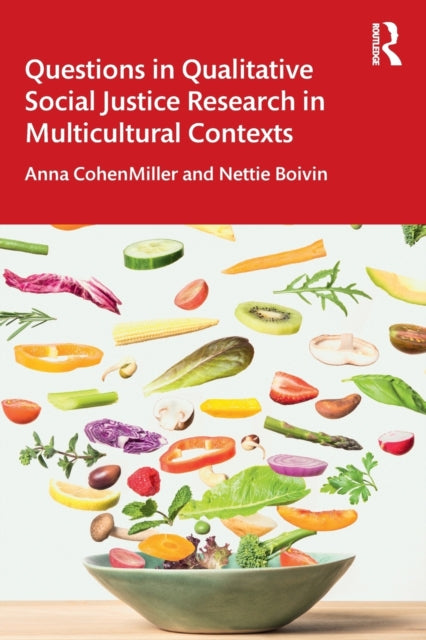
Anna CohenMiller,Nettie Boivin
Questions in Qualitative Social Justice Research in Multicultural Contexts
Questions in Qualitative Social Justice Research in Multicultural Contexts
💎 Earn 226 Points (£2.26) on this item.
We can order this item for you. Delivery usually takes about 4 to 6 weeks.
This item is not held in our immediate stock. We will order it for you after checkout.
Estimated delivery: About 4 to 6 weeks
YOU SAVE £2.69
- Condition: Brand new
- UK Delivery times: Usually arrives within 2 - 3 working days
- UK Shipping: Fee starts at £2.39. Subject to product weight & dimension
Bulk ordering. Want 15 or more copies? Get a personalised quote and bigger discounts. Learn more about bulk orders.
Couldn't load pickup availability
- More about Questions in Qualitative Social Justice Research in Multicultural Contexts
This book provides practical guidance for students designing, implementing, and analyzing multicultural research data, and reflecting on multicultural research issues in context. It emphasizes key themes in multicultural contexts, such as the nature of power, and guides researchers towards a truly collaborative research process.
\n Format: Paperback / softback
\n Length: 230 pages
\n Publication date: 27 October 2021
\n Publisher: Taylor & Francis Ltd
\n
Here is the rephrased text:
Exploring the Complexities of Multiculturalism: A Comprehensive Guide
In today's increasingly diverse and interconnected world, understanding multiculturalism has become crucial for individuals, organizations, and societies alike. Multiculturalism refers to the presence of multiple cultural groups within a single society or community, each with its unique traditions, beliefs, values, and practices. This rich tapestry of diversity can bring both challenges and opportunities, as it requires us to navigate complex social dynamics, appreciate different perspectives, and foster inclusivity.
This comprehensive guide aims to provide a comprehensive understanding of multiculturalism, its origins, theories, and practical applications. We will explore the historical context of multiculturalism, examining how it has evolved over time and its impact on societies and individuals. We will also delve into the theoretical frameworks that underpin multiculturalism, such as cultural relativism, critical multiculturalism, and hybridity.
Through extensive use of case studies and real-life experiences, we will demonstrate the practical outcomes of research in multicultural contexts. We will showcase how researchers have approached diverse populations, collected data, and analyzed it to shed light on important issues such as identity, prejudice, discrimination, and social integration.
Furthermore, this guide will offer practical guidance for students embarking on designing, implementing, and analyzing multicultural research data. We will discuss the challenges and ethical considerations involved in conducting research with diverse populations, and provide tips and techniques for ensuring the validity and reliability of research findings.
In addition, we will examine and emphasize key themes in multicultural contexts, such as the nature of power, cultural hierarchies, and the dynamics of cultural change. We will guide researchers towards a truly collaborative research process, emphasizing the importance of building relationships, respecting cultural differences, and engaging in reflexive and ethical practices.
By the end of this guide, readers will have a deeper appreciation of the complexities of multiculturalism, and the tools and skills necessary to navigate its challenges and seize its opportunities. Multiculturalism is not just a theoretical concept; it is a lived reality that requires us to be open-minded, empathetic, and committed to promoting diversity and inclusivity in all aspects of our lives.
Understanding Multiculturalism:
Multiculturalism is a complex phenomenon that has evolved over centuries, shaped by historical events, migration patterns, and cultural exchange. It refers to the presence of multiple cultural groups within a single society or community, each with its unique traditions, beliefs, values, and practices. Multiculturalism can be observed in various contexts, including countries, cities, workplaces, and educational institutions.
Historical Context:
Multiculturalism has a rich historical context, dating back to ancient times when different civilizations interacted and exchanged ideas. The concept of multiculturalism gained prominence in the 20th century, particularly in response to the rise of globalization, which facilitated the movement of people across borders and the exchange of cultural practices.
The 20th century saw significant waves of immigration, leading to the growth of multicultural communities in many countries. This migration brought with it a diverse range of cultures, languages, religions, and customs, which challenged traditional notions of identity and belonging. As a result, multiculturalism became a political and social movement aimed at promoting diversity, inclusivity, and social justice.
Theoretical Frameworks:
Multiculturalism is underpinned by various theoretical frameworks that provide different perspectives on the nature of cultural diversity and its impact on society. Some of the most influential theoretical frameworks include:
Cultural Relativism: Cultural relativism suggests that each culture has its own unique set of beliefs, values, and practices, and that these should be respected and understood. It emphasizes the importance of avoiding cultural imperialism and promoting cultural exchange and dialogue.
Critical Multiculturalism: Critical multiculturalism challenges the dominant narratives and power structures that perpetuate cultural inequality and discrimination. It emphasizes the need for social and political change to address the systemic issues that contribute to cultural marginalization.
Hybridity: Hybridity refers to the blending of different cultural elements and the creation of new cultural forms. It recognizes the fluidity and adaptability of cultures and the potential for hybrid identities and practices.
Practical Applications:
Multiculturalism has practical applications in various fields, including education, healthcare, politics, and social work. In education, multiculturalism promotes cultural diversity and inclusivity, enabling students to learn from and appreciate different perspectives. It also promotes cross-cultural understanding and empathy, which are essential for building inclusive and equitable societies.
In healthcare, multiculturalism ensures that healthcare providers are aware of and sensitive to the cultural backgrounds and beliefs of their patients. It promotes patient-centered care, which takes into account the patient's cultural context and preferences.
In politics, multiculturalism promotes diversity and inclusivity in decision-making processes. It recognizes the importance of representing diverse communities and ensuring that their voices are heard and considered.
In social work, multiculturalism promotes social justice and the empowerment of marginalized communities. It emphasizes the importance of addressing the social and economic factors that contribute to cultural marginalization and promoting social integration.
Case Studies and Real-Life Experiences:
To demonstrate the practical outcomes of research in multicultural contexts, this guide will include extensive use of case studies and real-life experiences. These case studies will showcase how researchers have approached diverse populations, collected data, and analyzed it to shed light on important issues such as identity, prejudice, discrimination, and social integration.
For example, one case study may explore the experiences of immigrants in a particular country, examining their challenges and successes in integrating into the local community. Another case study may examine the impact of cultural differences on healthcare outcomes, highlighting the importance of culturally sensitive care.
Conclusion:
In conclusion, understanding multiculturalism is crucial for individuals, organizations, and societies to navigate the complexities of our increasingly diverse and interconnected world. Multiculturalism brings both challenges and opportunities, as it requires us to appreciate different perspectives, foster inclusivity, and address social inequalities.
This comprehensive guide aims to provide a comprehensive understanding of multiculturalism, its origins, theories, and practical applications. Through extensive use of case studies and real-life experiences, we will demonstrate the practical outcomes of research in multicultural contexts and offer practical guidance for students designing, implementing, and analyzing multicultural research data.
By the end of this guide, readers will have a deeper appreciation of the complexities of multiculturalism, and the tools and skills necessary to navigate its challenges and seize its opportunities. Multiculturalism is not just a theoretical concept; it is a lived reality that requires us to be open-minded, empathetic, and committed to promoting diversity and inclusivity in all aspects of our lives.
\n Weight: 404g\n
Dimension: 154 x 233 x 20 (mm)\n
ISBN-13: 9780367250409\n \n
This item can be found in:
UK and International shipping information
UK and International shipping information
UK Delivery and returns information:
- Delivery within 2 - 3 days when ordering in the UK.
- Shipping fee for UK customers from £2.39. Fully tracked shipping service available.
- Returns policy: Return within 30 days of receipt for full refund.
International deliveries:
Shulph Ink now ships to Australia, Belgium, Canada, France, Germany, Ireland, Italy, India, Luxembourg Saudi Arabia, Singapore, Spain, Netherlands, New Zealand, United Arab Emirates, United States of America.
- Delivery times: within 5 - 10 days for international orders.
- Shipping fee: charges vary for overseas orders. Only tracked services are available for most international orders. Some countries have untracked shipping options.
- Customs charges: If ordering to addresses outside the United Kingdom, you may or may not incur additional customs and duties fees during local delivery.