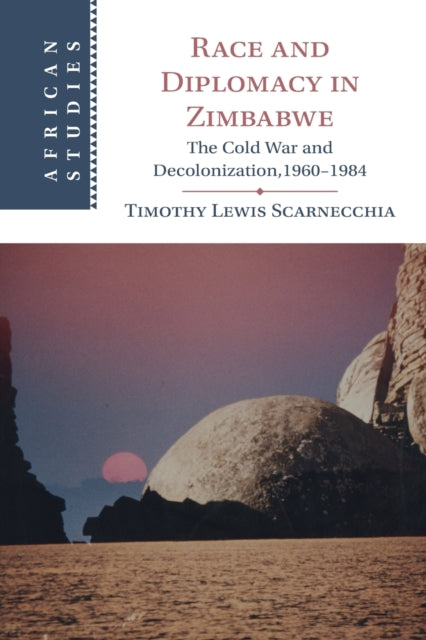
Timothy LewisScarnecchia
Race and Diplomacy in Zimbabwe: The Cold War and Decolonization,1960-1984
Race and Diplomacy in Zimbabwe: The Cold War and Decolonization,1960-1984
💎 Earn 118 Points (£1.18) on this item.
We can order this item for you. Delivery usually takes about 4 to 6 weeks.
This item is not held in our immediate stock. We will order it for you after checkout.
Estimated delivery: About 4 to 6 weeks
YOU SAVE £1.40
- Condition: Brand new
- UK Delivery times: Usually arrives within 2 - 3 working days
- UK Shipping: Fee starts at £2.39. Subject to product weight & dimension
Bulk ordering. Want 15 or more copies? Get a personalised quote and bigger discounts. Learn more about bulk orders.
Couldn't load pickup availability
- More about Race and Diplomacy in Zimbabwe: The Cold War and Decolonization,1960-1984
The Rhodesian crisis and the early-1980s crisis of independent Zimbabwe were influenced by Cold War historical transformations, including African decolonization, the failure of American power in Vietnam, and the rise of Third World political power. Timothy Scarnecchia's book examines the rivalry between Joshua Nkomo and Robert Mugabe and how foreign relations bureaucracies in the US, UK, and South Africa created a Cold War race state notion of Zimbabwe that rationalized Mugabe's state crimes in return for Cold War loyalty to Western powers.
Format: Paperback / softback
Length: 368 pages
Publication date: 09 March 2023
Publisher: Cambridge University Press
The Rhodesian crisis of the 1960s and 1970s, as well as the early-1980s crisis of independent Zimbabwe, can be comprehended within the context of the historical transformations wrought by the Cold War. These transformations were influenced by various factors, including African decolonization in the 1960s, the failure of American power in Vietnam, and the rise of Third World political power. In this examination of the diplomacy of decolonization in Zimbabwe, Timothy Scarnecchia delves into the rivalry between Joshua Nkomo and Robert Mugabe. He explores how both leaders capitalized on Cold War racialized thinking about what Zimbabwe should be. Scarnecchia's research is based on a wealth of archival source materials, which he uses to uncover how foreign relations bureaucracies in the US, UK, and South Africa created a Cold War race state notion of Zimbabwe. This notion allowed them to rationalize Mugabe's state crimes in exchange for Cold War loyalty to Western powers.
The Rhodesian crisis of the 1960s and 1970s, as well as the early-1980s crisis of independent Zimbabwe, can be comprehended within the context of the historical transformations wrought by the Cold War. These transformations were influenced by various factors, including African decolonization in the 1960s, the failure of American power in Vietnam, and the rise of Third World political power. In this examination of the diplomacy of decolonization in Zimbabwe, Timothy Scarnecchia delves into the rivalry between Joshua Nkomo and Robert Mugabe. He explores how both leaders capitalized on Cold War racialized thinking about what Zimbabwe should be. Scarnecchia's research is based on a wealth of archival source materials, which he uses to uncover how foreign relations bureaucracies in the US, UK, and South Africa created a Cold War race state notion of Zimbabwe. This notion allowed them to rationalize Mugabe's state crimes in exchange for Cold War loyalty to Western powers.
The Rhodesian crisis of the 1960s and 1970s, as well as the early-1980s crisis of independent Zimbabwe, can be comprehended within the context of the historical transformations wrought by the Cold War. These transformations were influenced by various factors, including African decolonization in the 1960s, the failure of American power in Vietnam, and the rise of Third World political power. In this examination of the diplomacy of decolonization in Zimbabwe, Timothy Scarnecchia delves into the rivalry between Joshua Nkomo and Robert Mugabe. He explores how both leaders capitalized on Cold War racialized thinking about what Zimbabwe should be. Scarnecchia's research is based on a wealth of archival source materials, which he uses to uncover how foreign relations bureaucracies in the US, UK, and South Africa created a Cold War race state notion of Zimbabwe. This notion allowed them to rationalize Mugabe's state crimes in exchange for Cold War loyalty to Western powers.
The Rhodesian crisis of the 1960s and 1970s, as well as the early-1980s crisis of independent Zimbabwe, can be comprehended within the context of the historical transformations wrought by the Cold War. These transformations were influenced by various factors, including African decolonization in the 1960s, the failure of American power in Vietnam, and the rise of Third World political power. In this examination of the diplomacy of decolonization in Zimbabwe, Timothy Scarnecchia delves into the rivalry between Joshua Nkomo and Robert Mugabe. He explores how both leaders capitalized on Cold War racialized thinking about what Zimbabwe should be. Scarnecchia's research is based on a wealth of archival source materials, which he uses to uncover how foreign relations bureaucracies in the US, UK, and South Africa created a Cold War race state notion of Zimbabwe. This notion allowed them to rationalize Mugabe's state crimes in exchange for Cold War loyalty to Western powers.
ISBN-13: 9781009281706
Edition number: Revised ed
UK and International shipping information
UK and International shipping information
UK Delivery and returns information:
- Delivery within 2 - 3 days when ordering in the UK.
- Shipping fee for UK customers from £2.39. Fully tracked shipping service available.
- Returns policy: Return within 30 days of receipt for full refund.
International deliveries:
Shulph Ink now ships to Australia, Belgium, Canada, France, Germany, Ireland, Italy, India, Luxembourg Saudi Arabia, Singapore, Spain, Netherlands, New Zealand, United Arab Emirates, United States of America.
- Delivery times: within 5 - 10 days for international orders.
- Shipping fee: charges vary for overseas orders. Only tracked services are available for most international orders. Some countries have untracked shipping options.
- Customs charges: If ordering to addresses outside the United Kingdom, you may or may not incur additional customs and duties fees during local delivery.