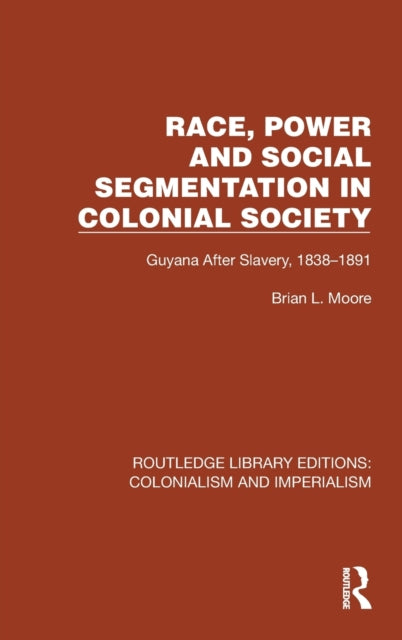
Brian L. Moore
Race, Power and Social Segmentation in Colonial Society: Guyana After Slavery, 1838-1891
Race, Power and Social Segmentation in Colonial Society: Guyana After Slavery, 1838-1891
💎 Earn 775 Points (£7.75) on this item.
We can order this item for you. Delivery usually takes about 4 to 6 weeks.
This item is not held in our immediate stock. We will order it for you after checkout.
Estimated delivery: About 4 to 6 weeks
- Condition: Brand new
- UK Delivery times: Usually arrives within 2 - 3 working days
- UK Shipping: Fee starts at £2.39. Subject to product weight & dimension
Bulk ordering. Want 15 or more copies? Get a personalised quote and bigger discounts. Learn more about bulk orders.
Couldn't load pickup availability
- More about Race, Power and Social Segmentation in Colonial Society: Guyana After Slavery, 1838-1891
Race, Power and Social Segmentation in Colonial Society (1987) explores social classes and ethnic groups in Guyana after slavery, addressing pluralism versus stratification and providing a detailed interdisciplinary analysis of structural change over half a century.
Format: Hardback
Length: 322 pages
Publication date: 03 May 2023
Publisher: Taylor & Francis Ltd
In 1987, renowned sociologist Eric Hobsbawm published "Race, Power and Social Segmentation in Colonial Society," a groundbreaking study that delved into the intricate dynamics of Guyanese society following the abolition of slavery. This comprehensive work not only examined the realm of social classes and ethnic groups but also delved into the theoretical complexities surrounding the debate on pluralism versus stratification. Moreover, it offered a thorough interdisciplinary analysis of the profound structural transformations that occurred within a composite colonial society over a remarkable span of half a century.
Hobsbawm's study shed light on the complex interplay of race, power, and social stratification in the post-slavery era. He explored how these factors shaped the lives of individuals and communities, contributing to the formation of distinct social hierarchies and divisions. Through meticulous research and analysis, Hobsbawm demonstrated how colonialism had created a hierarchical structure that perpetuated inequality and discrimination, with certain groups enjoying privileges and benefits while others faced marginalization and oppression.
One of the key themes of "Race, Power and Social Segmentation in Colonial Society" was the concept of social classes. Hobsbawm argued that the colonial period had witnessed the emergence of a new social order characterized by the dominance of a small elite class, which wielded significant economic and political power. This elite class, often drawn from the ruling elites of the colonizing nations, had the ability to control resources, exploit labor, and maintain their dominance through a system of patronage and coercion.
At the same time, Hobsbawm recognized the existence of a broader middle class, composed of individuals who had gained some economic and social mobility through education, entrepreneurship, or government service. However, this middle class was often limited in its influence and power, as it was subject to the dictates of the elite class and the colonial government.
In addition to social classes, Hobsbawm also examined the role of ethnic groups in shaping colonial society. He noted that the colonial powers had often used race as a tool to divide and control populations, creating distinct ethnic identities that served to reinforce social hierarchies and divisions. For example, in Guyana, the colonial government had promoted the development of a Creole elite class, which was seen as superior to the indigenous Amerindian and African populations.
Hobsbawm's study also explored the mechanisms through which structural change occurred in colonial societies. He argued that the process of structural transformation was driven by a combination of internal and external factors, including economic development, political instability, and social movements. For instance, in Guyana, the abolition of slavery in 1833 had led to a period of economic growth and development, which had created opportunities for individuals from marginalized communities to rise up and challenge the dominant elite class.
However, this period of structural change was also marked by political instability and social unrest, as different ethnic groups sought to assert their dominance and claim their rightful place in the social hierarchy. This led to a period of conflict and violence, as the colonial government struggled to maintain order and control over the diverse and complex society.
In conclusion, "Race, Power and Social Segmentation in Colonial Society" by Eric Hobsbawm is a seminal work that provides a comprehensive and insightful analysis of the complex dynamics of Guyanese society following the abolition of slavery. Through his interdisciplinary approach, Hobsbawm shed light on the role of race, power, and social classes in shaping colonial society and the processes through which structural change occurred. This study remains a valuable contribution to the field of sociology and colonial studies, offering valuable insights into the enduring legacies of colonialism and the challenges faced by post-colonial societies in the pursuit of social justice and equality.
Weight: 630g
Dimension: 160 x 243 x 26 (mm)
ISBN-13: 9781032456188
This item can be found in:
UK and International shipping information
UK and International shipping information
UK Delivery and returns information:
- Delivery within 2 - 3 days when ordering in the UK.
- Shipping fee for UK customers from £2.39. Fully tracked shipping service available.
- Returns policy: Return within 30 days of receipt for full refund.
International deliveries:
Shulph Ink now ships to Australia, Belgium, Canada, France, Germany, Ireland, Italy, India, Luxembourg Saudi Arabia, Singapore, Spain, Netherlands, New Zealand, United Arab Emirates, United States of America.
- Delivery times: within 5 - 10 days for international orders.
- Shipping fee: charges vary for overseas orders. Only tracked services are available for most international orders. Some countries have untracked shipping options.
- Customs charges: If ordering to addresses outside the United Kingdom, you may or may not incur additional customs and duties fees during local delivery.