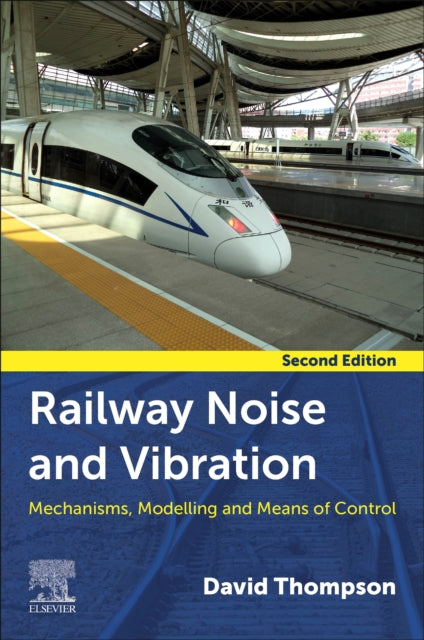
DavidThompson
Railway Noise and Vibration: Mechanisms, Modelling, and Means of Control
Railway Noise and Vibration: Mechanisms, Modelling, and Means of Control
💎 Earn 937 Points (£9.37) on this item.
YOU SAVE £17.42
- Condition: Brand new
- UK Delivery times: Usually arrives within 2 - 3 working days
- UK Shipping: Fee starts at £2.39. Subject to product weight & dimension
Bulk ordering. Want 15 or more copies? Get a personalised quote and bigger discounts. Learn more about bulk orders.
Couldn't load pickup availability
- More about Railway Noise and Vibration: Mechanisms, Modelling, and Means of Control
Railway Noise and Vibration: Mechanisms, Modelling, and Means of Control, 2nd Edition is a comprehensive guide to rail noise and vibration theory and modeling, covering sources, theoretical approaches, and practical implementations with examples of noise control technology. It is essential for professionals working in the railway industry to address noise and vibration issues for high-speed intercity traffic, freight, and suburban metros, and light-rail systems.
Format: Paperback / softback
Length: 608 pages
Publication date: 23 February 2024
Publisher: Elsevier Science Publishing Co Inc
Railway Noise and Vibration: Mechanisms, Modelling, and Means of Control, 2nd Edition presents a comprehensive and up-to-date overview of the state-of-the-art in rail noise and vibration theory and modelling. This comprehensive text delves into the various sources of noise and vibration encountered in railways, including rolling noise, curve squeal, bridge noise, aerodynamic noise, ground vibration, and ground-borne noise, as well as vehicle interior noise. It systematically covers relevant theoretical modelling approaches and their practical implementation, providing extensive examples of noise control technology applied at the source.
Noise and vibration pose significant challenges to the further development of railway networks worldwide for high-speed intercity traffic, freight, suburban metros, and light-rail systems. In many cases, noise problems are inadequately addressed due to a lack of understanding of the underlying causes. This new edition of Railway Noise and Vibration serves as an invaluable reference for professionals working in the field of noise and vibration from railways, whether they are involved in industry, consultancy, or academic research.
The book begins by providing an introduction to the mechanisms and sources of noise and vibration in railways. It explains the physical principles governing these phenomena and discusses the various factors that contribute to their generation, such as wheel-rail contact, track irregularities, and vehicle dynamics. The authors then delve into the theoretical modelling approaches used to predict and control noise and vibration. They discuss the advantages and limitations of different modelling techniques, such as finite element analysis, modal analysis, and experimental methods, and provide examples of their practical application in railway noise and vibration control.
In the subsequent chapters, the book covers each source of noise and vibration in detail. It provides a comprehensive description of the mechanisms behind these phenomena, including the generation of sound waves, vibration transmission, and the interaction between different components of the railway system. The authors also discuss the measurement techniques used to assess noise and vibration levels and the criteria for evaluating the effectiveness of noise control measures.
Throughout the text, extensive examples of noise control technology applied at the source are provided. These examples include the use of noise barriers, vibration isolation systems, acoustic liners, and active noise control technologies. The authors discuss the design and implementation of these technologies, as well as their performance in reducing noise and vibration levels in real-world railway environments.
In addition to its technical content, Railway Noise and Vibration also includes chapters on the regulatory framework and policy considerations related to noise and vibration from railways. It discusses the legal requirements and standards set by governments and regulatory bodies worldwide and the strategies employed by railway operators to manage noise and vibration in a sustainable and environmentally friendly manner.
The book concludes with a summary of the key findings and recommendations presented throughout the text. It highlights the importance of a comprehensive understanding of noise and vibration in railways and emphasizes the need for ongoing research and development in this field to improve the safety, comfort, and efficiency of railway operations.
In conclusion, Railway Noise and Vibration: Mechanisms, Modelling, and Means of Control, 2nd Edition is an essential resource for professionals working in the field of noise and vibration from railways. It provides a comprehensive and up-to-date overview of the state-of-the-art in rail noise and vibration theory and modelling, covering a wide range of topics from mechanisms and sources to theoretical modelling approaches and practical implementation. With its extensive examples of noise control technology applied at the source and its focus on the regulatory framework and policy considerations, this book is an invaluable reference for all those seeking to improve the noise and vibration performance of railways.
Dimension: 229 x 151 (mm)
ISBN-13: 9780128219799
Edition number: 2 ed
This item can be found in:
UK and International shipping information
UK and International shipping information
UK Delivery and returns information:
- Delivery within 2 - 3 days when ordering in the UK.
- Shipping fee for UK customers from £2.39. Fully tracked shipping service available.
- Returns policy: Return within 30 days of receipt for full refund.
International deliveries:
Shulph Ink now ships to Australia, Belgium, Canada, France, Germany, Ireland, Italy, India, Luxembourg Saudi Arabia, Singapore, Spain, Netherlands, New Zealand, United Arab Emirates, United States of America.
- Delivery times: within 5 - 10 days for international orders.
- Shipping fee: charges vary for overseas orders. Only tracked services are available for most international orders. Some countries have untracked shipping options.
- Customs charges: If ordering to addresses outside the United Kingdom, you may or may not incur additional customs and duties fees during local delivery.