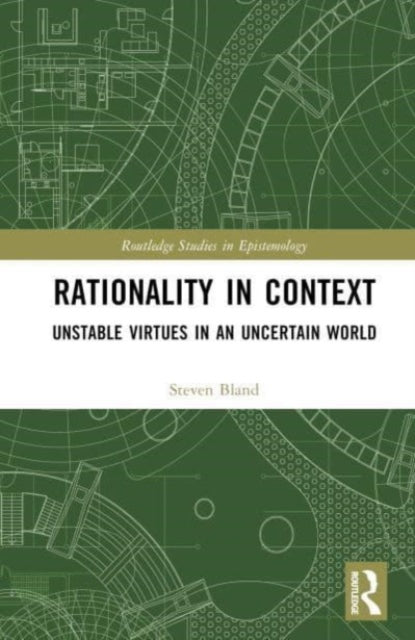
StevenBland
Rationality in Context: Unstable Virtues in an Uncertain World
Rationality in Context: Unstable Virtues in an Uncertain World
💎 Earn 811 Points (£8.11) on this item.
We can order this item for you. Delivery usually takes about 4 to 6 weeks.
This item is not held in our immediate stock. We will order it for you after checkout.
Estimated delivery: About 4 to 6 weeks
YOU SAVE £9.63
- Condition: Brand new
- UK Delivery times: Usually arrives within 2 - 3 working days
- UK Shipping: Fee starts at £2.39. Subject to product weight & dimension
Bulk ordering. Want 15 or more copies? Get a personalised quote and bigger discounts. Learn more about bulk orders.
Couldn't load pickup availability
- More about Rationality in Context: Unstable Virtues in an Uncertain World
This book uses psychological literature on rationality to weigh in on the debate between virtue epistemologists and epistemic situationists, arguing that an interactionist framework is needed to square epistemic theory with empirical facts about reasoning and inference. It links this controversy to the Rationality Wars and the person-situation debate and proposes that epistemic virtues and vices are both responsive to and responsible for the environments in which they're manifested and cultivated.
Format: Hardback
Length: 292 pages
Publication date: 01 December 2023
Publisher: Taylor & Francis Ltd
The psychological literature on rationality has played a crucial role in shaping the ongoing debate between virtue epistemologists and epistemic situationists. This book aims to contribute to this discussion by examining the ways in which both sides have misinterpreted the relevant literature and proposing an interactionist framework that can reconcile epistemic theory with empirical facts about reasoning and inference.
The empirical literature on human rationality has undergone a remarkable expansion in recent years, generating significant insights into the nature and limitations of human reasoning. This book takes a close look at these developments and their implications for epistemology. In particular, it critically evaluates the treatment of the rationality literature within the recent controversy between virtue epistemologists and epistemic situationists.
Virtue epistemologists argue that knowledge is grounded in stable epistemic virtues, such as wisdom, courage, and honesty. They believe that these virtues can be developed through practice and that they provide a reliable basis for knowledge acquisition. Epistemic situationists, on the other hand, argue that such a project is doomed by empirical evidence of widespread irrationality. They claim that individual dispositions and situational factors are the primary determinants of epistemic success, failure, and improvement.
The book argues that both virtue theorists and epistemic situationists have misunderstood the implications of these debates. Virtue theorists, for example, tend to focus exclusively on personal dispositions and situational factors as two independent sources of epistemic success, failure, and improvement. This approach neglects the important role that interactions between epistemic agents and their social, informational, and institutional environments play in shaping rational and irrational behavior. Epistemic situationists, on the other hand, tend to downplay the importance of epistemic virtues and focus solely on the role of situational factors in determining epistemic outcomes.
A more accurate reading of the empirical literature implies that interactions between epistemic agents and their social, informational, and institutional environments are the fundamental drivers of both rational and irrational behavior. This insight motivates an interactionist framework that conceives of epistemic virtues and vices as both responsive to and responsible for the environments in which theyre manifested and cultivated.
The central aim of this book is to present and defend this novel type of virtue epistemology. It will explore the ways in which interactions between epistemic agents and their social, informational, and institutional environments shape the development and cultivation of epistemic virtues and vices. It will also consider the implications of this framework for epistemic practice, such as how we can develop more effective epistemic strategies and interventions that take into account the complex interplay between individual dispositions and situational factors.
In conclusion, the explosion of empirical literature on human rationality has led to seismic shifts across a multitude of academic disciplines. This book considers its implications for epistemology and proposes an interactionist framework that can reconcile epistemic theory with empirical facts about reasoning and inference. By recognizing the importance of interactions between epistemic agents and their social, informational, and institutional environments, we can develop more effective epistemic strategies and interventions that promote rational and informed decision-making.
Dimension: 229 x 152 (mm)
ISBN-13: 9781032511207
This item can be found in:
UK and International shipping information
UK and International shipping information
UK Delivery and returns information:
- Delivery within 2 - 3 days when ordering in the UK.
- Shipping fee for UK customers from £2.39. Fully tracked shipping service available.
- Returns policy: Return within 30 days of receipt for full refund.
International deliveries:
Shulph Ink now ships to Australia, Belgium, Canada, France, Germany, Ireland, Italy, India, Luxembourg Saudi Arabia, Singapore, Spain, Netherlands, New Zealand, United Arab Emirates, United States of America.
- Delivery times: within 5 - 10 days for international orders.
- Shipping fee: charges vary for overseas orders. Only tracked services are available for most international orders. Some countries have untracked shipping options.
- Customs charges: If ordering to addresses outside the United Kingdom, you may or may not incur additional customs and duties fees during local delivery.