Shulph Ink
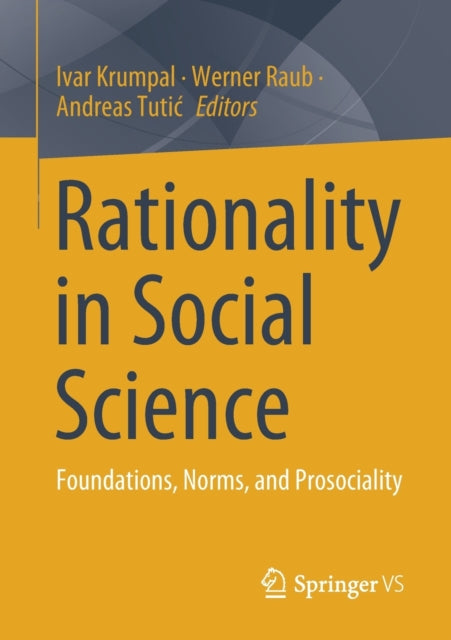
Rationality in Social Science: Foundations, Norms, and Prosociality
Rationality in Social Science: Foundations, Norms, and Prosociality
💎 Earn 227 Points (£2.27) on this item.
We can order this item for you. Delivery usually takes about 4 to 6 weeks.
This item is not held in our immediate stock. We will order it for you after checkout.
Estimated delivery: About 4 to 6 weeks
YOU SAVE £9.57
- Condition: Brand new
- UK Delivery times: Usually arrives within 2 - 3 working days
- UK Shipping: Fee starts at £2.39. Subject to product weight & dimension
Bulk ordering. Want 15 or more copies? Get a personalised quote and bigger discounts. Learn more about bulk orders.
Couldn't load pickup availability
- More about Rationality in Social Science: Foundations, Norms, and Prosociality
This volume discusses the concept of rationality and its significance for theory and empirical research in social science, highlighting the use of rational choice assumptions for research on social norms, cooperation, and prosociality.
Format: Paperback / softback
Length: 292 pages
Publication date: 03 September 2021
Publisher: Springer Fachmedien Wiesbaden
The notion of rationality holds immense importance in the realm of social science, serving as a cornerstone for both theoretical and empirical research. Within the framework of an analytical and empirical approach, this comprehensive volume presents innovative contributions that delve into the methodological foundations and fundamental assumptions of theories of rational choice. By emphasizing the integration of rational choice principles, the volume showcases their utility in exploring critical social phenomena, including the genesis, evolution, and consequences of social norms, as well as the factors that foster cooperation and prosocial behavior.
The study of rationality encompasses a wide range of disciplines, including economics, psychology, sociology, political science, and anthropology. It seeks to understand how individuals and groups make decisions, weigh options, and allocate resources in a manner that is consistent with their goals and values. Rationality is often viewed as a cognitive process that involves the use of logic, reason, and evidence to make informed choices.
However, the concept of rationality is not without its critics. Some argue that it is too narrow and limited, failing to account for the complex and subjective nature of human behavior. Others suggest that rationality is influenced by a range of factors, including emotions, biases, and social norms, which can lead to irrational and unintended outcomes.
Despite these challenges, the study of rationality remains an important area of research in social science. By understanding how individuals and groups make decisions, researchers can develop more effective policies, interventions, and strategies to promote social welfare, reduce inequality, and address complex social problems.
One of the key contributions of this volume is its exploration of the use of rational choice assumptions in research on fundamental problems in social theory. Social norms, for example, are a fundamental aspect of human society, shaping behavior and attitudes across cultures and generations. By employing rational choice assumptions, researchers can examine the conditions under which social norms emerge, evolve, and have an impact on individual and group behavior.
Similarly, the study of cooperation and prosocial behavior is another area where rational choice assumptions are particularly relevant. By examining the incentives and constraints that influence individuals' decisions to cooperate or engage in prosocial behavior, researchers can develop insights into the factors that promote social cohesion and stability.
In addition to these theoretical contributions, the volume also includes empirical research that employs rational choice assumptions to examine a range of social phenomena. For example, researchers have used rational choice models to examine the factors that influence voting behavior, the formation of political alliances, and the spread of infectious diseases.
Overall, the concept of rationality and its significance for theory and empirical research in social science are key topics of scholarly discussion. This volume assembles novel contributions on methodological foundations and basic assumptions of theories of rational choice, highlighting their utility in exploring critical social phenomena and developing insights into the factors that shape human behavior and society.
Weight: 400g
Dimension: 210 x 148 (mm)
ISBN-13: 9783658335359
Edition number: 1st ed. 2021
This item can be found in:
UK and International shipping information
UK and International shipping information
UK Delivery and returns information:
- Delivery within 2 - 3 days when ordering in the UK.
- Shipping fee for UK customers from £2.39. Fully tracked shipping service available.
- Returns policy: Return within 30 days of receipt for full refund.
International deliveries:
Shulph Ink now ships to Australia, Belgium, Canada, France, Germany, Ireland, Italy, India, Luxembourg Saudi Arabia, Singapore, Spain, Netherlands, New Zealand, United Arab Emirates, United States of America.
- Delivery times: within 5 - 10 days for international orders.
- Shipping fee: charges vary for overseas orders. Only tracked services are available for most international orders. Some countries have untracked shipping options.
- Customs charges: If ordering to addresses outside the United Kingdom, you may or may not incur additional customs and duties fees during local delivery.