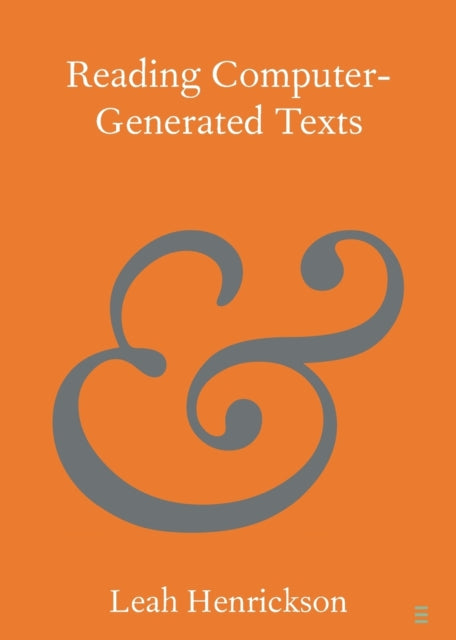
LeahHenrickson
Reading Computer-Generated Texts
Reading Computer-Generated Texts
💎 Earn 66 Points (£0.66) on this item.
We can order this item for you. Delivery usually takes about 4 to 6 weeks.
This item is not held in our immediate stock. We will order it for you after checkout.
Estimated delivery: About 4 to 6 weeks
YOU SAVE £0.78
- Condition: Brand new
- UK Delivery times: Usually arrives within 2 - 3 working days
- UK Shipping: Fee starts at £2.39. Subject to product weight & dimension
Bulk ordering. Want 15 or more copies? Get a personalised quote and bigger discounts. Learn more about bulk orders.
Couldn't load pickup availability
- More about Reading Computer-Generated Texts
Natural language generation (NLG) is the process where computers produce output in readable human languages, often indistinguishable from human-written texts. It challenges traditional conceptions of authorship and reader responsibility and explores the social value of computer-generated texts and their implications for modern writing, publishing, and reading practices.
Format: Paperback / softback
Length: 75 pages
Publication date: 11 February 2021
Publisher: Cambridge University Press
Natural language generation (NLG) is a fascinating field that involves the use of computers to produce output in human languages that can be read and understood by humans. NLG has a wide range of applications, including news articles, sports reports, prose fiction, and poetry. The output produced by NLG can be incredibly sophisticated and often indistinguishable from human-written text, making it difficult for readers to discern whether a text has been generated by a computer or by a human author.
One of the key challenges of NLG is the issue of authorship. Traditional conceptions of authorship typically involve a human author who creates a text through a process of writing and editing. However, NLG challenges this notion by enabling computers to generate text without the involvement of a human author. This raises questions about who is responsible for the creation of NLG-generated text and what it means to be an author in the age of NLG.
In some instances, NLG-generated text can be considered to be the work of an author. For example, if a computer program is designed to generate poetry based on a set of rules and parameters, the resulting poetry can be seen as the work of the program's author. However, in other instances, NLG-generated text may not be considered to be the work of an author. For example, if a news article is generated by a computer program that analyzes data and produces a summary of the news, the article may not be considered to be the work of a human author.
Another issue that NLG raises is the question of reader responsibility. In traditional reading practices, readers are responsible for interpreting and understanding the text they read. However, with NLG-generated text, readers may not be aware that the text has been generated by a computer. This can lead to a lack of critical thinking and a reliance of the text, as readers may rely on the information presented in the text without questioning its accuracy or reliability.
The social value of NLG-generated text is a complex issue that requires further exploration. On the one hand, NLG-generated text can provide a valuable source of information and entertainment for people who may not have the time or resources to read traditional human-written text. On the other hand, NLG-generated text may also have negative consequences, such as the spread of misinformation or the erosion of human-written literature.
NLG has significant implications for modern writing, publishing, and reading practices. For example, NLG-generated text can be used to create personalized content for individual readers, such as news articles or book recommendations. NLG can also be used to automate certain writing tasks, such as generating captions for images or writing product descriptions.
However, there are also concerns about the impact of NLG on the job market for writers and editors. As NLG technology advances, it may become increasingly difficult for human writers and editors to find work, as computers may be able to produce text more efficiently and effectively than humans.
In conclusion, natural language generation (NLG) is a rapidly evolving field that has the potential to revolutionize the way. The social value of NLG-generated text is a complex issue that requires further exploration. NLG has significant implications for modern writing, publishing, and reading practices, but it also raises important questions about authorship, reader responsibility, and the future of human-written literature. As NLG technology continues to advance, it will be important to consider these issues and develop policies and practices that ensure that NLG is used in a responsible and ethical manner.
Weight: 104g
Dimension: 126 x 178 x 10 (mm)
ISBN-13: 9781108822862
UK and International shipping information
UK and International shipping information
UK Delivery and returns information:
- Delivery within 2 - 3 days when ordering in the UK.
- Shipping fee for UK customers from £2.39. Fully tracked shipping service available.
- Returns policy: Return within 30 days of receipt for full refund.
International deliveries:
Shulph Ink now ships to Australia, Belgium, Canada, France, Germany, Ireland, Italy, India, Luxembourg Saudi Arabia, Singapore, Spain, Netherlands, New Zealand, United Arab Emirates, United States of America.
- Delivery times: within 5 - 10 days for international orders.
- Shipping fee: charges vary for overseas orders. Only tracked services are available for most international orders. Some countries have untracked shipping options.
- Customs charges: If ordering to addresses outside the United Kingdom, you may or may not incur additional customs and duties fees during local delivery.