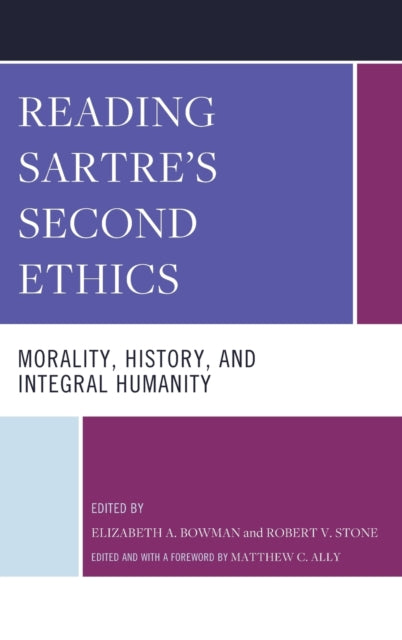
Elizabeth A. Bowman,Robert V. Stone
Reading Sartre's Second Ethics: Morality, History, and Integral Humanity
Reading Sartre's Second Ethics: Morality, History, and Integral Humanity
We can order this item for you. Delivery usually takes about 4 to 6 weeks.
This item is not held in our immediate stock. We will order it for you after checkout.
Estimated delivery: About 4 to 6 weeks
- Condition: Brand new
- UK Delivery times: Usually arrives within 2 - 3 working days
- UK Shipping: Fee starts at £3.89. Subject to product weight & dimension
Bulk ordering. Want 15 or more copies? Get a personalised quote and bigger discounts. Learn more about bulk orders.
Couldn't load pickup availability
- More about Reading Sartre's Second Ethics: Morality, History, and Integral Humanity
Reading Sartres Second Ethics: Morality, History, and Integral Humanity provides a comprehensive interpretation of Jean-Paul Sartres mature dialectical ethics, focusing on the ends or goals of historical conduct and normativity and its ambiguous place in lived moral experience. It demonstrates that integral humanity is always possible because the means to it can always be invented.
Format: Hardback
Length: 424 pages
Publication date: 15 April 2023
Publisher: Lexington Books
Reading Sartres Second Ethics: Morality, History, and Integral Humanity provides a comprehensive, reconstructive, and critical interpretation of Jean-Paul Sartres mature dialectical ethics. Generally referred to as the "second ethics," the key texts are two posthumously published lectures, one delivered at the Gramsci Institute in Rome in 1964, the other scheduled to be delivered at Cornell University in 1965 but cancelled by Sartre in protest of U.S. foreign policy. Though quite different in content, method, and intended audience, Sartre gave both lectures the shared title "Morality and History." This is because, Elizabeth A. Bowman and Robert V. Stone argue, these texts comprise a single, systematic ethic in two parts. The first part (Rome) focuses primarily on the ends or goals of historical conduct; the second part (Cornell) focuses primarily on normativity and its ambiguous place in lived moral experience. The Cornell text argues that the ethical task of "making the human" cannot be properly understood apart from a regressive and phenomenological analysis; the Rome text argues that the progressive and dialectical goal of historical conduct is, precisely, "integral humanity." Taken together, the two texts demonstrate that integral humanity is always possible because the means to it can always be invented.
Sartre's "Second Ethics" is a profound exploration of morality, history, and human essence. The key texts, which include two posthumously published lectures, offer a comprehensive and critical interpretation of Sartre's mature dialectical ethics. These lectures, often referred to as the "second ethics," are distinct in content, method, and intended audience. However, they share a common theme: "Morality and History." This title reflects the idea that these texts constitute a single, systematic ethic divided into two parts. The first part, titled "Rome," primarily focuses on the ends or goals of historical conduct. Sartre argues that the ethical task of "making the human" cannot be fully understood without a regressive and phenomenological analysis. In this part, he explores the historical development of human consciousness and the various ways in which individuals have sought to realize their full potential. The second part, titled "Cornell," shifts the focus to normativity and its ambiguous place in lived moral experience. Sartre argues that the progressive and dialectical goal of historical conduct is precisely "integral humanity." He explores the concept of human freedom and the challenges individuals face in achieving it. The Cornell text emphasizes the importance of a phenomenological analysis in understanding the ethical task of "making the human." Sartre argues that the human being is not a fixed entity but a dynamic process of becoming. He suggests that the ethical challenge is to create the conditions for human beings to realize their full potential and to live a life of meaning and purpose. The Rome text, on the other hand, emphasizes the progressive and dialectical goal of historical conduct. Sartre argues that the progressive and dialectical goal of historical conduct is precisely "integral humanity." He suggests that the means to achieve this goal can always be invented and that human beings have the capacity to create a better world. Taken together, the two texts demonstrate that integral humanity is always possible because the means to it can always be invented. Sartre's "Second Ethics" offers a rich and nuanced understanding of morality, history, and human essence. It challenges traditional notions of morality and encourages individuals to think critically about their place in the world. By exploring the relationship between morality, history, and human freedom, Sartre provides a framework for living a life of meaning and purpose.
Weight: 735g
Dimension: 236 x 157 x 30 (mm)
ISBN-13: 9781793646514
UK and International shipping information
UK and International shipping information
We deliver throughout the United Kingdom and to 128 countries and territories worldwide, including the United States, Australia, Canada, Germany, Spain and France.