Shulph Ink
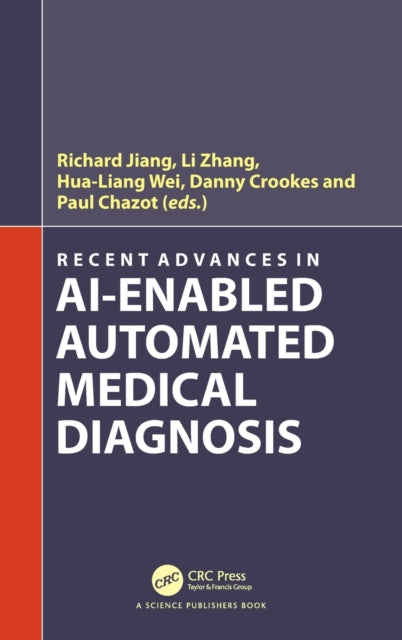
Recent Advances in AI-enabled Automated Medical Diagnosis
Recent Advances in AI-enabled Automated Medical Diagnosis
💎 Earn 811 Points (£8.11) on this item.
We can order this item for you. Delivery usually takes about 4 to 6 weeks.
This item is not held in our immediate stock. We will order it for you after checkout.
Estimated delivery: About 4 to 6 weeks
YOU SAVE £9.63
- Condition: Brand new
- UK Delivery times: Usually arrives within 2 - 3 working days
- UK Shipping: Fee starts at £2.39. Subject to product weight & dimension
Bulk ordering. Want 15 or more copies? Get a personalised quote and bigger discounts. Learn more about bulk orders.
Couldn't load pickup availability
- More about Recent Advances in AI-enabled Automated Medical Diagnosis
The growth of AI-based automated medical diagnosis has opened a door to a new era of medical research and industry, and this book captures the latest advances in this cross-disciplinary topic.
Format: Hardback
Length: 364 pages
Publication date: 20 October 2022
Publisher: Taylor & Francis Ltd
The past decade has seen a remarkable surge in the field of deep learning, resulting in a significant advancement in AI-based automated medical diagnosis. This groundbreaking development has paved the way for a new era of medical research and industry, offering immense opportunities for researchers to explore and apply advanced machine learning techniques to address medical and clinical challenges.
This period can be aptly described as a golden age for those involved in the development and application of advanced machine learning techniques for medical and clinical problems. The field has witnessed a remarkable influx of talent and resources, driven by the immense potential of deep learning to revolutionize healthcare.
One of the key advancements in deep learning has been its ability to analyze large amounts of medical data, including images, scans, and patient records. This has enabled researchers to develop more accurate and efficient diagnostic models, capable of identifying patterns and abnormalities that may be difficult to detect manually.
Another significant development has been the integration of deep learning with other fields such as computer vision, natural language processing, and genetics. This has allowed for the development of more comprehensive and personalized medical treatments, tailored to the individual needs of patients.
For example, deep learning algorithms can be used to analyze medical images and identify cancerous tumors with high accuracy, leading to early detection and improved treatment outcomes. Similarly, natural language processing can be used to interpret patient symptoms and provide more accurate diagnoses, reducing the burden on healthcare professionals.
In addition to its applications in healthcare, deep learning has also found its way into other industries such as finance, transportation, and energy. For instance, deep learning algorithms can be used to analyze financial data and predict market trends, leading to more efficient investment strategies and better risk management.
However, despite the many benefits of deep learning, there are also challenges that need to be addressed. One of the main concerns is the issue of bias and discrimination in AI-based systems. Since deep learning models are trained on large datasets, they may perpetuate and amplify existing biases, leading to unfair and inaccurate diagnoses for certain groups of patients.
To address this issue, researchers are actively working on developing methods to ensure that AI-based systems are more transparent, accountable, and unbiased. This includes developing new training datasets that represent diverse populations and using techniques such as adversarial training to identify and mitigate biases.
Another challenge is the scalability of deep learning systems. As medical data continues to grow in volume and complexity, it becomes increasingly difficult to train and maintain large-scale deep learning models. This requires the development of new computing technologies and algorithms that can handle large datasets efficiently and effectively.
Despite these challenges, the future of deep learning in healthcare is bright. With continued advancements in technology and research, deep learning is poised to become an even more powerful tool for improving patient care and advancing medical research.
In conclusion, the past decade has seen a remarkable surge in the field of deep learning, resulting in a significant advancement in AI-based automated medical diagnosis. This groundbreaking development has paved the way for a new era of medical research and industry, offering immense opportunities for researchers to explore and apply advanced machine learning techniques to address medical and clinical challenges.
While there are challenges that need to be addressed, the future of deep learning in healthcare is bright, and with continued advancements in technology and research, it is poised to become an even more powerful tool for improving patient care and advancing medical research.
Weight: 840g
Dimension: 234 x 156 (mm)
ISBN-13: 9781032008431
UK and International shipping information
UK and International shipping information
UK Delivery and returns information:
- Delivery within 2 - 3 days when ordering in the UK.
- Shipping fee for UK customers from £2.39. Fully tracked shipping service available.
- Returns policy: Return within 30 days of receipt for full refund.
International deliveries:
Shulph Ink now ships to Australia, Belgium, Canada, France, Germany, Ireland, Italy, India, Luxembourg Saudi Arabia, Singapore, Spain, Netherlands, New Zealand, United Arab Emirates, United States of America.
- Delivery times: within 5 - 10 days for international orders.
- Shipping fee: charges vary for overseas orders. Only tracked services are available for most international orders. Some countries have untracked shipping options.
- Customs charges: If ordering to addresses outside the United Kingdom, you may or may not incur additional customs and duties fees during local delivery.