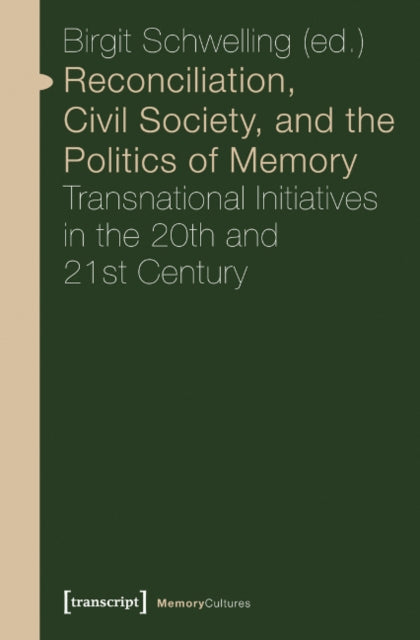
Birgit Schwelling
Reconciliation, Civil Society, and the Politics - Transnational Initiatives in the 20th and 21st Century
Reconciliation, Civil Society, and the Politics - Transnational Initiatives in the 20th and 21st Century
💎 Earn 169 Points (£1.69) on this item.
We can order this item for you. Delivery usually takes about 4 to 6 weeks.
This item is not held in our immediate stock. We will order it for you after checkout.
Estimated delivery: About 4 to 6 weeks
YOU SAVE £7.14
- Condition: Brand new
- UK Delivery times: Usually arrives within 2 - 3 working days
- UK Shipping: Fee starts at £2.39. Subject to product weight & dimension
Bulk ordering. Want 15 or more copies? Get a personalised quote and bigger discounts. Learn more about bulk orders.
Couldn't load pickup availability
- More about Reconciliation, Civil Society, and the Politics - Transnational Initiatives in the 20th and 21st Century
Civil society has played a critical role in reconciliation initiatives since the beginning of the 20th century, challenging the conventional understanding of reconciliation as a benign state-driven process. Studies explore how civil society actors have confronted and coped with the past, offering a critical perspective on local and transnational reconciliation acts.
Format: Paperback / softback
Length: 372 pages
Publication date: 08 December 2021
Publisher: Transcript Verlag
Since the beginning of the 20th century, civil society has played a crucial role in fostering reconciliation initiatives. This collection of essays challenges the conventional notion of reconciliation as a solely state-driven process, instead exploring how a diverse range of civil society actors, including Turkish intellectuals who apologize for the Armenian Genocide, religious organizations working towards improving Franco-German relations, and others, have grappled with and addressed the past. Through critical analysis, these studies shed light on the complexities and challenges of local and transnational reconciliation acts, questioning the extent to which speech has replaced silence, remembrance has overshadowed forgetting, and engagement has overshadowed oblivion.
The essays in this volume offer a nuanced and multifaceted understanding of the role of civil society in reconciliation processes. They demonstrate that reconciliation is not solely a top-down initiative driven by the state but is also shaped by the actions and interventions of various civil society actors. These actors, whether they are individuals, organizations, or networks, play a vital role in challenging historical narratives, promoting empathy and understanding, and fostering dialogue and cooperation.
One of the key themes explored in the essays is the power of speech and language in reconciliation. The authors argue that speech can be a powerful tool for promoting reconciliation, as it allows individuals and groups to express their emotions, acknowledge past wrongs, and seek forgiveness. However, they also note that speech can be used to perpetuate harmful narratives and silence marginalized voices, leading to further divisions and conflicts.
Another important theme is the role of memory and remembrance in reconciliation. The authors argue that memory plays a crucial role in shaping individuals' and communities' understanding of the past, and that forgetting or ignoring the past can lead to the repetition of historical injustices. They suggest that remembrance can be a powerful tool for promoting reconciliation, as it allows individuals and groups to acknowledge the pain and suffering of the past and work towards healing and justice.
However, the authors also note that remembrance can be a double-edged sword, as it can lead to the perpetuation of harmful stereotypes and narratives. They argue that remembrance should be approached with caution and sensitivity, and that it is important to recognize the complexities and nuances of different historical experiences.
The essays in this volume also explore the role of engagement and participation in reconciliation processes. The authors argue that reconciliation is not a one-time event but a ongoing process that requires sustained effort and commitment. They suggest that civil society actors can play a vital role in promoting engagement and participation, by creating spaces for dialogue, fostering collaboration, and advocating for social change.
However, the authors also note that engagement and participation can be challenging, particularly in contexts where there is a history of conflict and violence. They argue that civil society actors must be aware of the power dynamics and social inequalities that may influence reconciliation processes and work to promote inclusivity and equity.
In conclusion, the essays in this volume offer a critical perspective on the role of civil society in reconciliation processes since the beginning of the 20th century. They challenge the conventional understanding of reconciliation as a solely state-driven process and demonstrate that a range of civil society actors, including Turkish intellectuals, religious organizations, and others, have played a vital role in confronting and addressing the past. Through their analysis, the authors shed light on the complexities and challenges of local and transnational reconciliation acts, highlighting the power of speech, memory, remembrance, engagement, and participation in promoting reconciliation and healing.
Weight: 518g
Dimension: 224 x 150 x 27 (mm)
ISBN-13: 9783837619317
This item can be found in:
UK and International shipping information
UK and International shipping information
UK Delivery and returns information:
- Delivery within 2 - 3 days when ordering in the UK.
- Shipping fee for UK customers from £2.39. Fully tracked shipping service available.
- Returns policy: Return within 30 days of receipt for full refund.
International deliveries:
Shulph Ink now ships to Australia, Belgium, Canada, France, Germany, Ireland, Italy, India, Luxembourg Saudi Arabia, Singapore, Spain, Netherlands, New Zealand, United Arab Emirates, United States of America.
- Delivery times: within 5 - 10 days for international orders.
- Shipping fee: charges vary for overseas orders. Only tracked services are available for most international orders. Some countries have untracked shipping options.
- Customs charges: If ordering to addresses outside the United Kingdom, you may or may not incur additional customs and duties fees during local delivery.