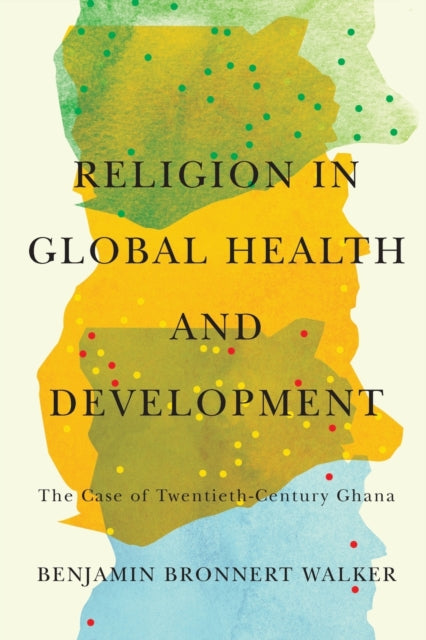
Benjamin Bronnert Walker
Religion in Global Health and Development: The Case of Twentieth-Century Ghana
Religion in Global Health and Development: The Case of Twentieth-Century Ghana
💎 Earn 155 Points (£1.55) on this item.
- Condition: Brand new
- UK Delivery times: Usually arrives within 2 - 3 working days
- UK Shipping: Fee starts at £2.39. Subject to product weight & dimension
Bulk ordering. Want 15 or more copies? Get a personalised quote and bigger discounts. Learn more about bulk orders.
Couldn't load pickup availability
- More about Religion in Global Health and Development: The Case of Twentieth-Century Ghana
The COVID-19 pandemic has highlighted the impact of global health on billions of lives, and religion has played a significant role in this field. Benjamin Walker's book Religion in Global Health and Development explores the religious features of colonial state architecture and its impact on global health in Ghana between 1940 and 1990. It challenges narrow approaches and offers new ways of conceptualizing global health.
Format: Paperback / softback
Length: 336 pages
Publication date: 20 April 2022
Publisher: McGill-Queen's University Press
The COVID-19 pandemic has highlighted the significant impact of global health on the lives of billions of people worldwide. However, the field of global health has traditionally focused on the practices, norms, and failures of global health, with limited attention paid to the role of religion. This limited perspective has led to a narrow understanding of the relationship between religion and global health. In his book, "Religion in Global Health and Development," Benjamin Walker seeks to challenge this limited approach by examining the historical connections between religion and global health in Ghana. Walker's book provides a comprehensive overview of the establishment of colonial development projects in the twentieth century, with a particular focus on the period between 1940 and 1990. By crossing the colonial-postcolonial divide, analyzing local contexts, and identifying overlooked streams of personnel and funding, Walker offers new ways of conceptualizing global health. The book highlights the role of religion and religious actors in shaping health services and the state in Ghana. Religion played a critical role in the establishment of health services, including the provision of healthcare, education, and social welfare. Religious organizations provided healthcare services, while religious leaders played a significant role in promoting health and well-being. Additionally, religion was used as a tool for social control and political mobilization. The book also explores the challenges faced by religious actors in the context of global health. For example, religious beliefs and practices can conflict with modern medical practices, leading to resistance to healthcare interventions. Additionally, religious organizations can be vulnerable to political and economic pressures, which can impact their ability to provide healthcare services. Despite these challenges, religion has the potential to play a positive role in global health. Religion can provide a sense of community, support, and hope, which can be particularly important in times of crisis. Additionally, religious organizations can provide valuable resources and expertise in the field of global health. However, it is important to recognize that the relationship between religion and global health is complex and multifaceted. Different religious traditions have different perspectives on health and well-being, and these perspectives can vary across different regions and communities. Additionally, the role of religion in global health can be influenced by political, economic, and social factors. In conclusion, the COVID-19 pandemic has highlighted the significant impact of global health on the lives of billions of people worldwide. However, the field of global health has traditionally focused on the practices, norms, and failures of global health, with limited attention paid to the role of religion. Benjamin Walker's book, "Religion in Global Health and Development," provides a comprehensive overview of the historical connections between religion and global health in Ghana. By crossing the colonial-postcolonial divide, analyzing local contexts, and identifying overlooked streams of personnel and funding, Walker offers new ways of conceptualizing global health. The book highlights the role of religion and religious actors in shaping health services and the state in Ghana, while also exploring the challenges faced by religious actors in the context of global health. While religion has the potential to play a positive role in global health, it is important to recognize that the relationship between religion and global health is complex and multifaceted.
Weight: 504g
Dimension: 153 x 229 x 25 (mm)
ISBN-13: 9780228011699
This item can be found in:
UK and International shipping information
UK and International shipping information
UK Delivery and returns information:
- Delivery within 2 - 3 days when ordering in the UK.
- Shipping fee for UK customers from £2.39. Fully tracked shipping service available.
- Returns policy: Return within 30 days of receipt for full refund.
International deliveries:
Shulph Ink now ships to Australia, Belgium, Canada, France, Germany, Ireland, Italy, India, Luxembourg Saudi Arabia, Singapore, Spain, Netherlands, New Zealand, United Arab Emirates, United States of America.
- Delivery times: within 5 - 10 days for international orders.
- Shipping fee: charges vary for overseas orders. Only tracked services are available for most international orders. Some countries have untracked shipping options.
- Customs charges: If ordering to addresses outside the United Kingdom, you may or may not incur additional customs and duties fees during local delivery.