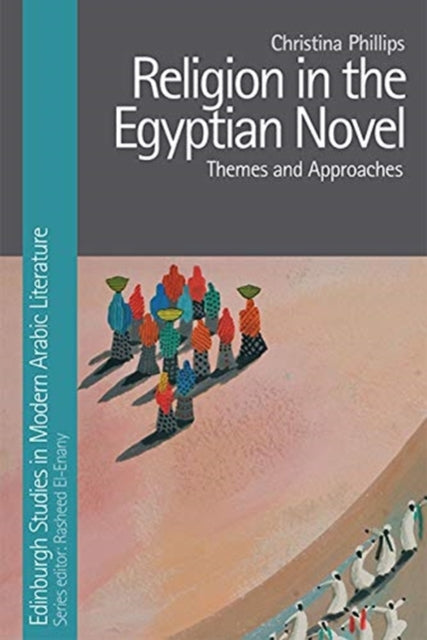
Christina Phillips
Religion in the Egyptian Novel
Religion in the Egyptian Novel
💎 Earn 115 Points (£1.15) on this item.
YOU SAVE £6.99
- Condition: Brand new
- UK Delivery times: Usually arrives within 2 - 3 working days
- UK Shipping: Fee starts at £3.89. Subject to product weight & dimension
Bulk ordering. Want 15 or more copies? Get a personalised quote and bigger discounts. Learn more about bulk orders.
Couldn't load pickup availability
- More about Religion in the Egyptian Novel
This book explores the relationship between religion and secularism in the modern Arabic novel, tracing its development from the early twentieth century to the present.
Format: Paperback / softback
Length: 296 pages
Publication date: 31 May 2021
Publisher: Edinburgh University Press
This is a comprehensive and original study of religion in modern Arabic literature, spanning from its early twentieth-century origins to the present day. Author Phillips delves into a thematic exploration of the complex interplay between religion and secularism, as manifested in the pages of Egyptian novels.
The emergence of the modern Arabic novel can be traced back to the early twentieth century, a period marked by significant social and political changes in the Arab world. The novel, as a form of literature, emerged as a means of expressing the aspirations and struggles of the Arab people, particularly those living in the urban centers.
One of the key themes that emerged in the modern Arabic novel was the conflict between religion and secularism. The novelists of this period were deeply influenced by the Western cultural and intellectual traditions, which were rapidly spreading throughout the Arab world. As a result, they began to question the traditional religious beliefs and practices that had been prevalent in the Arab world for centuries.
The novelists of the early twentieth century were particularly interested in exploring the role of religion in shaping the identity of the Arab people. They believed that religion was not just a set of beliefs and practices, but also a powerful tool that could be used to promote social justice and equality. However, they also recognized that religion could be used to justify oppressive and authoritarian regimes, which were often opposed to the aspirations of the Arab people.
As a result, the modern Arabic novel often depicted the conflict between religion and secularism as a central theme. The novelists explored the ways in which religion could be used to promote social change and progress, as well as the ways in which it could be used to justify oppressive and authoritarian regimes. They also examined the ways in which individuals could navigate the complex web of religious beliefs and practices in order to achieve their own personal goals and aspirations.
One of the most notable novelists of the early twentieth century was the Egyptian author Naguib Mahfouz. Mahfouz's novels, such as "The Hunger" and "The Thief," were deeply influenced by the Western cultural and intellectual traditions. However, they also reflected the traditional religious beliefs and practices of the Arab world. In "The Hunger," for example, Mahfouz explored the role of religion in shaping the identity of the Egyptian people during the period of the French occupation. He depicted the conflict between the traditional religious beliefs of the Egyptians and the secularism of the French occupiers, and the ways in which individuals could navigate this complex web of beliefs and practices in order to achieve their own personal goals.
Another notable novelist of the early twentieth century was the Syrian author George Kawakib. Kawakib's novels, such as "The River" and "The Woman Who Walked into Doors," were also deeply influenced by the Western cultural and intellectual traditions. However, they also reflected the traditional religious beliefs and practices of the Arab world. In "The River," for example, Kawakib explored the role of religion in shaping the identity of the Syrian people during the period of the French occupation. He depicted the conflict between the traditional religious beliefs of the Syrians and the secularism of the French occupiers, and the ways in which individuals could navigate this complex web of beliefs and practices in order to achieve their own personal goals.
In addition to exploring the conflict between religion and secularism, the modern Arabic novel also explored other themes such as nationalism, gender, and social class. The novelists of this period were deeply interested in exploring the ways in which these themes intersected with religious beliefs and practices, and how they shaped the identity of the Arab people.
For example, in "The Woman Who Walked into Doors," the Syrian author Kawakib explored the role of gender in shaping the identity of the Arab people during the period of the French occupation. He depicted the conflict between the traditional gender roles of the Arab women and the secularism of the French occupiers, and the ways in which individuals could navigate this complex web of beliefs and practices in order to achieve their own personal goals.
Similarly, in "The Hunger," the Egyptian author Mahfouz explored the role of nationalism in shaping the identity of the Egyptian people during the period of the French occupation. He depicted the conflict between the traditional nationalist beliefs of the Egyptians and the secularism of the French occupiers, and the ways in which individuals could navigate this complex web of beliefs and practices in order to achieve their own personal goals.
In conclusion, the modern Arabic novel is a rich and complex form of literature that explores a wide range of themes, including religion, secularism, nationalism, gender, and social class. The novelists of this period were deeply influenced by the Western cultural and intellectual traditions, but they also reflected the traditional religious beliefs and practices of the Arab world. As a result, the modern Arabic novel is a valuable source of insight into the complex interplay between religion and secularism in the Arab world.
Weight: 446g
Dimension: 154 x 232 x 26 (mm)
ISBN-13: 9781474483889
UK and International shipping information
UK and International shipping information
We deliver throughout the United Kingdom and to 128 countries and territories worldwide, including the United States, Australia, Canada, Germany, Spain and France.