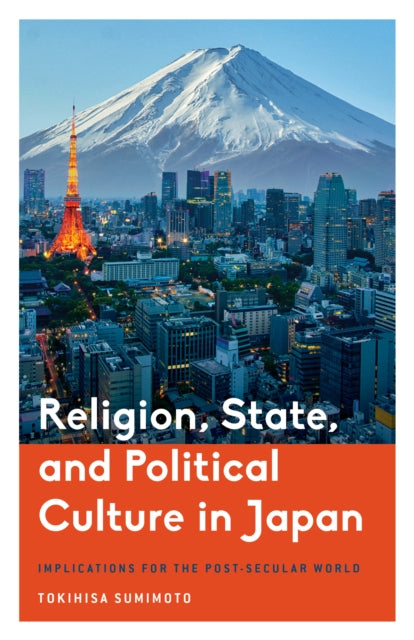
Tokihisa Sumimoto
Religion, State, and Political Culture in Japan: Implications for the Post-Secular World
Religion, State, and Political Culture in Japan: Implications for the Post-Secular World
💎 Earn 531 Points (£5.31) on this item.
We can order this item for you. Delivery usually takes about 4 to 6 weeks.
This item is not held in our immediate stock. We will order it for you after checkout.
Estimated delivery: About 4 to 6 weeks
- Condition: Brand new
- UK Delivery times: Usually arrives within 2 - 3 working days
- UK Shipping: Fee starts at £2.39. Subject to product weight & dimension
Bulk ordering. Want 15 or more copies? Get a personalised quote and bigger discounts. Learn more about bulk orders.
Couldn't load pickup availability
- More about Religion, State, and Political Culture in Japan: Implications for the Post-Secular World
Japan has a secular civilization with a history of state-worship and economic growth, but lacks socially influential religions independent of the state. This has led to a lack of democratic principles and a need for reconstructive postmodernism to democratize and humanize secular civilizations. The book applies this concept to Japan and global governance in the post-secular age.
Format: Hardback
Length: 182 pages
Publication date: 06 November 2023
Publisher: Bloomsbury Publishing PLC
Japan has a long history of secular civilization, characterized by the officially-sanctioned unification of nationalism and state-worship that reached its apotheosis during World War II and the economic growth-oriented post-war period. However, the relationship between religion and state has varied significantly over time, with the absence of religions that are socially influential but independent from the state or the absence of a dualistic relationship between religion and state being consistently observed throughout Japan's history. This has led to the underdevelopment of the kind of political ethos that should underpin democratic principles such as the rule of law and human rights.
This book examines the concept of "reconstructive postmodernism," a perspective that has emerged from a normative approach to international relations that emphasizes the need to democratize and humanize the secularistic civilizations based on the reconstruction of spirituality and religiosity. Using this concept, this book offers a number of implications of its findings to the case of Japan and for global governance in the post-secular age more broadly.
One of the key implications of reconstructive postmodernism is that it challenges the traditional Western understanding of secularism as a purely negative phenomenon. Instead, reconstructive postmodernism recognizes that secularism can be a positive force for social and political change, provided that it is accompanied by a commitment to human rights and democratic principles. This means that secularism should not be seen as a threat to religion but rather as a means of promoting religious freedom and tolerance.
Another implication of reconstructive postmodernism is that it challenges the notion of secularism as a universal phenomenon. While secularism has been widely adopted in Western societies, it has not been universally accepted in other parts of the world. This has led to a variety of conflicts and tensions, particularly in the Middle East and Africa. Reconstructive postmodernism suggests that secularism can be adapted to different cultural contexts and that it can be used to promote social and political stability.
One of the challenges that reconstructive postmodernism faces is the fact that it is often seen as a Western-centric perspective. This is because it was developed in response to the challenges faced by Western societies in the post-World War II period. However, reconstructive postmodernism can be applied to other parts of the world, and it can be used to promote social and political change in a variety of contexts.
One of the ways that reconstructive postmodernism can be applied to Japan is by promoting religious freedom and tolerance. Japan has a long history of religious diversity, and it has been a leader in promoting religious freedom and tolerance in the region. However, there are still some challenges that need to be addressed, such as the lack of religious freedom for certain religious groups and the lack of recognition of religious diversity in the Japanese constitution.
Another way that reconstructive postmodernism can be applied to Japan is by promoting social and political stability. Japan has experienced a number of economic and social challenges in recent years, and it has been struggling to find a way to address these challenges. Reconstructive postmodernism suggests that secularism can be used to promote social and political stability by promoting a sense of community and by providing a framework for social and political decision-making.
In conclusion, Japan has a long history of secular civilization, characterized by the officially-sanctioned unification of nationalism and state-worship that reached its apotheosis during World War II and the economic growth-oriented post-war period. However, the relationship between religion and state has varied significantly over time, with the absence of religions that are socially influential but independent from the state or the absence of a dualistic relationship between religion and state being consistently observed throughout Japan's history. This has led to the underdevelopment of the kind of political ethos that should underpin democratic principles such as the rule of law and human rights. Reconstructive postmodernism offers a number of implications of its findings to the case of Japan and for global governance in the post-secular age more broadly. By promoting religious freedom and tolerance, promoting social and political stability, and recognizing the diversity of religious beliefs and practices, reconstructive postmodernism can help to create a more peaceful and prosperous world.
Weight: 354g
Dimension: 223 x 145 x 19 (mm)
ISBN-13: 9781786605948
This item can be found in:
UK and International shipping information
UK and International shipping information
UK Delivery and returns information:
- Delivery within 2 - 3 days when ordering in the UK.
- Shipping fee for UK customers from £2.39. Fully tracked shipping service available.
- Returns policy: Return within 30 days of receipt for full refund.
International deliveries:
Shulph Ink now ships to Australia, Belgium, Canada, France, Germany, Ireland, Italy, India, Luxembourg Saudi Arabia, Singapore, Spain, Netherlands, New Zealand, United Arab Emirates, United States of America.
- Delivery times: within 5 - 10 days for international orders.
- Shipping fee: charges vary for overseas orders. Only tracked services are available for most international orders. Some countries have untracked shipping options.
- Customs charges: If ordering to addresses outside the United Kingdom, you may or may not incur additional customs and duties fees during local delivery.