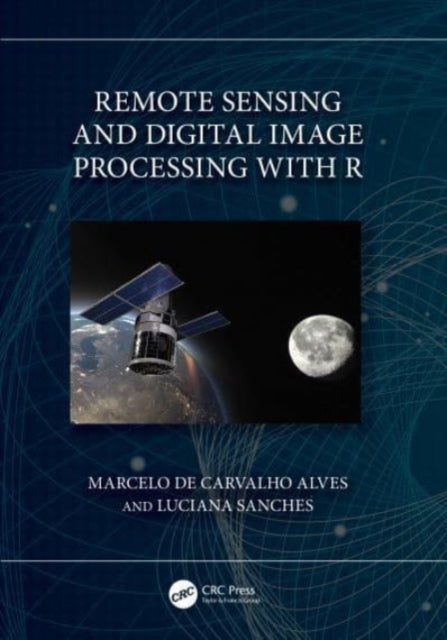
Marcelode Carvalho Alves,LucianaSanches
Remote Sensing and Digital Image Processing with R
Remote Sensing and Digital Image Processing with R
💎 Earn 689 Points (£6.89) on this item.
YOU SAVE £8.18
- Condition: Brand new
- UK Delivery times: Usually arrives within 2 - 3 working days
- UK Shipping: Fee starts at £2.39. Subject to product weight & dimension
Bulk ordering. Want 15 or more copies? Get a personalised quote and bigger discounts. Learn more about bulk orders.
Couldn't load pickup availability
- More about Remote Sensing and Digital Image Processing with R
This book provides a comprehensive introduction to remote sensing with a focus on free and open-source (FOSS) R platform. It covers the theory and applications of remote sensing in water, soil, vegetation, and atmosphere, and includes data analysis in the R platform. It also offers case studies and hands-on exercises to help readers understand the potential and limitations of remote sensing.
Format: Hardback
Length: 526 pages
Publication date: 30 June 2023
Publisher: Taylor & Francis Ltd
Here is the rephrased text:
Remote sensing is a powerful tool for gathering information about the Earth's water, soil, vegetation, and atmosphere. It involves the use of sensors to collect data from a distance and can be used to monitor and analyze a wide range of environmental factors. There are two main types of remote sensing: passive and active. Passive remote sensing involves the use of sensors to collect data without emitting any radiation. This type of sensing is commonly used for monitoring changes in the Earth's surface, such as changes in temperature, humidity, and vegetation cover. Active remote sensing involves the use of sensors to emit radiation, such as radar or lidar, to collect data. This type of sensing is commonly used for mapping and measuring the properties of the Earth's surface, such as topography, soil composition, and vegetation density.
Remote sensing has a wide range of applications in water, soil, vegetation, and atmosphere. In water, remote sensing can be used to monitor water quality, track water flow, and detect changes in water levels. It can also be used to monitor coastal erosion, detect fish populations, and monitor the effects of climate change on water resources. In soil, remote sensing can be used to monitor soil moisture, soil temperature, and soil nutrients. It can also be used to monitor soil erosion, detect landslides, and monitor the effects of agricultural practices on soil quality. In vegetation, remote sensing can be used to monitor vegetation cover, track vegetation growth, and detect changes in vegetation health. It can also be used to monitor the effects of climate change on vegetation productivity and to map the distribution of vegetation types. In atmosphere, remote sensing can be used to monitor air quality, track weather patterns, and detect changes in atmospheric composition. It can also be used to monitor the effects of climate change on atmospheric circulation and to map the distribution of greenhouse gases.
Data analysis in free and open-source (FOSS) R platform is a crucial aspect of remote sensing. R is a powerful programming language that is widely used in the scientific community for data analysis and visualization. FOSS R platform provides a free and open-source alternative to commercial software, making remote sensing accessible to anyone with a computer. The R platform includes a wide range of libraries and tools that can be used for data analysis, including statistical analysis, machine learning, and visualization. One of the key advantages of using the R platform for remote sensing data analysis is its flexibility. R is a versatile programming language that can be used for a wide range of tasks, from simple data manipulation to complex data analysis and visualization. It is also highly customizable, allowing users to tailor their analysis to their specific needs. Another advantage of using the R platform for remote sensing data analysis is its accessibility. R is freely available and can be downloaded from the internet. It is also widely supported by a large community of users, including scientists, researchers, and developers, who can provide assistance and support for users who are new to the platform.
In addition to its flexibility and accessibility, the R platform for remote sensing data analysis also offers a wide range of features and capabilities. For example, R includes a powerful statistical analysis library, such as RStudio, which can be used for data manipulation, hypothesis testing, and statistical modeling. R also includes a machine learning library.
In this course, we will explore the theory of passive and active remote sensing and its applications in water, soil, vegetation, and atmosphere. We will cover data analysis in the free and open-source (FOSS) R platform, which makes remote sensing accessible to anyone with a computer. We will include case studies from different environments with free software algorithm and R toolset for active learning and learn-by-doing. We will provide hands-on exercises at the end of each chapter and encourage readers to understand the potential and the limitations of the environments, remote sensing targets, and process. We will also explore current trends and developments in remote sensing in homework assignments with data to further explore the use of free multispectral remote sensing data, including very high spatial resolution data sources for target recognition with image processing techniques.
In conclusion, remote sensing is a powerful tool for gathering information about the Earth's water, soil, vegetation, and atmosphere. It involves the use of sensors to collect data from a distance and can be used to monitor and analyze a wide range of environmental factors. There are two main types of remote sensing: passive and active. Passive remote sensing involves the use of sensors to collect data without emitting any radiation. This type of sensing is commonly used for monitoring changes in the Earth's surface, such as changes in temperature, humidity, and vegetation cover. Active remote sensing involves the use of sensors to emit radiation, such as radar or lidar, to collect data. This type of sensing is commonly used for mapping and measuring the properties of the Earth's surface, such as topography, soil composition, and vegetation density.
Data analysis in free and open-source (FOSS) R platform is a crucial aspect of remote sensing. R is a powerful programming language that is widely used in the scientific community for data analysis and visualization. FOSS R platform provides a free and open-source alternative to commercial software, making remote sensing accessible to anyone with a computer. The R platform includes a wide range of libraries and tools that can be used for data analysis, including statistical analysis, machine learning, and visualization. One of the key advantages of using the R platform for remote sensing data analysis is its flexibility. R is a versatile programming language that can be used for a wide range of tasks, from simple data manipulation to complex data analysis and visualization. It is also highly customizable, allowing users to tailor their analysis to their specific needs. Another advantage of using the R platform for remote sensing data analysis is its accessibility. R is freely available and can be downloaded from the internet. It is also widely supported by a large community of users, including scientists, researchers, and developers, who can provide assistance and support for users who are new to the platform.
In addition to its flexibility and accessibility, the R platform for remote sensing data analysis also offers a wide range of features and capabilities. For example, R includes a powerful statistical analysis library, such as RStudio, which can be used for data manipulation, hypothesis testing, and statistical modeling. R also includes a machine learning.
Weight: 1150g
Dimension: 254 x 178 (mm)
ISBN-13: 9781032359229
UK and International shipping information
UK and International shipping information
UK Delivery and returns information:
- Delivery within 2 - 3 days when ordering in the UK.
- Shipping fee for UK customers from £2.39. Fully tracked shipping service available.
- Returns policy: Return within 30 days of receipt for full refund.
International deliveries:
Shulph Ink now ships to Australia, Belgium, Canada, France, Germany, Ireland, Italy, India, Luxembourg Saudi Arabia, Singapore, Spain, Netherlands, New Zealand, United Arab Emirates, United States of America.
- Delivery times: within 5 - 10 days for international orders.
- Shipping fee: charges vary for overseas orders. Only tracked services are available for most international orders. Some countries have untracked shipping options.
- Customs charges: If ordering to addresses outside the United Kingdom, you may or may not incur additional customs and duties fees during local delivery.