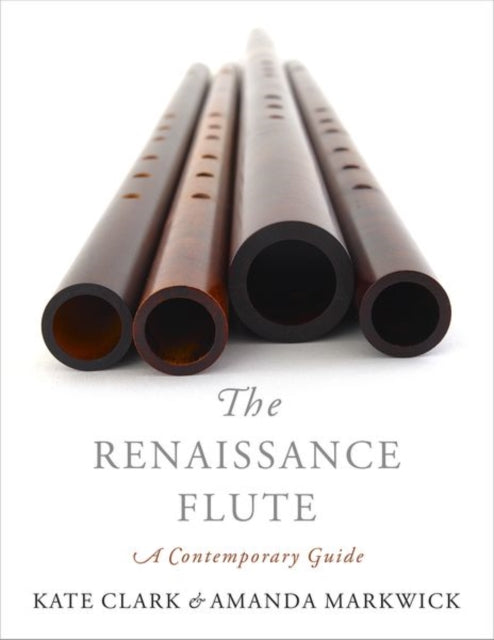
KateClark,AmandaMarkwick
Renaissance Flute: A Contemporary Guide
Renaissance Flute: A Contemporary Guide
💎 Earn 165 Points (£1.65) on this item.
YOU SAVE £1.96
- Condition: Brand new
- UK Delivery times: Usually arrives within 2 - 3 working days
- UK Shipping: Fee starts at £2.39. Subject to product weight & dimension
Bulk ordering. Want 15 or more copies? Get a personalised quote and bigger discounts. Learn more about bulk orders.
Couldn't load pickup availability
- More about Renaissance Flute: A Contemporary Guide
The Renaissance Flute: A Contemporary Guide by Kate Clark and Amanda Markwick is the first ever practitioners handbook for the renaissance flute. It provides a clear and accessible introduction to the world and repertoire of the instrument, covering practicalities, music, and theory. It includes nearly 40 full pages of exercises and a companion website with recorded examples and filmed instructions.
Format: Paperback / softback
Length: 304 pages
Publication date: 17 September 2020
Publisher: Oxford University Press Inc
The Renaissance flute, with its rich history, stunning repertoire, and mellow tone, has attracted a significant following among flutists, whether they specialize in modern flute or historical instruments. However, delving into the study of renaissance flute has proven a challenge. There exists a confusing array of editions of renaissance music, specialized (and often expensive) facsimiles of manuscripts and early prints, and unfamiliar notations, while at the same time, there is a dearth of resources for beginners.
Confronting this challenge, Kate Clark and Amanda Markwick offer flutists of all levels a clear and accessible introduction to the world and repertoire of the instrument. In The Renaissance Flute: A Contemporary Guide, Clark and Markwick cover all aspects, from practicalities such as buying and maintaining the instrument to actual music for solo and group performance to theory designed to improve the understanding and playing of renaissance polyphony. This approach enables students to immerse themselves at their own pace and build on their skills with each chapter. With nearly 40 full pages of exercises, and a companion website with recorded examples and filmed instructions from the authors, The Renaissance Flute provides professionals and newcomers alike a new entryway into the world and practice of renaissance music.
The Renaissance flute is a fascinating instrument with a rich history and a wide range of musical possibilities. Its mellow tone and versatile range make it an ideal choice for both modern flute players and those interested in historical instruments. However, studying the renaissance flute can be daunting due to the abundance of editions, facsimiles, and unfamiliar notations. This handbook aims to provide flutists of all levels with a comprehensive guide to the world and repertoire of the renaissance flute.
In this handbook, we will explore the history, construction, and playing techniques of the renaissance flute. We will also discuss the different types of renaissance music and the notations used to represent it. We will provide a comprehensive list of resources for beginners, including books, websites, and online courses.
One of the challenges of studying the renaissance flute is the abundance of editions and facsimiles of manuscripts and early prints. These resources can be expensive and difficult to access, making it challenging for beginners to get started. However, there are some excellent resources available that can help you get started.
One of the most comprehensive resources for renaissance flute is the "Renaissance Flute" series by Kate Clark and Amanda Markwick. This series includes three volumes: The Renaissance Flute: A Contemporary Guide, The Renaissance Flute: A Performance Guide, and The Renaissance Flute: A Technical Guide. Each volume provides a detailed introduction to the renaissance flute, its history, construction, and playing techniques. It also includes a wide range of exercises and repertoire for solo and group performance.
In addition to the "Renaissance Flute" series, there are many other excellent resources available for beginners. The "Flute Masterclass" series by Paul Harris and David Burgess is a popular resource that provides a comprehensive introduction to the renaissance flute. It includes a wide range of exercises and repertoire for solo and group performance and is designed to help beginners build their skills and confidence.
Another excellent resource for beginners is the "Renaissance Flute" website by Amanda Markwick. This website includes a wide range of resources, including articles, videos, and recordings of renaissance flute performances. It also includes a list of recommended books and resources for beginners.
In addition to these resources, there are many online courses available that can help you learn the renaissance flute. These courses typically include video lessons, exercises, and repertoire for solo and group performance. Some of the most popular online courses include "The Renaissance Flute" course by Paul Harris and David Burgess, "Renaissance Flute Basics" course by Amanda Markwick, and "Renaissance Flute Masterclass" course by Paul Harris and David Burgess.
Once you have a solid foundation in the renaissance flute, you can begin exploring the different types of renaissance music and the notations used to represent it. Renaissance music is characterized by its complex polyphony and its use of modal harmony. The most common notations used in renaissance music are mensural notation and tablature.
Mensural notation is a system of notation that uses a staff to represent the pitch of the music. It is used to represent both monophonic and polyphonic music. Mensural notation is typically used to represent music from the late Renaissance and early Baroque periods.
Tablature is a system of notation that uses a grid of lines and dots to represent the pitch of the music. It is used to represent both monophonic and polyphonic music. Tablature is typically used to represent music from the late Baroque and early Classical periods.
In addition to mensural notation and tablature, there are many other notations used in renaissance music. These include figured bass notation, which is used to represent the bass line of a piece of music, and organum notation, which is used to represent the upper voices of a piece of music.
Once you have a good understanding of the different types of renaissance music and the notations used to represent it, you can begin exploring the repertoire of the renaissance flute. The renaissance flute is a versatile instrument that can be used to play a wide range of music, from solo and chamber music to orchestral and operatic music.
One of the most popular types of renaissance music is the madrigal. Madrigals are a type of vocal music that was popular in the late Renaissance and early Baroque periods. They are characterized by their complex polyphony and their use of modal harmony. Madrigals typically include four voices, with the tenor voice being the highest voice.
Another popular type of renaissance music is the concerto. Concertos are a type of instrumental music that was popular in the late Renaissance and early Baroque periods. They are characterized by their use of solo instruments and their complex polyphony. Concertos typically include three movements.
In addition to madrigals and concertos, there are many other types of renaissance music that the renaissance flute can be used to play. These include sonatas, suites, and operas. Sonatas are a type of instrumental music that was popular in the late Renaissance and early Baroque periods. They are characterized by their use of solo instruments and their complex polyphony. Suites are a type of instrumental music that was popular in the late Renaissance and early Baroque periods. They are characterized by their use of a suite of movements, each of which is a separate piece of music. Operas are a type of dramatic music that was popular in the late Renaissance and early Baroque periods. They are characterized by their use of vocal music and their complex polyphony.
In conclusion, the renaissance flute is a fascinating instrument with a rich history and a wide range of musical possibilities. Its mellow tone and versatile range make it an ideal choice for both modern flute players and those interested in historical instruments. However, studying the renaissance flute can be daunting due to the abundance of editions, facsimiles, and unfamiliar notations. This handbook aims to provide flutists of all levels with a comprehensive guide to the world and repertoire of the renaissance flute. By exploring the history, construction, and playing techniques of the renaissance flute, discussing the different types of renaissance music and the notations used to represent it, and providing a comprehensive list of resources for beginners, we hope to help you get started on your journey to becoming a renaissance flute player. With dedication and practice, you can unlock the full potential of this beautiful instrument and enjoy the rich and complex world of renaissance music.
Weight: 760g
Dimension: 215 x 279 x 19 (mm)
ISBN-13: 9780190913328
UK and International shipping information
UK and International shipping information
UK Delivery and returns information:
- Delivery within 2 - 3 days when ordering in the UK.
- Shipping fee for UK customers from £2.39. Fully tracked shipping service available.
- Returns policy: Return within 30 days of receipt for full refund.
International deliveries:
Shulph Ink now ships to Australia, Belgium, Canada, France, Germany, Ireland, Italy, India, Luxembourg Saudi Arabia, Singapore, Spain, Netherlands, New Zealand, United Arab Emirates, United States of America.
- Delivery times: within 5 - 10 days for international orders.
- Shipping fee: charges vary for overseas orders. Only tracked services are available for most international orders. Some countries have untracked shipping options.
- Customs charges: If ordering to addresses outside the United Kingdom, you may or may not incur additional customs and duties fees during local delivery.