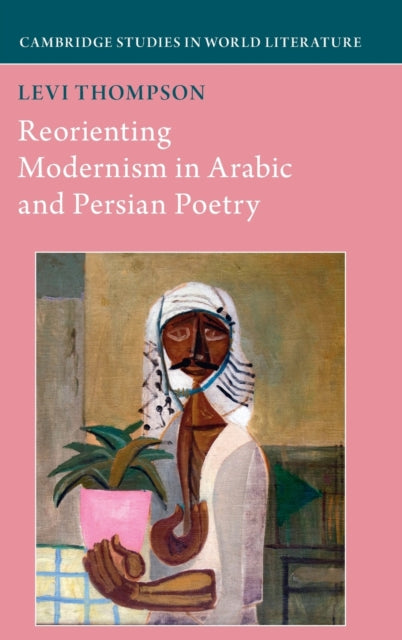
LeviThompson
Reorienting Modernism in Arabic and Persian Poetry
Reorienting Modernism in Arabic and Persian Poetry
💎 Earn 387 Points (£3.87) on this item.
We can order this item for you. Delivery usually takes about 4 to 6 weeks.
This item is not held in our immediate stock. We will order it for you after checkout.
Estimated delivery: About 4 to 6 weeks
YOU SAVE £4.59
- Condition: Brand new
- UK Delivery times: Usually arrives within 2 - 3 working days
- UK Shipping: Fee starts at £2.39. Subject to product weight & dimension
Bulk ordering. Want 15 or more copies? Get a personalised quote and bigger discounts. Learn more about bulk orders.
Couldn't load pickup availability
- More about Reorienting Modernism in Arabic and Persian Poetry
The book Re-orienting Modernism in Arabic and Persian Poetry is the first to study the parallel development of modernist poetry in Arabic and Persian. It presents a fresh line of comparative inquiry into minor literatures and challenges Europe's position at the center of literary modernism by reading Arabic and Persian poetry comparatively within the context of the Cold War.
Format: Hardback
Length: 280 pages
Publication date: 08 December 2022
Publisher: Cambridge University Press
Re-orienting Modernism in Arabic and Persian Poetry is a groundbreaking work that delves into the systematic study of the parallel development of modernist poetry in Arabic and Persian. This book offers a fresh and innovative approach to comparative inquiry within the realm of world literary studies, focusing on the literary exchanges between Arabic and Persian cultures. By examining these exchanges, readers gain a deeper understanding of the evolution of modernist poetry in both traditions, challenging the notion of Europe's centrality in literary modernism. This argument makes a significant contribution to the ongoing efforts to globalize modernist studies by comparing Arabic and Persian poetry within the context of the Cold War, thus establishing the Middle East as a significant player in broader modernist developments.
To explore the profound connections between Arabic and Persian modernist poetry in both form and content, the book selects works from prominent poets from Iraq and Iran. Badr Shakir al-Sayyab and Abd al-Wahhab al-Bayati, from Iraq, and Nima Yushij, Ahmad Shamlu, and Forough Farrokhzad, from Iran, are among the key figures whose works are analyzed in detail. Through their writings, the book sheds light on the shared themes, stylistic innovations, and cultural influences that shaped the development of modernist poetry in these two linguistic and cultural contexts.
The first chapter of the book provides an overview of the historical and cultural contexts that shaped the development of modernist poetry in Arabic and Persian. It explores the political, social, and intellectual developments that occurred in these regions during the late 19th and early 20th centuries, which influenced the emergence of modernist literary movements. The chapter also highlights the role of print media, such as newspapers and magazines, in disseminating modernist ideas and fostering literary exchanges between Arabic and Persian speakers.
The second chapter delves into the theoretical frameworks and critical approaches that have been employed to study modernist poetry. It discusses the influence of Western literary theories, such as deconstruction and post-structuralism, on the interpretation of Arabic and Persian modernist poetry. The chapter also explores the role of nationalism, colonialism, and the struggle for cultural identity in shaping the expression of modernist poetry in these regions.
The third chapter focuses on the formal aspects of modernist poetry in Arabic and Persian. It examines the use of language languages.
The fourth chapter explores the thematic and stylistic innovations that characterized modernist poetry in Arabic and Persian. It discusses the use of symbolism
The fifth chapter examines the cultural influences and intertextual references in modernist poetry in Arabic and Persian. It discusses the influence of traditional Arabic and Persian literature, as well as Western literature, on the development of modernist poetry. The chapter also explores the role of gender, sexuality, and the body in modernist poetry in these regions.
The sixth chapter examines the reception of modernist poetry in Arabic and Persian cultures. It discusses the challenges faced by modernist poets in these regions, such as censorship and political repression, and the ways in which they responded to these challenges. The chapter also explores the impact of modernist poetry on the broader the impact of modernist poetry on the development of contemporary Arabic and Persian literature.
The seventh chapter concludes the book by reflecting on the significance
The seventh chapter concludes the book by reflecting on the significance of Re-orienting Modernism in Arabic and Persian Poetry in the study of modernist literature and cultural studies. It emphasizes the importance of comparative analysis and interdisciplinary approaches in understanding the complexities. It suggests that the book emphasizes the importance of comparative analysis and interdisciplinary approaches in understanding the complexities of modernist literature and cultural studies. It suggests that the study of modernist poetry in Arabic and Persian offers valuable insights into the broader global context of modernist movements and the interconnectedness of different cultural traditions.
In conclusion, Re-orienting Modernism in Arabic and Persian Poetry is a groundbreaking work that offers a fresh and innovative approach to comparative inquiry within the realm. By examining the parallel development of modernist poetry in Arabic and Persian, this book challenges the notion of Europe's centrality in literary modernism and establishes the Middle East as a significant participant in broader modernist developments. Through its comprehensive analysis of key poets' works, the book sheds light on the profound connections between Arabic and Persian modernist poetry in both form and content. By exploring the historical, cultural, theoretical, formal, thematic, stylistic, cultural, and receptional aspects of modernist poetry, this book provides valuable insights into the complexities of modernist literature and cultural studies. It emphasizes the importance of interdisciplinary approaches in understanding the interconnected
In conclusion, Re-orienting Modernism in Arabic and Persian Poetry is a groundbreaking work that offers a fresh and innovative approach to comparative inquiry within the realm of world literary studies. By examining the parallel development of modernist poetry in Arabic and Persian, this book challenges the notion of Europe's centrality in literary modernism and establishes the Middle East as a significant participant in broader modernist developments. Through its comprehensive analysis of key poets' works, the book sheds light on the profound connections between Arabic and Persian modernist poetry in both form and content. By exploring the historical, cultural, theoretical, formal, thematic, stylistic, cultural, and receptional aspects of modernist poetry, this book provides valuable insights into the complexities of modernist literature and cultural studies. It emphasizes the importance of interdisciplinary approaches in understanding the interconnectedness of different cultural traditions.
Weight: 468g
ISBN-13: 9781009164474
This item can be found in:
UK and International shipping information
UK and International shipping information
UK Delivery and returns information:
- Delivery within 2 - 3 days when ordering in the UK.
- Shipping fee for UK customers from £2.39. Fully tracked shipping service available.
- Returns policy: Return within 30 days of receipt for full refund.
International deliveries:
Shulph Ink now ships to Australia, Belgium, Canada, France, Germany, Ireland, Italy, India, Luxembourg Saudi Arabia, Singapore, Spain, Netherlands, New Zealand, United Arab Emirates, United States of America.
- Delivery times: within 5 - 10 days for international orders.
- Shipping fee: charges vary for overseas orders. Only tracked services are available for most international orders. Some countries have untracked shipping options.
- Customs charges: If ordering to addresses outside the United Kingdom, you may or may not incur additional customs and duties fees during local delivery.