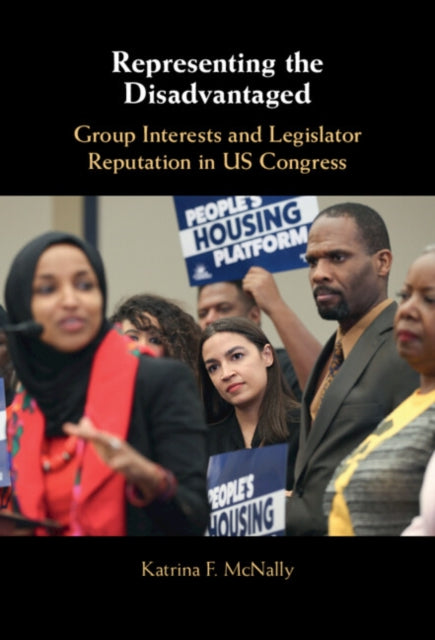
Katrina F.McNally
Representing the Disadvantaged: Group Interests and Legislator Reputation in US Congress
Representing the Disadvantaged: Group Interests and Legislator Reputation in US Congress
💎 Earn 387 Points (£3.87) on this item.
We can order this item for you. Delivery usually takes about 4 to 6 weeks.
This item is not held in our immediate stock. We will order it for you after checkout.
Estimated delivery: About 4 to 6 weeks
YOU SAVE £4.59
- Condition: Brand new
- UK Delivery times: Usually arrives within 2 - 3 working days
- UK Shipping: Fee starts at £3.89. Subject to product weight & dimension
Bulk ordering. Want 15 or more copies? Get a personalised quote and bigger discounts. Learn more about bulk orders.
Couldn't load pickup availability
- More about Representing the Disadvantaged: Group Interests and Legislator Reputation in US Congress
A study by Katrina F. McNally examines the factors that influence members of Congress to advocate for disadvantaged or marginalized groups, such as Black Americans, LGBTQ, Latinx, women, and the poor. She develops the concept of an "advocacy window" and analyzes the impact of constituency factors, personal demographics, and institutional characteristics on the likelihood of members deciding to cultivate a reputation as a disadvantaged group advocate. The study provides fresh insight into the tradeoffs members face as they consider taking up issues important to different groups.
Format: Hardback
Length: 300 pages
Publication date: 25 November 2021
Publisher: Cambridge University Press
Congress' limited attention to disadvantaged or marginalized groups, such as Black Americans, LGBTQ, Latinx, women, and the poor, is a well-documented and often discussed issue. However, this study takes a different approach by focusing on the members of Congress who advocate for these groups. Katrina F. McNally introduces the concept of an "advocacy window," which emerges as members of Congress contemplate incorporating advocacy for disadvantaged groups into their legislative portfolios. Through the use of new data, McNally analyzes the factors that influence whether members of the Senate or House of Representatives decide to establish themselves as advocates for these groups.
The study explores the impact of constituency factors, personal demographics, and institutional characteristics on the likelihood of members pursuing this advocacy. By comparing legislative activism across different disadvantaged groups rather than examining one group in isolation, the study offers a fresh perspective on the tradeoffs that members face when considering taking up issues that are important to various groups.
One of the key findings of the study is that the advocacy window is influenced by a range of factors, including the political climate, the level of public support for the disadvantaged group, and the presence of influential champions within Congress. For example, during periods of heightened political polarization and public opposition to a particular disadvantaged group, members may be less likely to advocate for them. Conversely, when there is strong public support for a group and influential champions within Congress, members are more likely to prioritize their interests.
Personal demographics also play a significant role in shaping the advocacy window. For instance, members who identify as members of the disadvantaged group themselves or who have close personal connections to members of the group are more likely to advocate for them. Additionally, members who are from diverse or marginalized communities themselves are more likely to be aware of the issues facing these groups and to prioritize their advocacy.
Institutional characteristics, such as the structure of Congress and the political party affiliation of members, also impact the advocacy window. For example, members of Congress who are part of smaller caucuses or who are in the minority party may have more opportunities to advocate for disadvantaged groups due to their increased visibility and influence within the institution.
Overall, this study provides valuable insights into the factors that influence members of Congress' decision to advocate for disadvantaged or marginalized groups. By examining the advocacy window across different disadvantaged groups, the study sheds light on the tradeoffs that members face as they navigate the complex political landscape and work to advance the interests of their constituents.
The limited attention Congress gives to disadvantaged or marginalized groups, including Black Americans, LGBTQ, Latinx, women, and the poor, is a well-known and often remarked upon phenomenon. This study aims to explore the factors that influence members of Congress to advocate for these groups and when and why they do so.
Katrina F. McNally develops the concept of an "advocacy window," which emerges as members of Congress consider incorporating advocacy for disadvantaged groups into their legislative portfolios. Using new data, McNally analyzes the impact of constituency factors, personal demographics, and institutional characteristics on the likelihood that members of the Senate or House of Representatives will decide to cultivate a reputation as a disadvantaged group advocate.
The study finds that the advocacy window is influenced by a range of factors, including the political climate, the level of public support for the disadvantaged group, and the presence of influential champions within Congress. For example, during periods of heightened political polarization and public opposition to a particular disadvantaged group, members may be less likely to advocate for them. Conversely, when there is strong public support for a group and influential champions within Congress, members are more likely to prioritize their interests.
Personal demographics also play a significant role in shaping the advocacy window. For instance, members who identify as members of the disadvantaged group themselves or who have close personal connections to members of the group are more likely to advocate for them. Additionally, members who are from diverse or marginalized communities themselves are more likely to be aware of the issues facing these groups and to prioritize their advocacy.
Institutional characteristics, such as the structure of Congress and the political party affiliation of members, also impact the advocacy window. For example, members of Congress who are part of smaller caucuses or who are in the minority party may have more opportunities to advocate for disadvantaged groups due to their increased visibility and influence within the institution.
Overall, this study provides valuable insights into the factors that influence members of Congress' decision to advocate for disadvantaged or marginalized groups. By examining the advocacy window across different disadvantaged groups, the study sheds light on the tradeoffs that members face as they navigate the complex political landscape and work to advance the interests of their constituents.
In conclusion, Congress' limited attention to disadvantaged or marginalized groups is a well-documented issue that requires urgent attention. This study highlights the factors that influence members of Congress to advocate for these groups and provides valuable insights into the tradeoffs that members face as they navigate the complex political landscape. By examining the advocacy window across different disadvantaged groups, the study sheds light on the need for greater representation and support for these communities.
Weight: 588g
Dimension: 160 x 236 x 26 (mm)
ISBN-13: 9781108838221
UK and International shipping information
UK and International shipping information
We deliver throughout the United Kingdom and to 128 countries and territories worldwide, including the United States, Australia, Canada, Germany, Spain and France.