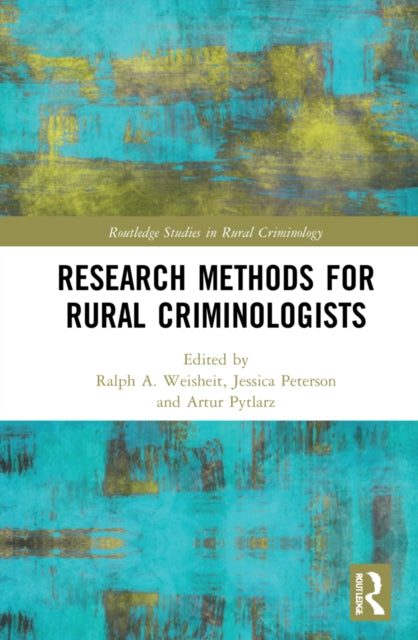
Ralph A. Weisheit,Jessica Rene Peterson,Artur Pytlarz
Research Methods for Rural Criminologists
Research Methods for Rural Criminologists
💎 Earn 811 Points (£8.11) on this item.
We can order this item for you. Delivery usually takes about 4 to 6 weeks.
This item is not held in our immediate stock. We will order it for you after checkout.
Estimated delivery: About 4 to 6 weeks
YOU SAVE £9.63
- Condition: Brand new
- UK Delivery times: Usually arrives within 2 - 3 working days
- UK Shipping: Fee starts at £2.39. Subject to product weight & dimension
Bulk ordering. Want 15 or more copies? Get a personalised quote and bigger discounts. Learn more about bulk orders.
Couldn't load pickup availability
- More about Research Methods for Rural Criminologists
Rural criminological research requires unique preparation due to absence or inadequate official data, isolation, and distance from the researchers office to the study site. This book explores the issues, challenges, and solutions for rural researchers in criminology, integrating state-of-the-art methodological approaches with practical illustrations. It is an internationally comprehensive compendium of methods for students, scholars, and practitioners, particularly in rural health care, rural social work, and rural poverty.
Format: Hardback
Length: 240 pages
Publication date: 29 April 2022
Publisher: Taylor & Francis Ltd
Conducting rural criminological research presents researchers with a range of concerns, including the absence or inadequate availability of official data on crime, the tendency to make superficial rural-urban comparisons, the isolation and physical distance from the researchers' office to the study site, and the lack of services or access to justice. This unique cultural context necessitates a creative approach to studying rural crime, as traditional research methods may not fully apply.
When conducting research in rural settings, researchers must undergo a specific preparation process. This preparation involves a range of considerations, from defining the research space at the project's inception to collecting and analyzing data. These processes differ significantly from those involved in urban research.
This book aims to address the various issues, challenges, and solutions faced by rural researchers in the field of criminology. By integrating state-of-the-art methodological approaches with practical illustrations, this book serves as an internationally comprehensive compendium of methods for students, scholars, and practitioners. While contributing to the growing field of rural criminology, this book will also be of interest to those engaged with related areas such as rural health care, rural social work, and rural poverty.
The book begins by exploring the historical and contextual factors that shape rural crime and its research. It then discusses the methodological challenges unique to rural settings, including the scarcity of data, the heterogeneity of populations, and the challenges of accessing and interviewing rural residents. The book provides detailed guidance on how to overcome these challenges, including the use of qualitative and quantitative research methods, mixed-methods approaches, and participatory research methodologies.
In addition to methodological considerations, the book also addresses the ethical implications of conducting research in rural communities. It discusses the importance of respecting the privacy and confidentiality of research participants, as well as the potential for harm or exploitation. The book provides practical advice on how to navigate ethical dilemmas and ensure that research is conducted in a responsible and respectful manner.
The book also highlights the importance of interdisciplinary collaboration in rural criminological research. It discusses the benefits of working with researchers from other fields, such as rural health care, rural social work, and rural development, to gain a holistic understanding of the issues and challenges facing rural communities. The book provides examples of successful interdisciplinary collaborations and outlines the steps that researchers can take to facilitate these partnerships.
Throughout the book, practical illustrations and case studies are used to demonstrate the application of the methods discussed. These examples are drawn from a range of rural contexts, including rural Australia, rural Canada, and rural the United States, and provide a rich source of information and insights for researchers and practitioners.
In conclusion, Conducting rural criminological research presents unique challenges and opportunities for researchers. By adapting existing research methods and embracing interdisciplinary collaboration, researchers can gain a deeper understanding of rural crime and its impact on rural communities. This book provides a comprehensive and practical guide to conducting rural criminological research, and will be of interest to students, scholars, and practitioners in the field.
Weight: 453g
Dimension: 234 x 156 (mm)
ISBN-13: 9780367632885
This item can be found in:
UK and International shipping information
UK and International shipping information
UK Delivery and returns information:
- Delivery within 2 - 3 days when ordering in the UK.
- Shipping fee for UK customers from £2.39. Fully tracked shipping service available.
- Returns policy: Return within 30 days of receipt for full refund.
International deliveries:
Shulph Ink now ships to Australia, Belgium, Canada, France, Germany, Ireland, Italy, India, Luxembourg Saudi Arabia, Singapore, Spain, Netherlands, New Zealand, United Arab Emirates, United States of America.
- Delivery times: within 5 - 10 days for international orders.
- Shipping fee: charges vary for overseas orders. Only tracked services are available for most international orders. Some countries have untracked shipping options.
- Customs charges: If ordering to addresses outside the United Kingdom, you may or may not incur additional customs and duties fees during local delivery.