1
/
of
1
Costin Vilcu
Reshaping Convex Polyhedra
Reshaping Convex Polyhedra
💎 Earn 454 Points (£4.54) on this item.
Regular price
£90.85 GBP
Regular price
£109.99 GBP
Sale price
£90.85 GBP
Unit price
/
per
Taxes included.
Shipping calculated at checkout.
YOU SAVE £19.14
- Condition: Brand new
- UK Delivery times: Usually arrives within 2 - 3 working days
- UK Shipping: Fee starts at £2.39. Subject to product weight & dimension
Bulk ordering. Want 15 or more copies? Get a personalised quote and bigger discounts. Learn more about bulk orders.
Couldn't load pickup availability
- More about Reshaping Convex Polyhedra
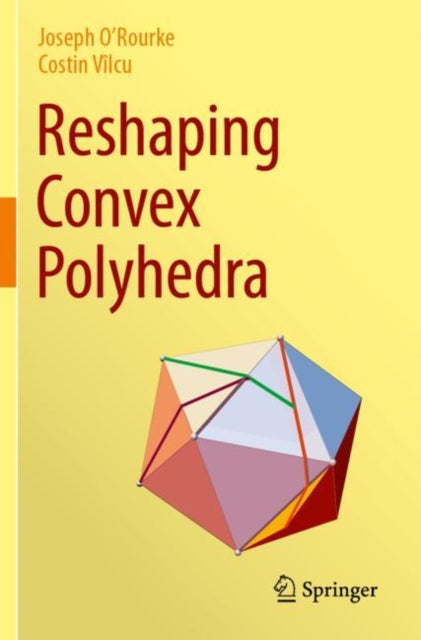
^ the="" study="" of="" convex="" polyhedra="" in="" ordinary="" space="" is="" a="" central="" piece="" classical="" and="" modern="" geometry="" that="" has="" had="" significant="" impact="" on="" many="" areas="" mathematics="" also="" computer="" science.="" present="" book="" project="" by="" joseph="" o’rourke="" costin="" vîlcu="" brings="" together="" two="" important="" strands="" subject="" —="" combinatorics="" polyhedra,="" intrinsic="" underlying="" surface.="" this="" leads="" to="" remarkable="" interplay="" concepts="" come="" life="" wide="" range="" very="" attractive="" topics="" concerning="" polyhedra.="" gets="" message="" across="" thetheory="" although="" with="" roots,="" still="" much="" alive="" today="" continues="" be="" inspiration="" basis="" lot="" current="" research="" activity.="" work="" presented="" manuscript="" interesting="" applications="" discrete="" computational="" geometry,="" as="" well="" other="" mathematics.="" treated="" detail="" include="" unfolding="" onto="" surfaces,="" continuous="" flattening="" convexity="" theory="" minimal="" length="" enclosing="" polygons.="" along="" way,="" open="" problems="" suitable="" for="" graduate="" students="" are="" raised,="" both="" aThe focus of this monograph is converting—reshaping—one 3D convex polyhedron to another via an operation the authors call “tailoring.” A convex polyhedron is a gem-like shape composed of flat facets, the focus of study since Plato and Euclid. The tailoring operation snips off a corner (a “vertex”) of a polyhedron and sutures closed the hole. This is akin to Johannes Kepler’s “vertex truncation,” but differs in that the hole left by a truncated vertex is filled with new surface, whereas tailoring zips the hole closed. A powerful “gluing” theorem of A.D. Alexandrov from 1950 guarantees that, after closing the hole, the result is a new convex polyhedron. Given two convex polyhedra P, and Q inside P, repeated tailoringallows P to be reshaped to Q. Rescaling any Q to fit inside P, the result is universal: any P can be reshaped to any Q. This is one of the main theorems in Part I, with unexpected theoretical consequences. Part II carries out a systematic study of “vertex-merging,” a technique that can be viewed as a type of inverse operation to tailoring. Here the start is P which is gradually enlarged as much as possible, by inserting new surface along slits. In a sense, repeated vertex-merging reshapes P to be closer to planarity. One endpoint of such a process leads to P being cut up and “pasted” inside a cylinder. Then rolling the cylinder on a plane achieves an unfolding of P. The underlying subtext is a question posed by Geoffrey Shephard in 1975 and already implied by drawings by Albrecht Dürer in the 15th century: whether every convex polyhedron can be unfolded to a planar “net.” Toward this end, the authors initiate an exploration of convexity on convex polyhedra, a topic rarely studiedin the literature but with considerable promise for future development. This monograph uncovers new research directions and reveals connections among several, apparently distant, topics in geometry: Alexandrov’s Gluing Theorem, shortest paths and cut loci, Cauchy’s Arm Lemma, domes, quasigeodesics, convexity, and algorithms throughout. The interplay between these topics and the way the main ideas develop throughout the book could make the “journey” worthwhile for students and researchers in geometry, even if not directly interested in specific topics. Parts of the material will be of interest and accessible even to undergraduates. Although the proof difficulty varies from simple to quite intricate, with some proofs spanning several chapters, many examples and 125 figures help ease the exposition and illustrate the concepts. ^>
- Publication date: 2 April 2025
- Page count: 243
- Dimensions: Height 235 mm; Width 155 mm
- Publisher: Springer International Publishing AG
- Format: Paperback
- ISBN-13: 9783031475139
UK and International shipping information
UK and International shipping information
UK Delivery and returns information:
- Delivery within 2 - 3 days when ordering in the UK.
- Shipping fee for UK customers from £2.39. Fully tracked shipping service available.
- Returns policy: Return within 30 days of receipt for full refund.
International deliveries:
Shulph Ink now ships to Australia, Belgium, Canada, France, Germany, Ireland, Italy, India, Luxembourg Saudi Arabia, Singapore, Spain, Netherlands, New Zealand, United Arab Emirates, United States of America.
- Delivery times: within 5 - 10 days for international orders.
- Shipping fee: charges vary for overseas orders. Only tracked services are available for most international orders. Some countries have untracked shipping options.
- Customs charges: If ordering to addresses outside the United Kingdom, you may or may not incur additional customs and duties fees during local delivery.