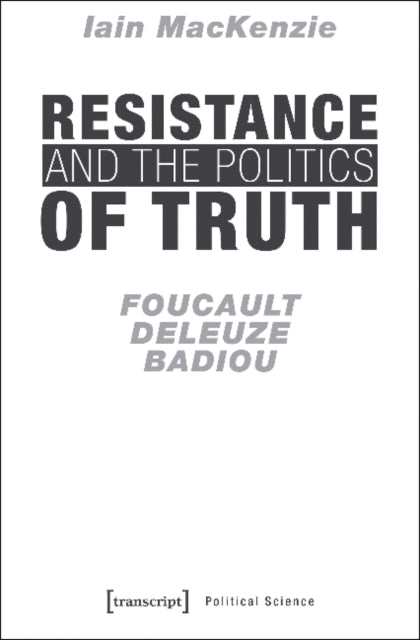
Iain Mackenzie
Resistance and the Politics of Truth - Foucault, Deleuze, Badiou
Resistance and the Politics of Truth - Foucault, Deleuze, Badiou
💎 Earn 140 Points (£1.40) on this item.
We can order this item for you. Delivery usually takes about 4 to 6 weeks.
This item is not held in our immediate stock. We will order it for you after checkout.
Estimated delivery: About 4 to 6 weeks
YOU SAVE £5.92
- Condition: Brand new
- UK Delivery times: Usually arrives within 2 - 3 working days
- UK Shipping: Fee starts at £2.39. Subject to product weight & dimension
Bulk ordering. Want 15 or more copies? Get a personalised quote and bigger discounts. Learn more about bulk orders.
Couldn't load pickup availability
- More about Resistance and the Politics of Truth - Foucault, Deleuze, Badiou
The maxim "The truth will set you free" has been challenged by poststructuralist politics and Alain Badiou's alternative post-foundational account. Iain MacKenzie argues that a critically oriented version of poststructuralism provides an understanding of the entwined nature of truth and power and offers a compelling account of resistance.
Format: Paperback / softback
Length: 148 pages
Publication date: 08 December 2021
Publisher: Transcript Verlag
The maxim "The truth will set you free" holds a central place in both theories and practices of resistance. However, it has faced significant criticism from various critical perspectives in the latter half of the 20th century. In this essay, Iain MacKenzie delves into two compelling perspectives: the poststructuralist politics of truth formulated by Michel Foucault and Gilles Deleuze, and the alternative post-foundational account of truth and militancy developed by Alain Badiou. MacKenzie argues that a critically oriented version of poststructuralism offers a profound understanding of the intricate relationship between truth and power, as well as a compelling account of the creative practices that can sustain resistance.
Michel Foucault and Gilles Deleuze's poststructuralist politics of truth is a powerful lens through which to examine the relationship between truth and power. Foucault and Deleuze argue that truth is not a fixed entity, but rather a construct created and enforced by social and political institutions. They highlight the ways in which power operates through the discursive production of truth, shaping our understanding of the world and limiting our ability to challenge dominant narratives.
One of the key insights of poststructuralism is that truth is not universal, but rather is shaped by the specific historical and cultural contexts in which it is produced. This means that different individuals and groups may have different understandings of the truth based on their experiences and perspectives. Foucault and Deleuze argue that the dominant narratives of power are often constructed to reinforce existing power structures and to marginalize those who challenge them.
To challenge these dominant narratives, Foucault and Deleuze advocate for a more critical approach to truth. They suggest that we should be skeptical of the claims made by those in power and seek to uncover the underlying structures and mechanisms that shape our understanding of the world. This requires a willingness to question our assumptions and to engage in dialogue with those who hold different perspectives.
One of the most significant contributions of poststructuralism to the study of truth and power is its emphasis on the role of language and discourse in shaping our understanding of the world. Foucault and Deleuze argue that language is not a neutral tool for communication, but rather is a powerful tool of domination and control. They highlight the ways in which language is used to construct identities, to marginalize certain groups, and to maintain power structures.
To challenge the power of language, Foucault and Deleuze advocate for a more democratic and inclusive approach to discourse. They suggest that we should strive to create spaces where different voices and perspectives can be heard and where dialogue can be fostered. This requires a commitment to social justice and to the dismantling of oppressive power structures.
In addition to their analysis of the relationship between truth and power, Foucault and Deleuze also offer a compelling account of the creative practices that can sustain resistance. They argue that resistance is not just a passive response to dominant narratives, but rather is a dynamic and creative process that involves the mobilization of collective power and the creation of new forms of knowledge and understanding.
One of the key creative practices that Foucault and Deleuze identify is the practice of genealogy. Genealogy involves the study of the historical and cultural roots of dominant narratives and the ways in which they have been constructed and enforced. By studying genealogy, individuals and groups can gain a deeper understanding of the underlying structures of power and the ways in which they have been reproduced over time.
Another creative practice that Foucault and Deleuze identify is the practice of dissidence. Dissidence involves the refusal to conform to dominant narratives and the pursuit of alternative forms of knowledge and understanding. It involves the creation of new spaces for dialogue and the dissemination of alternative ideas and perspectives.
In conclusion, the poststructuralist politics of truth formulated by Michel Foucault and Gilles Deleuze provides a powerful lens through which to examine the relationship between truth and power. Foucault and Deleuze argue that truth is not a fixed entity, but rather a construct created and enforced by social and political institutions. They highlight the ways in which power operates through the discursive production of truth, shaping our understanding of the world and limiting our ability to challenge dominant narratives. To challenge these dominant narratives, Foucault and Deleuze advocate for a more critical approach to truth, which involves being skeptical of the claims made by those in power and seeking to uncover the underlying structures and mechanisms that shape our understanding of the world. They also emphasize the role of language and discourse in shaping our understanding of the world and advocate for a more democratic and inclusive approach to discourse. Finally, Foucault and Deleuze offer a compelling account of the creative practices that can sustain resistance, such as genealogy and dissidence. By studying genealogy, individuals and groups can gain a deeper understanding of the underlying structures of power and the ways in which they have been reproduced over time, and by pursuing alternative forms of knowledge and understanding, they can create new spaces for dialogue and the dissemination of alternative ideas and perspectives.
Weight: 214g
Dimension: 159 x 226 x 13 (mm)
ISBN-13: 9783837639070
This item can be found in:
UK and International shipping information
UK and International shipping information
UK Delivery and returns information:
- Delivery within 2 - 3 days when ordering in the UK.
- Shipping fee for UK customers from £2.39. Fully tracked shipping service available.
- Returns policy: Return within 30 days of receipt for full refund.
International deliveries:
Shulph Ink now ships to Australia, Belgium, Canada, France, Germany, Ireland, Italy, India, Luxembourg Saudi Arabia, Singapore, Spain, Netherlands, New Zealand, United Arab Emirates, United States of America.
- Delivery times: within 5 - 10 days for international orders.
- Shipping fee: charges vary for overseas orders. Only tracked services are available for most international orders. Some countries have untracked shipping options.
- Customs charges: If ordering to addresses outside the United Kingdom, you may or may not incur additional customs and duties fees during local delivery.