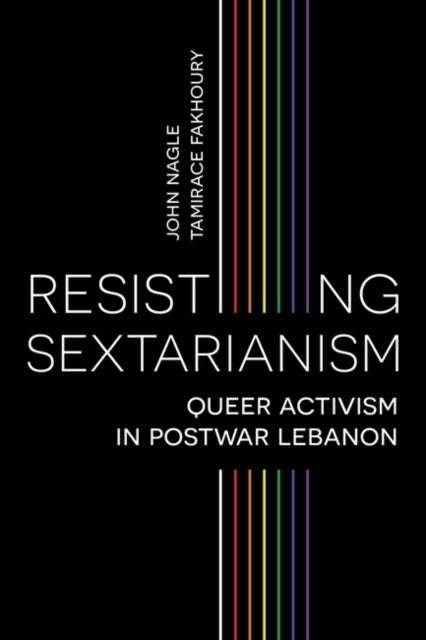
JohnNagle,TamiraceFakhoury
Resisting Sectarianism: Queer Activism in Postwar Lebanon
Resisting Sectarianism: Queer Activism in Postwar Lebanon
💎 Earn 110 Points (£1.10) on this item.
YOU SAVE £52.87
- Condition: Brand new
- UK Delivery times: Usually arrives within 2 - 3 working days
- UK Shipping: Fee starts at £2.39. Subject to product weight & dimension
Bulk ordering. Want 15 or more copies? Get a personalised quote and bigger discounts. Learn more about bulk orders.
Couldn't load pickup availability
- More about Resisting Sectarianism: Queer Activism in Postwar Lebanon
The Middle East is often portrayed as oppressively patriarchal and homophobic, but feminist and LGBTQ activism has emerged as a powerful force in recent years. This book explores the role of these movements in Lebanon's postwar sectarian system, highlighting their ability to attract members, construct campaigns, forge alliances, and generate resistance to sectarianism. It also traces the obstacles faced by these movements from sectarian parties and religious authorities.
\n Format: Hardback
\n Length: 208 pages
\n Publication date: 23 September 2021
\n Publisher: Bloomsbury Publishing PLC
\n
The Middle East is often portrayed as oppressively patriarchal and homophobic, yet in recent years, the region has emerged as a vibrant and significant arena for feminist and LGBTQ activism. This book offers an insightful exploration of this emerging politics through a unique analysis of feminist and LGBTQ social movements within the context of Lebanon's postwar sectarian system.
Resisting Sectarianism contends that LGBTQ and feminist social movements are powerful agents of political and social transformation in Lebanon. Through extensive ethnographic fieldwork, the book takes the reader deep into these movements, revealing how they attract members, construct campaigns, forge alliances, and generate significant forms of resistance to and change within the sectarian system. The book also traces the formidable obstacles that sectarian parties and religious authorities employ to weaken LGBTQ and feminist activism.
In Lebanon, the postwar sectarian system has created a complex and deeply divided society. The country is divided into religious and ethnic factions, with each group holding its own set of beliefs and values. This sectarianism has permeated all aspects of Lebanese life, from politics to social norms and cultural practices. However, LGBTQ and feminist social movements have emerged as powerful forces for change in this context.
LGBTQ social movements in Lebanon have faced significant challenges, including discrimination, violence, and legal marginalization. Despite these obstacles, LGBTQ activists have worked tirelessly to build a community and advocate for their rights. They have organized events, created safe spaces, and worked with local organizations to promote LGBTQ visibility and acceptance.
Feminist social movements in Lebanon have also faced significant challenges, including gender-based violence, limited access to education and employment, and social and cultural norms that perpetuate gender inequality. Feminist activists have worked to challenge these norms and promote gender equality through advocacy, education, and activism.
One of the key strategies that LGBTQ and feminist social movements have employed in Lebanon is the use of intersectionality. Intersectionality recognizes that different forms of oppression, such as gender, sexuality, race, and class, intersect and reinforce each other. By highlighting these intersections, social movements can create a more comprehensive and effective response to social and political challenges.
Another important strategy that social movements have employed is the use of social media and digital technology. Social media has provided a platform for activists to connect with each other, share information, and mobilize support. Digital technology has also enabled activists to create innovative campaigns and initiatives that challenge traditional power structures and promote social change.
Despite the significant challenges that LGBTQ and feminist social movements face in Lebanon, they have made significant progress in recent years. These movements have gained visibility and support, and they have played a crucial role in promoting LGBTQ and feminist rights in the country.
However, there is still much work to be done. Sectarianism continues to be a major obstacle to social change, and religious authorities continue to exert pressure on LGBTQ and feminist activists. Additionally, gender-based violence and discrimination remain prevalent in Lebanese society, and women's rights are still largely ignored.
To address these challenges, social movements need to continue to build their capacity and strengthen their alliances. They also need to engage with local communities and institutions to promote social change and create a more inclusive and just society.
In conclusion, the Middle East is often portrayed as oppressively patriarchal and homophobic, yet in recent years, the region has become a vibrant and significant arena for feminist and LGBTQ activism. Resisting Sectarianism argues that LGBTQ and feminist social movements are powerful agents of political and social transformation in Lebanon. Through extensive ethnographic fieldwork, the book offers an insightful exploration of these emerging movements, revealing how they attract members, construct campaigns, forge alliances, and generate significant forms of resistance to and change within the sectarian system. While there are still significant challenges to be overcome, social movements have made significant progress in recent years, and they continue to play a crucial role in promoting LGBTQ and feminist rights in the country.
\n Weight: 480g\n
Dimension: 241 x 178 x 22 (mm)\n
ISBN-13: 9781786997999\n \n
This item can be found in:
UK and International shipping information
UK and International shipping information
UK Delivery and returns information:
- Delivery within 2 - 3 days when ordering in the UK.
- Shipping fee for UK customers from £2.39. Fully tracked shipping service available.
- Returns policy: Return within 30 days of receipt for full refund.
International deliveries:
Shulph Ink now ships to Australia, Belgium, Canada, France, Germany, Ireland, Italy, India, Luxembourg Saudi Arabia, Singapore, Spain, Netherlands, New Zealand, United Arab Emirates, United States of America.
- Delivery times: within 5 - 10 days for international orders.
- Shipping fee: charges vary for overseas orders. Only tracked services are available for most international orders. Some countries have untracked shipping options.
- Customs charges: If ordering to addresses outside the United Kingdom, you may or may not incur additional customs and duties fees during local delivery.