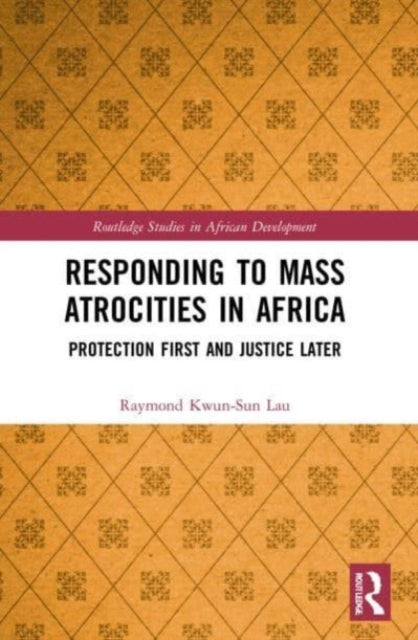
Raymond Kwun-Sun Lau
Responding to Mass Atrocities in Africa: Protection First and Justice Later
Responding to Mass Atrocities in Africa: Protection First and Justice Later
💎 Earn 221 Points (£2.21) on this item.
We can order this item for you. Delivery usually takes about 4 to 6 weeks.
This item is not held in our immediate stock. We will order it for you after checkout.
Estimated delivery: About 4 to 6 weeks
YOU SAVE £2.63
- Condition: Brand new
- UK Delivery times: Usually arrives within 2 - 3 working days
- UK Shipping: Fee starts at £2.39. Subject to product weight & dimension
Bulk ordering. Want 15 or more copies? Get a personalised quote and bigger discounts. Learn more about bulk orders.
Couldn't load pickup availability
- More about Responding to Mass Atrocities in Africa: Protection First and Justice Later
The book explores the relationship between the Responsibility to Protect (R2P) and the International Criminal Court (ICC),challenging the assumption that they are always mutually reinforcing or complementary,and examining instead the many tensions which arise between the immediate imperative of saving lives and the more long-term prospect of punishing perpetrators and preventing future conflicts through deterrence. It provides context-independent proposals for resolving contradictions between the two principles, suggesting that focusing on timing and sequencing in invoking international R2P and ICC actions could facilitate the easing of tensions.
Format: Paperback / softback
Length: 246 pages
Publication date: 25 September 2023
Publisher: Taylor & Francis Ltd
The Responsibility to Protect (R2P) and the International Criminal Court (ICC) are two interconnected concepts that have gained significant attention in the international community in recent years. While these two institutions are often seen as complementary or mutually reinforcing, there are also many tensions and contradictions that arise between them. This book explores the relationship between R2P and the ICC, challenging the assumption that they are always mutually reinforcing or complementary.
The R2P principle, which emerged in the aftermath of the mass atrocities in Rwanda and Srebrenica in the mid-1990s, holds that states have a responsibility to protect their populations from genocide, war crimes, ethnic cleansing, and other forms of mass violence. The ICC, on the other hand, is an international criminal court established to prosecute individuals who are responsible for genocide, war crimes, and crimes against humanity.
One of the main tensions between R2P and the ICC is the timing and sequencing of their actions. The R2P principle emphasizes the immediate imperative of saving lives and providing humanitarian assistance to vulnerable communities. On the other hand, the ICC's mandate is to punish perpetrators and prevent future conflicts through deterrence. This creates a dilemma for policymakers and international actors, as they must balance the immediate need for protection with the long-term goal of justice.
Another tension arises from the different legal frameworks and procedures that govern the R2P and the ICC. The R2P principle is based on a normative framework that emphasizes the responsibility of states to protect their populations. The ICC, on the other hand, operates under a legal framework that is more specific and detailed, with its own set of rules and procedures. This can create confusion and uncertainty for policymakers and international actors, as they must navigate the complex legal landscape of both institutions.
Furthermore, there are concerns about the effectiveness of the ICC in prosecuting individuals responsible for mass atrocities. While the ICC has made significant progress in bringing cases against perpetrators, there have been criticisms about the length of the legal process, the lack of resources, and the political influence that can affect the outcomes of cases. This can undermine the credibility and legitimacy of the ICC, which is essential for its effectiveness in deterring future crimes.
To address these tensions and contradictions, the book provides context-independent proposals for resolving them. It suggests that focusing on timing and sequencing in invoking international R2P and ICC actions could facilitate the easing of tensions. By prioritizing protection and humanitarian assistance in the immediate aftermath of mass atrocities, policymakers and international actors can build trust and legitimacy with vulnerable communities. This can create a conducive environment for the ICC to prosecute perpetrators later on, as it will be seen as a legitimate and effective mechanism for achieving justice.
Drawing on examples from Uganda, Kenya, and Darfur, the book applies International Relations concepts and theories to deepen our understanding of international responses to mass atrocities. It explores the role of the United Nations, regional organizations, and non-governmental organizations in responding to mass atrocities, and the challenges and opportunities that they face. The book also examines the political and economic factors that can influence international responses to mass atrocities, and the ways in which these factors can hinder or facilitate effective responses.
Ultimately, the book concludes that a "Protection First, Justice Later" sequence approach is necessary for managing the tension and facilitating more effective and consistent international responses to mass atrocities. This approach emphasizes the immediate need for protection and humanitarian assistance, while also recognizing the importance of pursuing justice and accountability for perpetrators. By adopting this approach, policymakers and international actors can ensure that vulnerable communities are safeguarded in the short term, while also laying the foundation for long-term peace and stability.
This book makes an important contribution to discussions and debates surrounding international responses to genocide and mass atrocities. It will be of special interest to scholars, students, and policymakers in International Relations, Global Governance, African Studies, International Development, Human Rights, and International Criminal Law. By exploring the relationship between R2P and the ICC, this book provides valuable insights into the challenges and opportunities that arise in responding to these complex and pressing issues.
Weight: 453g
Dimension: 234 x 156 (mm)
ISBN-13: 9781032161570
This item can be found in:
UK and International shipping information
UK and International shipping information
UK Delivery and returns information:
- Delivery within 2 - 3 days when ordering in the UK.
- Shipping fee for UK customers from £2.39. Fully tracked shipping service available.
- Returns policy: Return within 30 days of receipt for full refund.
International deliveries:
Shulph Ink now ships to Australia, Belgium, Canada, France, Germany, Ireland, Italy, India, Luxembourg Saudi Arabia, Singapore, Spain, Netherlands, New Zealand, United Arab Emirates, United States of America.
- Delivery times: within 5 - 10 days for international orders.
- Shipping fee: charges vary for overseas orders. Only tracked services are available for most international orders. Some countries have untracked shipping options.
- Customs charges: If ordering to addresses outside the United Kingdom, you may or may not incur additional customs and duties fees during local delivery.