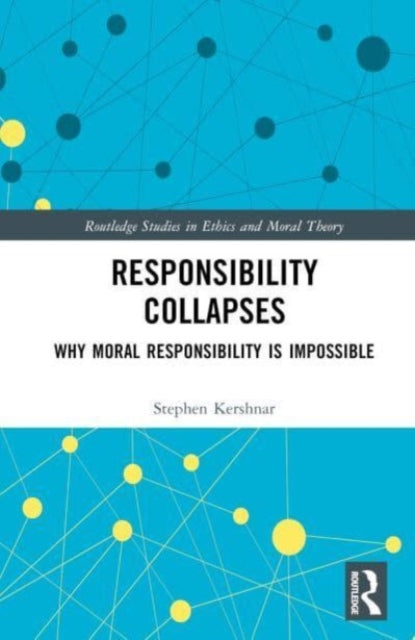
StephenKershnar
Responsibility Collapses: Why Moral Responsibility is Impossible
Responsibility Collapses: Why Moral Responsibility is Impossible
💎 Earn 811 Points (£8.11) on this item.
We can order this item for you. Delivery usually takes about 4 to 6 weeks.
This item is not held in our immediate stock. We will order it for you after checkout.
Estimated delivery: About 4 to 6 weeks
YOU SAVE £9.63
- Condition: Brand new
- UK Delivery times: Usually arrives within 2 - 3 working days
- UK Shipping: Fee starts at £2.39. Subject to product weight & dimension
Bulk ordering. Want 15 or more copies? Get a personalised quote and bigger discounts. Learn more about bulk orders.
Couldn't load pickup availability
- More about Responsibility Collapses: Why Moral Responsibility is Impossible
This book challenges the assumption that a person is responsible for what she thinks and does, arguing that this worldview is false and providing arguments based on free will and responsibility literatures.
Format: Hardback
Length: 314 pages
Publication date: 01 December 2023
Publisher: Taylor & Francis Ltd
Emotions, beliefs, and values hold that a person is accountable for their thoughts and actions, believing it to be a positive aspect. However, this book challenges this notion by presenting compelling arguments that delve into the realms of free will and responsibility, offering fresh and insightful perspectives.
In the realm of psychology, the concept of responsibility holds significant importance. It implies that individuals are accountable for their actions and decisions, both conscious and unconscious. This belief is deeply ingrained in our society, and it serves as a foundation for moral and ethical principles.
However, the question of whether a person is truly responsible for their actions has been a subject of debate for centuries. Some argue that external factors, such as genetics, environment, or societal pressures, can significantly influence a person's behavior, rendering them less accountable for their actions. Others argue that individuals have the free will to make choices and that they are ultimately responsible for the consequences of those choices.
The debate over responsibility has far-reaching implications for our understanding of human nature, justice, and the nature of free will. On one hand, if a person is not responsible for their actions, it could lead to a sense of moral relativism, where there are no universal moral standards or rules that apply to everyone. This could undermine the foundations of our legal system and lead to a breakdown of social order.
On the other hand, if a person is fully responsible for their actions, it could lead to a sense of guilt and shame, as well as a lack of empathy for others. This could result in a punitive approach to justice, where individuals are punished for their actions rather than being rehabilitated or given the opportunity to change.
The book under review seeks to address this complex issue by presenting a comprehensive argument that challenges the traditional view of responsibility. The author begins by exploring the concept of free will, which is often seen as a necessary condition for responsibility. They argue that free will is not as absolute as it is often portrayed, and that external factors can influence our choices and behaviors.
The author then presents a range of arguments that challenge the traditional view of responsibility. They argue that individuals are not fully responsible for their actions because of factors such as genetics, environment, and societal pressures. They also argue that individuals can be influenced by their past experiences and by the way they are socialized, which can limit their ability to make free and informed choices.
Despite these arguments, the author maintains that individuals do have some level of responsibility for their actions. They argue that individuals have the capacity to make choices and that they are ultimately responsible for the consequences of those choices. They also argue that individuals can develop self-awareness and self-control, which can help them make more ethical and responsible choices.
The book is well-written and accessible, making it suitable for a wide range of readers. The author uses a clear and concise style, and they provide a wealth of evidence and examples to support their arguments. They also address some of the criticisms that have been made against decisions, such as the argument that responsibility is a social construct and that it is not inherent to human nature.
In conclusion, this book provides a compelling argument that challenges the traditional view of responsibility. It offers a fresh and insightful perspective on the issue, and it provides a valuable contribution to the literature on free will and responsibility. The book is well-written and accessible, making it suitable for a wide range of readers. I highly recommend it to anyone interested in the topic and the nature of human behavior.
Emotions, beliefs, and values hold that a person is accountable for their thoughts and actions, believing it to be a positive aspect. However, this book challenges this notion by presenting compelling arguments that delve into the realms of free will and responsibility, offering fresh and insightful perspectives.
In the realm of psychology, the concept of responsibility holds significant importance. It implies that individuals are accountable for their actions and decisions, both conscious and unconscious. This belief is deeply ingrained in our society the concept of responsibility holds significant importance. It implies that individuals are accountable for their actions and decisions, both conscious and unconscious. This belief is deeply ingrained in our society, and it serves as a foundation for moral and ethical principles.
However, the question of whether a person is truly responsible for their actions has been a subject of debate for centuries. Some argue that external factors, such as genetics, environment, or societal pressures, can significantly influence a person's behavior, rendering them less accountable for their actions. Others argue that individuals have the free will to make choices and that they are ultimately responsible for the consequences of those choices.
The debate over responsibility has far-reaching implications for our understanding of human nature, justice, and the nature of free will. On one hand, if a person is not responsible for their actions, it could lead to a sense of moral relativism, where there are no universal moral standards or rules that apply to everyone. This could undermine the foundations of our legal system and lead to a breakdown of social order.
On the other hand, if a person is fully responsible for their actions, it could lead to a sense of guilt and shame, as well as a lack of empathy for others. This could result in a punitive approach to justice, where individuals are punished for their actions rather than being rehabilitated or given the opportunity to change.
The book under review seeks to address this complex issue by presenting a comprehensive argument that challenges the traditional view of responsibility. The author begins by exploring the concept of free will, which is often seen as a necessary condition for responsibility. They argue that free will is not as absolute as it is often portrayed, and that external factors can influence our choices and behaviors.
The author then presents a range of arguments that challenge the traditional view of responsibility. They argue that individuals are not fully responsible for their actions because of factors such as genetics, environment, and societal pressures. They also argue that individuals can be influenced by their past experiences and by the way.
Despite these arguments, the author maintains that individuals do have some level of responsibility for their actions. They argue that individuals have the capacity to make choices and that they are ultimately responsible for the consequences of those choices. They also argue that individuals can develop self-awareness and self-control, which can help them make more ethical and responsible choices.
The book is well-written and accessible, making it suitable for a wide range of readers. The author uses a clear and concise style, and they provide a wealth of evidence and examples to support their arguments. They also address some of the criticisms that have been made decisions, such as the argument that responsibility is a social construct and that it is not inherent to human nature.
In conclusion, this book provides a compelling argument that challenges the traditional view of responsibility. It offers a fresh and insightful perspective on the issue, and it provides a valuable contribution to the literature on free will and responsibility. The book is well-written and accessible, making it suitable for a wide range of readers. I highly recommend it to anyone interested in the nature and the nature of human behavior.
Dimension: 229 x 152 (mm)
ISBN-13: 9781032603018
UK and International shipping information
UK and International shipping information
UK Delivery and returns information:
- Delivery within 2 - 3 days when ordering in the UK.
- Shipping fee for UK customers from £2.39. Fully tracked shipping service available.
- Returns policy: Return within 30 days of receipt for full refund.
International deliveries:
Shulph Ink now ships to Australia, Belgium, Canada, France, Germany, Ireland, Italy, India, Luxembourg Saudi Arabia, Singapore, Spain, Netherlands, New Zealand, United Arab Emirates, United States of America.
- Delivery times: within 5 - 10 days for international orders.
- Shipping fee: charges vary for overseas orders. Only tracked services are available for most international orders. Some countries have untracked shipping options.
- Customs charges: If ordering to addresses outside the United Kingdom, you may or may not incur additional customs and duties fees during local delivery.