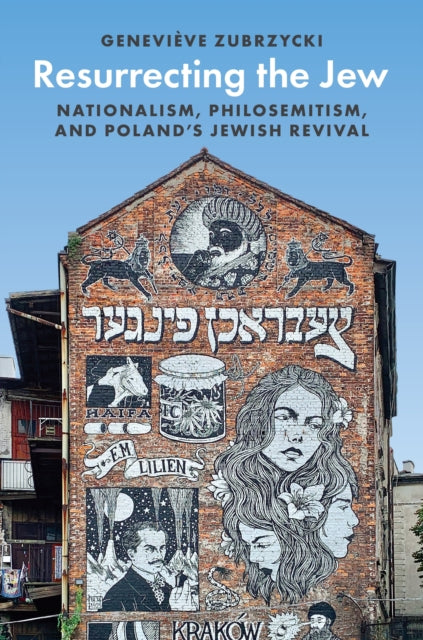
Genevieve Zubrzycki
Resurrecting the Jew: Nationalism, Philosemitism, and Poland's Jewish Revival
Resurrecting the Jew: Nationalism, Philosemitism, and Poland's Jewish Revival
💎 Earn 424 Points (£4.24) on this item.
YOU SAVE £20.03
- Condition: Brand new
- UK Delivery times: Usually arrives within 2 - 3 working days
- UK Shipping: Fee starts at £2.39. Subject to product weight & dimension
Bulk ordering. Want 15 or more copies? Get a personalised quote and bigger discounts. Learn more about bulk orders.
Couldn't load pickup availability
- More about Resurrecting the Jew: Nationalism, Philosemitism, and Poland's Jewish Revival
Format: Hardback
Length: 288 pages
Publication date: 27 September 2022
Publisher: Princeton University Press
Since the early 2000s, Poland has witnessed a remarkable resurgence of Jewish culture, driven primarily by non-Jewish Poles with a deep and passionate interest in all things Jewish. The popularity of Klezmer music, Jewish-style restaurants, kosher vodka, and festivals celebrating Jewish culture has soared, while the establishment of new museums, memorials, Jewish studies programs, and Holocaust research centers has sparked a profound exploration of Polish-Jewish relations before, during, and after the Holocaust. In her book, Resurrecting the Jew, Geneviève Zubrzycki delves into this revival and explores the significance of attempting to bring Jewish culture back to life in a country where 3 million Jews were brutally murdered and where only around 10,000 Jews currently reside.
Drawing on a decade of immersive participant-observation within Jewish and Jewish-related organizations in Poland, a Birthright trip to Israel with young Polish Jews, and over a hundred in-depth interviews with Jewish and non-Jewish Poles actively engaged in the Jewish revival, Resurrecting the Jew offers a comprehensive examination of Jewish life in Poland today. The book reveals how the revival has been propelled by progressive Poles who aim to disassociate Polishness from Catholicism, promote the idea of a multicultural Poland, and resist the far-right government. Moreover, it raises urgent and thought-provoking questions that extend far beyond Poland, addressing the boundaries of performative solidarity and empathetic forms of cultural appropriation.
The Jewish revival in Poland has been characterized by a renewed sense of pride and identity among non-Jewish Poles. Many individuals have taken it upon themselves to learn about Jewish history, traditions, and culture, often through formal education or informal learning experiences. This has led to a greater understanding and appreciation of Jewish contributions to Polish society and culture, as well as a growing recognition of the importance of preserving Jewish heritage.
One of the key drivers of the revival has been the desire to break free from the historical association between Polishness and Catholicism. Many non-Jewish Poles have felt that the Catholic Church's influence has been too dominant in Polish society and has obscured the rich diversity of Polish culture. The revival has provided an opportunity for non-Jewish Poles to reclaim their cultural heritage and explore the diverse religious and cultural traditions that have shaped Polish history.
Another factor contributing to the revival has been the growing recognition of the importance of promoting multiculturalism in Poland. The country has a history of religious and ethnic diversity, and the revival has been seen as a way to celebrate and promote this diversity. The establishment of Jewish-style restaurants, kosher vodka, and festivals celebrating Jewish culture has been embraced as a way to bring different communities together and promote understanding and tolerance.
However, the revival has also sparked debates and controversies. Some critics have argued that the cultural appropriation of Jewish traditions and symbols by non-Jewish Poles is disrespectful and insensitive. They argue that non-Jewish Poles should not attempt to reclaim Jewish culture or identity, as it is a sacred and deeply personal matter for Jewish individuals and communities.
In response to these concerns, many Jewish and non-Jewish Poles involved in the revival have emphasized the importance of respect and sensitivity. They have worked to ensure that Jewish traditions and symbols are used appropriately and with the consent of Jewish communities. They have also sought to educate non-Jewish Poles about the history and significance of Jewish culture, in order to promote understanding and appreciation rather than appropriation.
Despite these challenges, the Jewish revival in Poland has continued to grow and evolve. The establishment of new museums, memorials, and research centers has provided a platform for the exploration of Jewish history and culture, while the popularity of Jewish-style restaurants, kosher vodka, and festivals has brought different communities together in celebration of diversity.
In conclusion, the Jewish revival in Poland has been a remarkable phenomenon, driven by non-Jewish Poles with a deep interest in Jewish culture and history. The revival has been characterized by a renewed sense of pride and identity among non-Jewish Poles, as well as a desire to break free from the historical association between Polishness and Catholicism and promote multiculturalism. While the revival has sparked debates and controversies, it has also emphasized the importance of respect and sensitivity in cultural appropriation. As the revival continues to grow and evolve, it will be important to ensure that Jewish traditions and symbols are used appropriately and with the consent of Jewish communities, while also promoting understanding and appreciation of Jewish culture among non-Jewish Poles.
Dimension: 235 x 156 (mm)
ISBN-13: 9780691237220
This item can be found in:
UK and International shipping information
UK and International shipping information
UK Delivery and returns information:
- Delivery within 2 - 3 days when ordering in the UK.
- Shipping fee for UK customers from £2.39. Fully tracked shipping service available.
- Returns policy: Return within 30 days of receipt for full refund.
International deliveries:
Shulph Ink now ships to Australia, Belgium, Canada, France, Germany, Ireland, Italy, India, Luxembourg Saudi Arabia, Singapore, Spain, Netherlands, New Zealand, United Arab Emirates, United States of America.
- Delivery times: within 5 - 10 days for international orders.
- Shipping fee: charges vary for overseas orders. Only tracked services are available for most international orders. Some countries have untracked shipping options.
- Customs charges: If ordering to addresses outside the United Kingdom, you may or may not incur additional customs and duties fees during local delivery.